Introduction
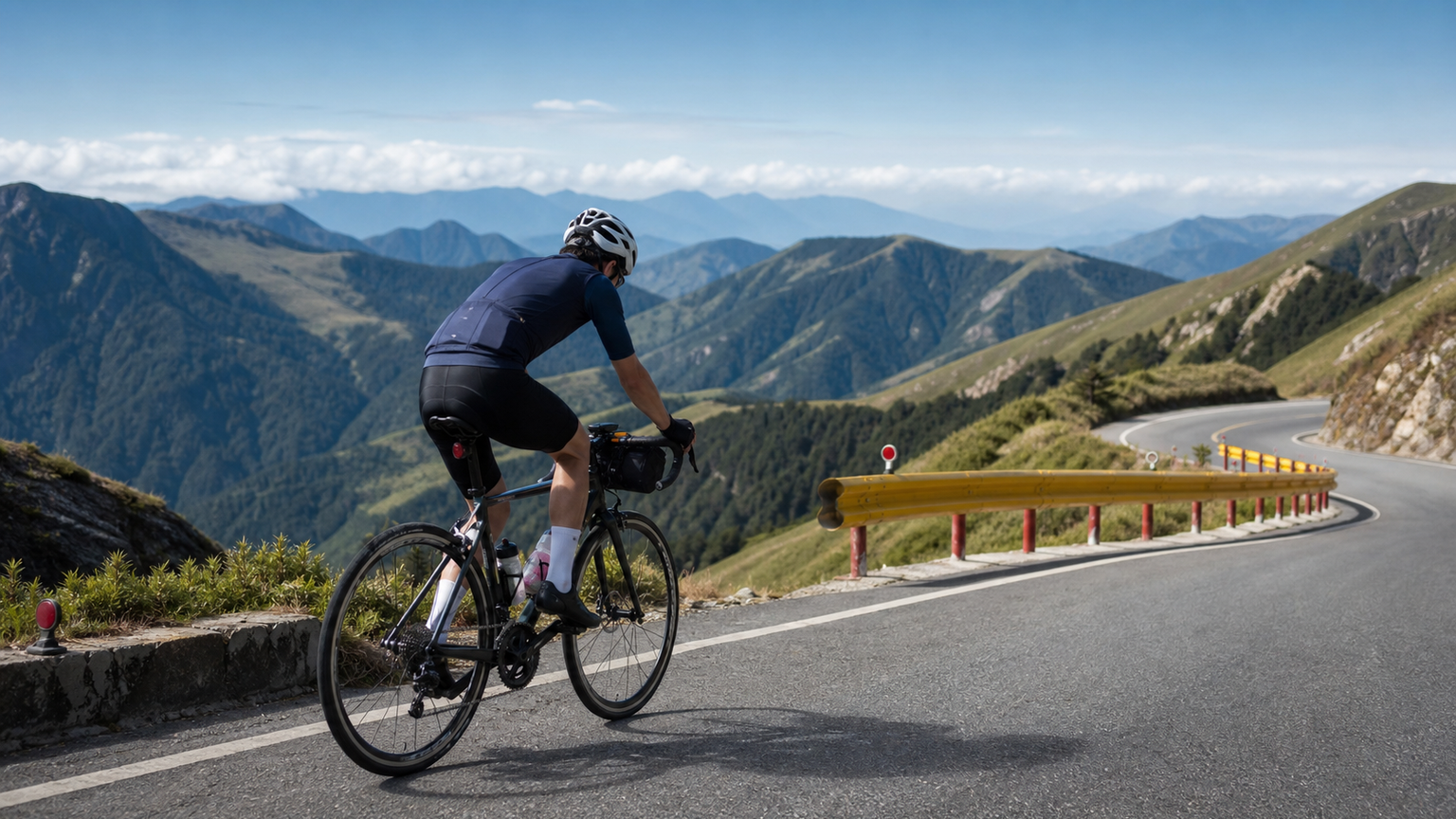
Wuling, the highest point on Taiwan’s road network at 3,275 meters above sea level, is a sacred mountain for every Taiwanese cyclist. Every year, the Wuling Climb Race attracts thousands of riders to challenge this mountain from various starting points. Among them, the full route starting from Puli features a total elevation gain of over 2,400 meters and spans approximately 100 kilometers, making it the most difficult climbing race in Taiwan. For most non-professional riders, finishing without blowing up is more important than chasing a specific time. This article focuses on pacing strategy and nutrition planning to help you find your own rhythm on the mountain.
Route Characteristics and Segment Analysis
The Wuling race route can be broadly divided into three main sections: the warm-up segment from Puli to Wushe, the transition segment from Wushe to Cingjing Farm, and the decisive segment from Cingjing to Wuling.
| Segment | Distance | Average Gradient | Characteristics |
|---|---|---|---|
| Puli → Wushe | Approx. 18km | 3-4% | Gentle climb warm-up, crowded |
| Wushe → Cingjing Farm | Approx. 22km | 5-6% | Establish rhythm, ample aid stations |
| Cingjing → Cuifeng | Approx. 25km | 6-7% | Gradient increases, open views |
| Cuifeng → Wuling | Approx. 20km | 7-9% | Rapid altitude gain, noticeable hypoxia |
Starting from Cuifeng, the altitude exceeds 2,000 meters, and most riders begin to feel the effects of high-altitude hypoxia. Heart rate can no longer reliably reflect output intensity, making a power meter the most dependable measure of effort at this point.
Pacing Strategy: The Core Principle of Negative Splitting
The most common mistake in climbing races is “going out too hard in the first half and blowing up in the second.” Because the Wuling race route is extremely long, the cost of this mistake is especially severe—once you blow up above 2,000 meters, you may be forced to continue at extremely low power for the remaining sections, which not only drastically increases your time but can also affect your health.
We recommend adopting a negative split pacing strategy, where intensity in the second half is slightly higher than in the first half:
- Early section (Puli to Wushe): Hold at 70-75% of your Functional Threshold Power (FTP) to allow the body to fully warm up
- Middle section (Wushe to Cingjing): Increase to 75-80% of FTP to establish a steady rhythm
- Late section (Cingjing to Cuifeng): Maintain 78-83% of FTP, adjusting slightly based on conditions
- Decisive section (Cuifeng to Wuling): Adjust between 75-85% of FTP depending on remaining energy
Riders without a power meter can use heart rate and RPE (Rate of Perceived Exertion) as references: keep RPE at 5-6 (on a 10-point scale) in the early section, and do not exceed 8 in the later sections.
Making Smart Use of Aid Stations
The Wuling race features multiple official aid stations along the route, located approximately near Wushe, Cingjing Farm, and Cuifeng. Using aid stations wisely is one of the key strategies for finishing.
Aid Station Principles:
- Replenish fluids before you feel thirsty; the high-altitude environment is dry, and dehydration occurs faster than at sea level
- Consume solid food every 40-50 minutes, such as bananas, energy bars, or rice balls
- Electrolyte replenishment is essential; prolonged sweating can easily lead to hyponatremia
- Do not spend more than 3 minutes at an aid station to avoid muscle stiffness from cooling down
Personal Nutrition Recommendations: In addition to official aid stations, carry 2-3 energy gels as emergency reserves. The distance between aid stations is greater after Cingjing, so be sure to top up at the Cingjing Farm aid station in advance.
Coping with High-Altitude Hypoxia
Above 2,500 meters, many riders begin to feel like their “breathing can’t keep up with their pedaling.” This is a normal response to decreased blood oxygen saturation at high altitude, but its impact can be mitigated through several methods:
- Actively lower your cadence: Shift to 85-90rpm to reduce the instantaneous load on the cardiorespiratory system
- Extend your exhalation: Breathe deeply and deliberately, with exhalation slightly longer than inhalation
- Lower your expected power: Above Cuifeng, FTP may drop by 10-15%; do not try to push through
- Headache is a warning sign: If you experience headache or nausea, immediately reduce intensity significantly and notify race officials
Practical Tips
- Avoid intense training in the week before the race to arrive at the start in optimal condition
- For races starting in the early morning, note the temperature difference between the start and the summit; bring at least one lightweight windbreaker
- Check that your brakes and shifting system are functioning properly before departure; brakes are just as important as climbing on the long descent
- Consider carrying salt tablets; after more than 2 hours of high-intensity output, take one every 30 minutes
- Do not blindly follow the pace of riders ahead of you; maintaining your own pace is the key to finishing
Conclusion
The Wuling Climb Race is not just a race—it is a journey of dialogue with yourself. The finish line at 3,275 meters awaits every rider willing to take on the challenge, but what ultimately gets you there is not speed, but strategy, patience, and a keen awareness of your body’s signals. Plan your pacing, fuel smartly, and respect the majesty of the mountain—Wuling will be right in front of you.
Related Reading
- Wuling Climb Guide: Challenge Strategies and Aid Station Planning on Taiwan’s Highest Road
- Wuling Guide: Pacing Strategy and Aid Station Arrangement Starting from Puli
- The Art of Pacing in Climbing Races: Perfect Strategy for the Wuling Cup and Eastbound Wuling
- Taiwan Cycling’s Hundred Peaks Challenge: Complete Preparation Guide for Conquering Wuling
#公路車 #西進武嶺 配速配瓦實驗 坡度分析 四小時內攻略 建大盃 NeverStop #西進武嶺攻略
6 年前
#北橫 + #北進武嶺 最硬的員工旅遊 EP1 | #公路車 #拉拉山 | 明池 | 武嶺 | 武陵農場 | 雲海 | Taiwan Cycling Route Wulin
6 年前
大禹嶺 到 武嶺牌樓 全程前後實況錄影 | 北進武嶺 | 東進武嶺 | KOM | 訓練台 | 坡度分析 | Taiwan KOM Last 10 km HARD | 公路車
6 年前
西進武嶺 世界紀錄挑戰!破2:30 ?!一群人推著一個夢上山 直播精華版 / ft. 張翰允 & 台視主播魏于恬 & KPLUS / #cycling 公路車 CT Yeh
2 個月前
西進武嶺各路段 前8000名 大數據分析 配速攻略/功率/心律/推力比/維持率/踏頻/踏瓦比/牽車率 大公開 | 建大盃 NeverStop 可參考 | 公路車 | CT Yeh
5 年前
FTL 與 SYB 車隊專訪 西進武嶺 實用攻略分享! 2小時 如何練?!你不知道的眉角!新手準備武嶺必看 EP1 | 實力派女車友 | 精華版 | 公路車 | CTYeh
4 年前
雨戰! 西進武嶺員工旅遊 加料 各路段大數據分析 | 同事端出5公斤的公路車來挑戰!? EP1
4 年前
崇越盃「西進武嶺」挑戰! / 天堂路史詩空拍 / 秘密爬坡武器/ PGYTECH CapLock MantisPod Power 續航拍攝棒 / 廢物伙伴軍團再次出征 / 公路車 / CT Yeh
2 年前