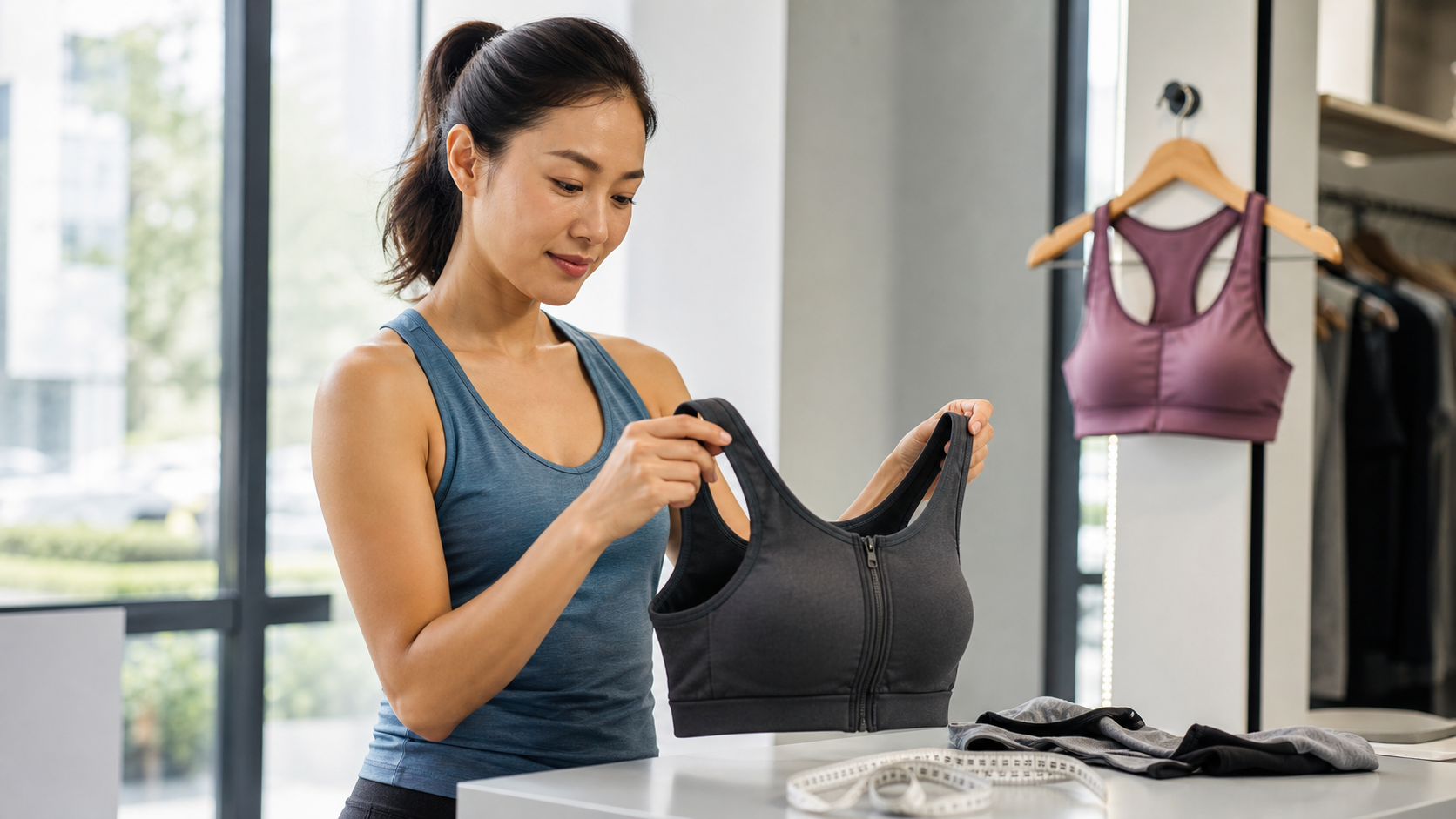
Introduction
Research indicates that up to 72% of female runners experience breast pain or discomfort while running, and for most of them, the root cause is: wearing the wrong sports bra. During running, the breasts can move vertically up to 8–12 cm. Without proper support, this not only causes immediate discomfort but may also lead to permanent loosening of the Cooper’s ligaments (the suspensory ligaments that support the breasts) over time. A well-fitted sports bra is one of the most worthwhile investments in a woman’s running gear.
Sports Bra Support Level Classification
| Support Level | Suitable Activities | Characteristics |
|---|---|---|
| Low Impact | Yoga, Pilates, brisk walking | Lightweight fabric, easy to put on and take off, wire-free |
| Medium Impact | Cycling, weight training, fast walking | Provides decent coverage, suitable for moderate-intensity activities |
| High Impact | Road running, jump rope, aerobic dance | Maximally restricts breast movement, usually features encapsulated cup design |
Road running requires a high-support level bra. If you are a C cup or above, the support requirements are even higher, and you should prioritize styles with underwire and encapsulated cup construction.
Two Main Design Types
Compression Sports Bra
- Compresses the breasts against the chest wall like an elastic bandage
- Suitable for women with A–B cups
- Easy to put on and take off, with a wide variety of styles
- Less effective for larger cup sizes (it merely flattens the breasts without truly limiting movement)
Encapsulation Sports Bra
- Provides an independent cup space for each breast
- Suitable for women with C cup and above
- Usually features underwire design, offering the strongest support
- Less breathable, can feel stuffy during long runs; choose styles with mesh back panels
How to Measure Your Size Correctly
Many women wear the wrong size for years, significantly reducing the bra’s support effectiveness. Correct measuring steps:
- Measure Band Size: Wrap the tape around the ribcage directly under the bust, take the measurement (in cm) snug against the skin, and convert it to a band number (in Taiwan, sizes like 32/34/36 are common; 1 inch ≈ 2.54 cm)
- Measure Bust Size: Wrap the tape around the fullest part of the chest
- Calculate Cup Difference: (Bust Size - Band Size) every 2.5 cm difference ≈ one cup size
Common Signs of an Ill-Fitting Bra:
- Straps slipping off shoulders: band too large, go down one size
- Underwire lifting away from the ribcage: cup too small, go up one size
- Shoulder straps bearing most of the weight: band too loose, tighten it or switch to a smaller band size
- Breast tissue spilling out over the top or sides of the cups: cup too small
Skin Care After Long Runs
Improper materials or design in sports bras can easily cause the following issues:
- Nipple chafing: Poorly designed seams (especially in front-closure styles) are the main culprit; choose seamless inner layers or use anti-chafing patches
- Shoulder strap marks: When the band is too large, the straps bear the weight, leaving deep marks after long runs; confirm the band is providing the primary support
- Skin dampness and stuffiness: Choose moisture-wicking fabrics (polyester/nylon blend), avoid pure cotton for long runs
Buying Considerations for Different Physiological Conditions
- Menstruation: Breasts become swollen and engorged; you may need a sports bra about half a cup size larger than usual
- Pregnancy: Breast size can change during each trimester; it is recommended to measure separately for each trimester
- Breastfeeding: Choose front-closure designs with soft materials that do not compress the milk ducts; it is recommended to nurse or pump before running
- Post-menopause: Cooper’s ligament elasticity decreases, requiring higher support levels
Practical Tips
- Try it on and bounce in person: Before buying online, it is best to try on in a physical store and simulate running and jumping movements in the fitting room to ensure there is no discomfort
- Consider Taiwan’s climate: Taiwan’s summers are hot and humid; prioritize lightweight, quick-drying styles with large mesh back panels
- Washing instructions: Sports bras should be hand-washed or machine-washed on a gentle cycle inside a laundry bag; avoid the dryer, as heat accelerates the aging of elastic materials
- Replacement cycle: It is recommended to replace running-specific bras every 50–70 washes (about one year); support drops significantly once the elastic materials degrade
- Budget allocation: It is recommended to have 2–3 sports bras to rotate, ensuring adequate drying time and extending the lifespan of each
Conclusion
A well-fitted sports bra is not just about running comfort; it is an investment in women’s long-term breast health. Starting today, re-measure your size and choose a high-support style that truly matches your body type and running volume—your body will thank you. Run free, starting with being unbound.
Related Reading
- Clothing Choices for Women’s Running: Sports Bra Support Levels and Sun Protection Strategies
- Sports Bra Buying Guide: Essential Gear Knowledge for Cycling and Running Women
- Sports Bras for Female Runners: Not Just Comfort, But a Health Issue
- Knee Braces and Ankle Supports for Road Running: When to Use Supportive Gear
一日北高前的高裝檢 | 北高 360 | 挑戰11小時的裝備 | 一日雙塔 | 補給
6 年前
戰略) Zwift Race 如何咬在第一集團 如何評估自己要開多少推力 (請開1.5倍速看)
7 年前
Fitting訓練兩用功率車 ! Thinkrider ST900 完整實測!/ 坡度升降 / 鄰居測試/ smart bike/公路車/ CT Yeh
2 年前
#公路車 #Fitting 靠人工智慧APP 幫你調整單車
6 年前
2022 前十五大自行車錶 !? 兩萬名車友大數據統計 | 你的上榜了嗎? | 菁英車友都用哪些錶? | Bryton Garmin 誰能拔得頭籌?| 車錶推薦 | 公路車 CT Yeh
4 年前
一日北高/長距離團騎 常見問題補充篇 / 組團或跟團的眉角 / 壯車友容易被瘦車友慢性拉爆 / 原來屁股痛可能是這個原因...? / 風場配速法 / 公路車 / CT Yeh
2 年前
西進武嶺 免費訓練分析服務 Intervals | 練不夠還是練過頭?你哪一種類型選手?AI模型告訴你! | 備戰神器 | 公路車 訓練 | CT Yeh
4 年前
單車 一日北高 ( 雙城 ) 肥宅雙人瘋狂行 紀錄片 REACTO
10 年前