Muscle Adaptations in Swimming: Prioritized Development of the Latissimus Dorsi, Deltoids, and Core Muscles
Introduction
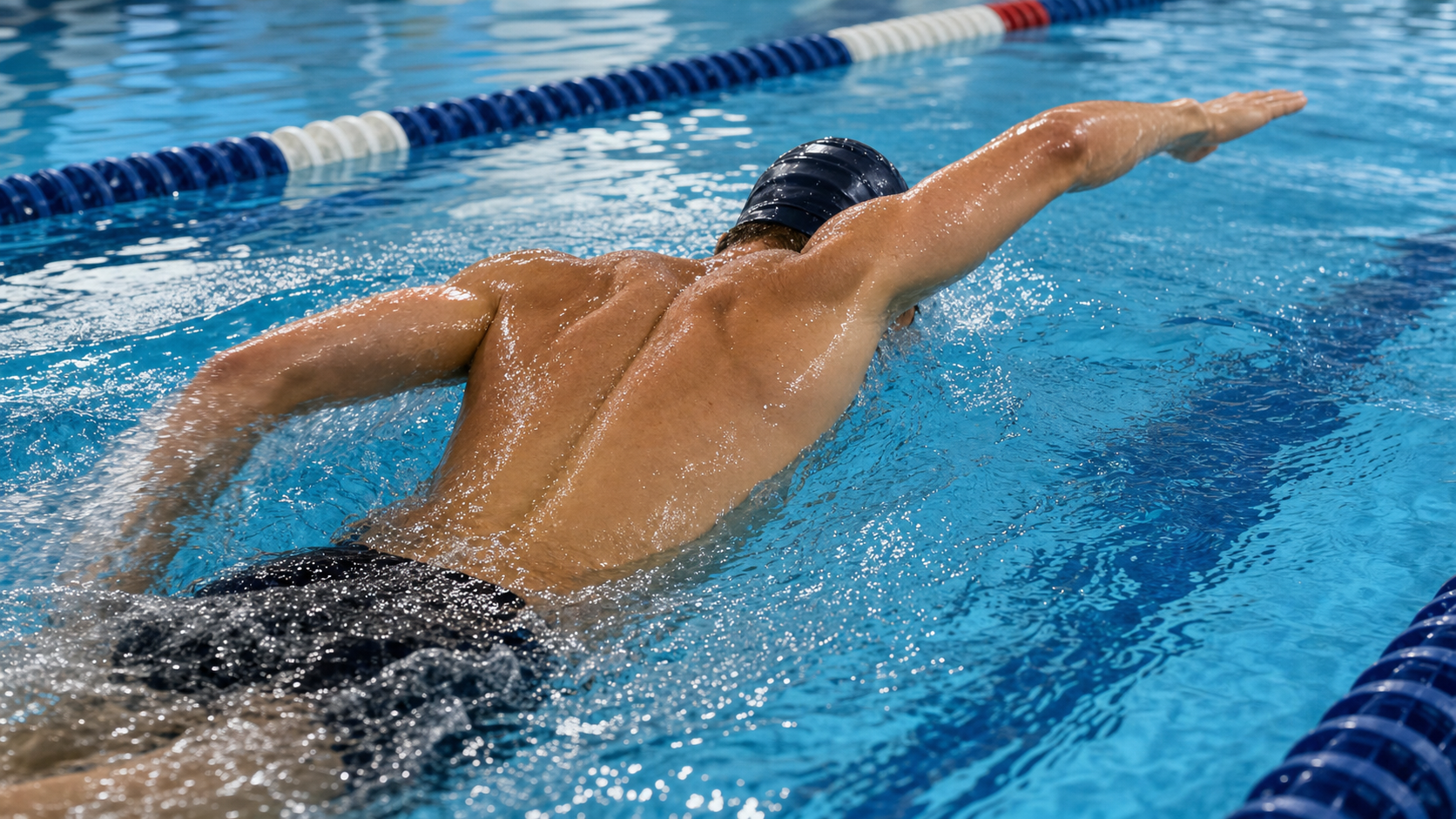
Many people notice that competitive swimmers have a distinctive physique: broad shoulders, a V-tapered back, a tightened core, and relatively slender legs. This is not just a visual impression—it is the concrete result of long-term, systematic swim training on muscular adaptation. Unlike running (which primarily trains the lower body) or cycling (dominated by the quadriceps), swimming is a sport highly dependent on the upper body and core, and its muscle recruitment patterns are distinctly unique.
Primary Muscles Used in Swimming
Freestyle (front crawl) is the most common swimming stroke and offers the highest training benefits. Below is the role of each major muscle group during the freestyle stroke cycle:
| Muscle Group | Main Phase of Movement | Function | Training Effect |
|---|---|---|---|
| Latissimus dorsi | Pull-down phase after hand entry | Shoulder adduction, extension | Primary propulsive muscle; most significant training effect |
| Teres major | Pull-down phase | Synergist to the lats | Enhances pull strength |
| Anterior deltoid | Hand entry, catch phase | Shoulder flexion | Effectively strengthened |
| Middle deltoid | Recovery phase above water | Shoulder abduction | Improved stability |
| Pectoralis major | Late pull-down phase | Shoulder adduction, horizontal flexion | Significantly strengthened |
| Triceps | Final push phase | Elbow extension | Strengthens end-of-push power |
| Core (transverse abdominis, erector spinae) | Entire stroke | Body rotation and stabilization | Functional core strengthening |
| Gluteus maximus | Kicking | Hip extension | Mildly strengthened |
The Latissimus Dorsi: The Engine of Swimming
The latissimus dorsi is the largest single muscle in the human body and the primary source of propulsion in the swimming pull. During the “catch to pull” phase of freestyle, the lats are responsible for pulling the arm backward through the water, acting like an oar to drive the body forward.
The effects of long-term swim training on the lats include:
Muscle fiber adaptations:
- Swim training primarily involves repeated, moderate-intensity movements, mainly enhancing the endurance capacity of slow-twitch fibers (Type I)
- Short-distance sprint training also recruits fast-twitch fibers (Type IIa), increasing explosive power
- Increases in muscle cross-sectional area (hypertrophy) are less than with weight training, but muscular endurance improves significantly
Neural adaptations:
- More efficient motor unit recruitment patterns
- Improved coordination between agonists and antagonists (when the lats contract, the anterior deltoid relaxes appropriately)
The Core: Swimming’s Underrated Key
The core training effect in swimming is often more comprehensive than it appears on the surface. Unlike land-based sports, the unstable environment of the water requires the core to remain continuously engaged to maintain posture, and the “body rotation” of swimming heavily recruits the deep core and obliques:
The core’s role in swimming:
- Maintaining a horizontal body position: Prevents the hips from sinking, counteracting the natural tendency of the legs to drop
- Transferring rotational power: The pulling force in freestyle originates from core rotation and is then transferred to the arms; a weak core = diminished pulling power
- Stabilizing breathing: During side breathing, the core must maintain the body’s axis stability while rotating
Primary core muscles involved:
- Transverse abdominis: The deepest abdominal stabilizer
- Internal & external obliques: Responsible for body rotation
- Erector spinae: Maintains spinal extension
Swimming’s Double-Edged Impact on the Shoulder Joint
Long-term swimming offers both benefits and risks for the shoulders. Frequent overhead movements are a high-risk factor for shoulder impingement syndrome, and “swimmer’s shoulder” is the most common swimming-related injury.
Prevention recommendations:
- Strengthen the rotator cuff: Stabilizers such as the supraspinatus, infraspinatus, and subscapularis
- Pay attention to stroke technique, avoiding excessive crossover of the arm past the midline during hand entry
- Lead with the elbow during the recovery phase (high elbow recovery) to reduce shoulder joint impingement
Practical Recommendations
-
Supplement with land-based core training: Swimming provides functional core work, but the intensity is insufficient for full strengthening. Pairing it with land exercises like planks, dead bugs, and side planks yields more comprehensive benefits.
-
Incorporate pull buoy training: Place the buoyancy aid between your thighs to eliminate leg kicking, placing greater load on the upper body and core to accelerate muscular adaptation.
-
Prioritize pull quality over speed: A high-quality stroke stimulates the lats more effectively than fast, sloppy pulling. Deliberately feel the “high elbow catch” to maximize the lats’ leverage.
-
Don’t skip rotator cuff strengthening: Add 2–3 sets of rotator cuff exercises per week (band external/internal rotation) to prevent swimmer’s shoulder while improving stroke efficiency.
-
Train a balanced variety of strokes: Breaststroke emphasizes the quadriceps and adductors; butterfly places the highest demands on the core and erector spinae. Rotating through different strokes creates more balanced full-body muscular development.
Conclusion
Swimming’s unique contribution to muscular development makes it a training option that other aerobic activities struggle to replace, particularly for strengthening the upper body and functional core. Understanding the role of each muscle group in the stroke cycle helps swimmers improve technique more purposefully, prevent injuries, and fully enjoy swimming’s unique advantages in building functional body strength.
Related Reading
- Muscle Activation Sequence in Swimming: Coordination of Shoulders, Lats, and Triceps
- Muscle Activation Patterns in Swimming: Which Muscle Groups Matter Most
- Strength Exercises for Swimmers: Pull-Ups, Shoulder Stability, and Core
- Swimming and Core Sculpting: The Benefits of Consistent Swimming for Waist and Abdominal Definition
一日北高/長距離團騎 常見問題補充篇 / 組團或跟團的眉角 / 壯車友容易被瘦車友慢性拉爆 / 原來屁股痛可能是這個原因...? / 風場配速法 / 公路車 / CT Yeh
2 年前
福隆鐵人團練隨拍
8 年前
CT暗黑廚房) 車友必備 宇宙無敵鮮蚵湯 幫助訓練恢復 天然食補 好市多 超肥鮮蚵 破PR
7 年前
[教學] Premiere 影片 手震 修正 教學 防抖 單眼 影像 GoPro 穩定 Video Stabilization
8 年前
靠單車減肥35公斤 心得分享與整理
7 年前
NEKO's Fun 高美濕地團練
8 年前
西進武嶺 免費訓練分析服務 Intervals | 練不夠還是練過頭?你哪一種類型選手?AI模型告訴你! | 備戰神器 | 公路車 訓練 | CT Yeh
4 年前
一起升級!海鷗盃LSD團練...JJSC Zone2招待 騎到手抖 / 公路車 / CT Yeh
1 天前