Introduction
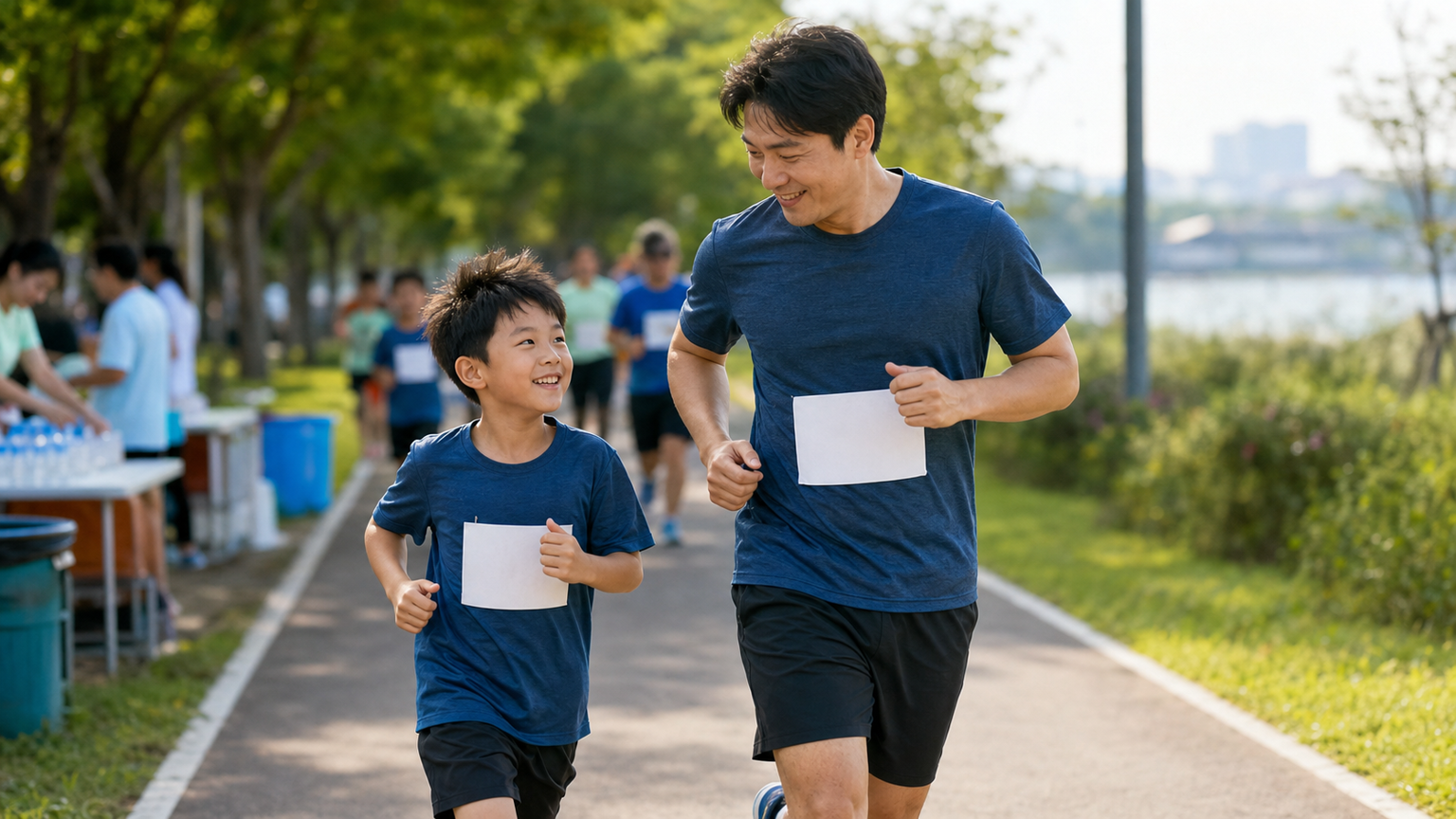
In recent years, road races in Taiwan have flourished, and many organizers have begun offering “Family” or “Parent-Child” categories, allowing adults and children to complete a course together. A family fun run is more than just exercise—it’s a family ritual. Wearing matching race shirts and crossing the finish line hand-in-hand creates a sense of accomplishment and joy that few other family activities can replicate.
However, taking your child to a road race isn’t as simple as “just bringing the kids along to play.” Whether pre-race preparation is sufficient, whether the child’s training volume is appropriate, and how to manage the child’s safety and emotions on race day all require advance planning. Based on practical experience, this article provides a complete guide for Taiwanese parents participating in family fun runs.
Choosing the Right Family Fun Run Event
Event Types and Distance Selection
Among the road races held in major Taiwanese cities, the categories suitable for families typically include the following:
| Category | Distance | Suitable Age | Notes |
|---|---|---|---|
| Mini Family Group | 1–1.5km | 4–8 years old | Strollers are usually allowed |
| Kids’ Group | 2–3km | 7–12 years old | Parents may run alongside or child may finish independently |
| Family Fun Group | 3–5km | 10 years and up | Parents and children finish together |
| Challenge Family Group | 5km | 12 years and up | Timed, with results |
When choosing a distance, use 80% of the distance your child can comfortably complete on a normal day as the guideline. The excitement of race day will make children run faster than usual; without that buffer, they may fall apart in the second half.
Key Factors in Evaluating an Event
- Course elevation changes: Choose a flat course whenever possible, especially for children under 10
- Shade coverage: Taiwan’s summer temperatures are high; routes with tree cover or coastal breezes are better for children
- Water station placement: There should be a water station every 1–1.5km to ensure children stay hydrated
- Medical support: Confirm that the venue has AED equipment and medical personnel
4-Week Pre-Race Preparation Plan
Physical Preparation
If your child doesn’t have a regular running habit, start gradually 4 weeks before the race after registering:
- Week 1: 10–15 minutes per session, alternating running and walking (run 3 minutes, walk 1 minute), 2 times per week
- Week 2: 15–20 minutes per session, reducing the walking ratio, 2–3 times per week
- Week 3: Attempt to complete 70% of the target distance in one go, 2 times per week
- Week 4 (race week): Taper; easy 15-minute runs each session to maintain fitness
Gear Preparation
- Running shoes: Break in your race-day shoes at least 2–3 weeks before the race to avoid blisters from new shoes
- Running apparel: Moisture-wicking, quick-dry fabric; avoid cotton
- Sunscreen: Water-resistant, SPF 30 or higher; apply 30 minutes before the race
- Anti-chafe patches: Apply in advance to friction areas such as the inner thighs and underarms
Race-Day Strategy
The 2 Hours Before the Start
- Breakfast should focus on easily digestible carbohydrates: congee, toast, and bananas are all good choices
- Avoid greasy foods and milk (some children are prone to diarrhea during exercise)
- Have your child use the restroom before leaving; race-day restrooms usually have long lines
Pacing Strategy: Parents Are the Most Important Pace Setters
- The atmosphere at the start is exciting, and children tend to take off too fast. Parents must actively slow down and guide the child to run according to plan
- Use a comfortable pace at which you “can still talk while running” as the baseline
- Tell your child: “Our goal is to finish happily, not to be first”
Handling Unexpected Situations
- If your child says they want to stop mid-race: walk for a bit, have them drink water and refuel, then ask whether it’s physical fatigue or an emotional issue
- Side stitch (abdominal cramp): slow down to a walk, raise both arms overhead and take deep breaths; it usually subsides in 2–3 minutes
- Blisters on the feet: bring spare bandages and decide whether to continue based on the situation
Practical Tips
- Let your child participate in the pre-race preparation process, including choosing the bib number and looking up the course map, to increase their sense of involvement and anticipation
- Prepare small rewards, but don’t make them conditional on results—reward completion, not “only if you finish in the top three”
- Take photos so your child can see their courage and effort being documented
- Celebrate properly after the race—enjoy a nice meal together to reinforce the connection between “running = happy memories”
- Respect your child’s feelings—if they clearly express they don’t want to run anymore, don’t force it; find other ways to maintain their exercise habits
Conclusion
The most precious part of a family fun run isn’t the ranking—it’s the time spent running side by side. When your child grows up and looks back on their childhood, they won’t remember the minutes and seconds; they’ll remember the moment their parents held their hand and said, “You did it!” Are you ready? Sign your child up for the next family fun run and hit the road!
Related Reading
- Running and Family Time: Preparing to Take Your Kids to a Family Fun Run
- Kids’ Road Races in Taiwan: An Introduction to Family-Friendly Running Events
- Family Participation in Road Racing: Getting Your Partner or Family to Fall in Love with Running
- Road Race Special Feature | Notes for Children and Teenagers Participating in Road Races (R056)
新屋團體繞圈賽 | 眾多菁英好手賽道奔馳 | 千瓦女子軍團 | 無敵交管狂獲好評 明年你一定不能錯過 | #公路車
5 年前
2023桃園團體繞圈賽/環台賽等級拍攝/賽事精華/ 10人一隊缺一不可!50隊廝殺大場面 / 第三屆 海鷗繞圈賽 /公路車/CT Yeh
2 年前
#PUSHBIKE 原來這麼好玩! 小朋友 滑步車 初體驗 超可愛
6 年前
Live) 備戰2019彰化經典百K 賽前攻略 (已完賽請看新影片
7 年前
第二屆 桃園團體繞圈賽!賽前指南 | 公路車 | CT Yeh
3 年前
2022 第二屆桃園團體公路車賽 前導 精華! | 公路車 | CT Yeh
3 年前
2023桃園團體繞圈賽 / 海鷗繞圈賽 | 全程空拍數據版 | 公路車 | CT Yeh
2 年前
第二屆 海鷗繞圈賽 / 桃園團體城市繞圈賽!多視角實況精華版 | | 訪問才是最好笑的 | 公路車 | CT Yeh
3 年前