Introduction
Many parents face this dilemma: their child is clearly not lacking in physical fitness, yet shows little interest in running; or the child once loved running but starts avoiding it after entering middle school. Motivation for exercise in teenagers is not just a matter of willpower—it involves multiple factors such as psychological development, social needs, self-identity, and a sense of achievement.
According to the Self-Determination Theory in sports psychology, lasting exercise motivation comes from the satisfaction of three core needs: competence (feeling capable), autonomy (feeling it is one’s own choice), and relatedness (feeling connected to a group). When these three needs are supported, children develop “intrinsic motivation” and want to run spontaneously; when these needs are suppressed, children are left with only “extrinsic motivation” (to avoid punishment or gain rewards), and once external pressure disappears, running stops immediately.
This article provides ten specific methods for cultivating running motivation in teenagers, helping parents and coaches shift from “making kids run” to “kids wanting to run.”
Building Competence: Let Kids Experience “I Can Do It”
Method 1: Set an Achievable Starting Point
The first enemy of motivation is “failing from the start.” If a child’s first running goal is set too high, and they end up gasping for air and feeling terrible about themselves, it is only natural that they won’t want to run next time.
How to do it: On the first run with your child, aim for “running 8 minutes without stopping” rather than 3 kilometers. After completing it, give specific positive feedback: “You just ran for 8 minutes without stopping—you’re stronger than you think!”
Method 2: Replace “Comparing with Others” with “Personal Progress”
| Motivation-killing statements | Motivation-building statements |
|---|---|
| You’re slower than the kid in the next class | You were 15 seconds faster than last week today |
| You came in last | You ran one more lap than last time today |
| Look at how easily others run | Can you feel your own progress? |
Method 3: Provide a Sense of Achievement through Skill Improvement
Teenagers appreciate the sense of achievement from “skill improvement” more than younger children do. Teach them concepts such as running form, pacing strategy, and heart rate control, making “progress” tangible and visible rather than being measured only by speed.
Supporting Autonomy: Give Kids Choices
Method 4: Let Kids Participate in Planning the Training Schedule
Instead of “You’re running 5 kilometers today,” say “We need to run twice this week—which days do you want to run? How far?” Giving them room to choose leads to significantly higher commitment to the plan they helped create.
Method 5: Offer a Variety of Running Formats
- Monotonous track running → add trail running, park routes, riverside paths
- Solo training → occasionally join a running club or sign up for races together
- Fixed pace → fartlek runs (free acceleration and deceleration), music-tempo runs
Let kids explore different forms of running and find the one that appeals to them most.
Method 6: Allow for “Reasons Not to Run”
Forcibly enforced running plans erode autonomy. Establish a rule: “If you’re really tired or in a bad mood, you can switch to walking or another activity, but you need to tell me why.” This framework preserves room for autonomy while maintaining a connection to exercise.
Strengthening Relatedness: Finding a Place in the Group
Method 7: Join a Running Community or Club
Peer influence during adolescence is far greater than adults imagine. If a child’s friends are also running, motivation increases dramatically. Encourage kids to join the school track and field club, a community running group, or find classmates with similar interests for morning runs.
Method 8: Parents Lead by Example Rather Than Just Urging
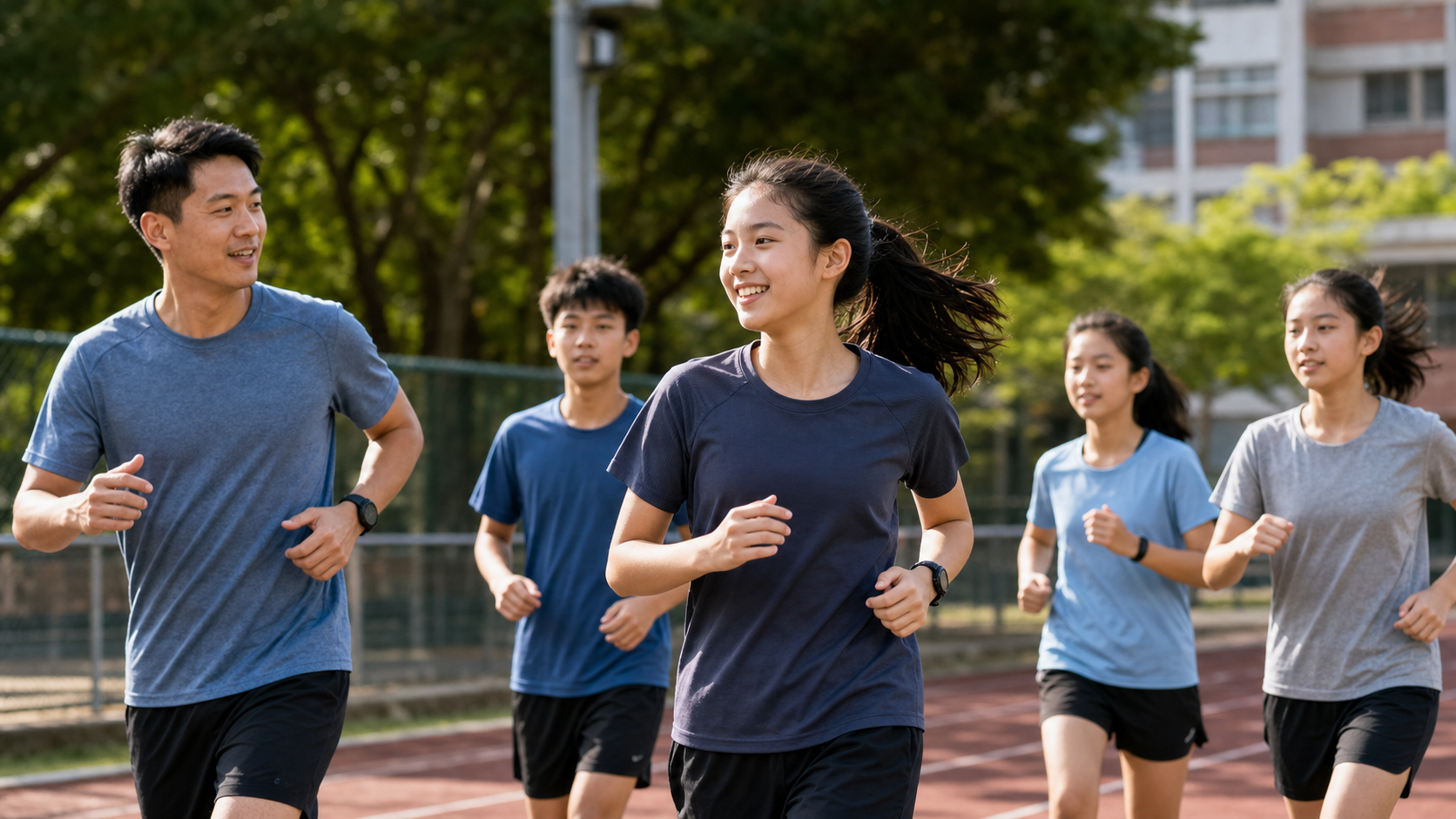
“Go run, I’ll wait for you here” and “Let’s go run together” have vastly different impacts on a child. Parents who have running habits see significantly higher rates of their children maintaining exercise habits. Parent-child running is one of the most powerful motivational tools.
Method 9: Let the Child’s Effort Be “Seen”
- Share the child’s running records in the family group chat
- Display race bibs or finisher medals after events
- Look at GPS running data together and analyze progress
Other Motivation-Boosting Techniques
Method 10: Connect Running with the Child’s Interests
- Music-loving kids → let them pick their own running playlist and run to the beat
- Data-loving kids → use a sports watch to track heart rate, cadence, and pace
- Nature-loving kids → trail running, mountain path running
- Social kids → team relay races, running with friends
Practical Advice
- Observe the child’s motivation signals: Asking to go for a run proactively indicates intrinsic motivation; needing to be urged every time means only extrinsic motivation exists, and strategies need adjustment
- Celebrate small milestones, which don’t have to be performance-based—they can be things like “ran three consecutive weeks without a break”
- Avoid over-praising: “You’re really amazing” is not as good as “The way you tried today is worth recognizing”
- Accept ups and downs: Motivation naturally fluctuates; during low periods, lower the demands to maintain the habit rather than going all-or-nothing
- Take the long view: Cultivating motivation is a project that takes three to six months or more; parental patience is the most critical factor
Conclusion
Helping kids fall in love with running is never the result of force—it is about gradually building the feelings of “I can do it,” “I choose to run,” and “Someone runs with me.” Every child finds their love for running at a different pace. Some fall in love after their first race finish; others need two or three years of nurturing before the spark ignites. The task of parents and coaches is not to push but to accompany—guarding the flame of athletic passion that could ignite at any moment.
Related Reading
- Raising Young Runners: A Training Guide for Children and Teenagers
- The Psychology of Teenage Running: Balancing Competitive Pressure and Enjoying the Sport
- Maintaining Running Motivation: Psychological Strategies to Avoid Burnout in Long-Term Training
- Igniting Passion: How to Help Teenagers Sustain Athletic Motivation
#PUSHBIKE 原來這麼好玩! 小朋友 滑步車 初體驗 超可愛
6 年前
一日北高前的高裝檢 | 北高 360 | 挑戰11小時的裝備 | 一日雙塔 | 補給
6 年前
靠單車減肥35公斤 心得分享與整理
7 年前
一日北高常見問題大集合 | 攻略 | 路線 | 訓練 | 補給 | 自行車 單車 | 一日雙城 | 雙塔 | TWB北高360 | 屁股痛
6 年前
Never Stop 西進武嶺 前後雙機 完整全程錄影 訓練台 實境
8 年前
一個測試有沒有認真練車的方法😂 #公路車
10 個月前
2019 柯P 超越北高 第一集團實錄 (11小時實錄請參考另一部影片) 一日雙城 一日北高 NeverStop Taiwan Long Distance Cycling Challenge
7 年前
單車 一日北高 ( 雙城 ) 肥宅雙人瘋狂行 紀錄片 REACTO
10 年前