Introduction
Many parents in Taiwan habitually buy “children’s sizes” of adult shoe models when choosing running shoes for their kids, or use the same brand’s youth models as running shoes. This approach may seem economical, but it can actually have a negative impact on a child’s foot development. Children’s foot structure is vastly different from that of adults, and their needs in a running shoe differ greatly as well.
This article starts from the physiology of the foot, explains the core logic behind children’s shoe design, and provides concrete guidelines for shoe selection to help Taiwanese parents pick truly suitable running shoes for their children.
Physiological Characteristics of Children’s Feet
Arch Development Process
Infants and toddlers are naturally flat-footed. The arch typically begins to form gradually after ages 4–6 as walking increases, and most children’s arches approach adult form by ages 8–10. Some children’s arches don’t fully develop until around age 12.
This means: putting excessive corrective support in shoes for developing arches may interfere with the natural strengthening process of the arch. Moderate barefoot activity and flexible uppers, on the other hand, help the development of the small muscles in the soles of the feet.
Structural Differences Between Children’s and Adult Feet
| Feature | Children’s Feet | Adult Feet |
|---|---|---|
| Toe alignment | Spread out in a fan shape, wider forefoot | Relatively narrower, especially after wearing shoes |
| Arch | Developing, thicker soft tissue | Fully formed, thinner fat pad |
| Bones | More cartilaginous components, highly moldable | Ossification complete, harder |
| Growth rate | Grows an average of 1–2 sizes per year | Stable |
| Gait | Smaller stride, weaker ankle control | Mature gait |
Core Principles of Children’s Shoe Design
Principle 1: Sufficient Forefoot Space
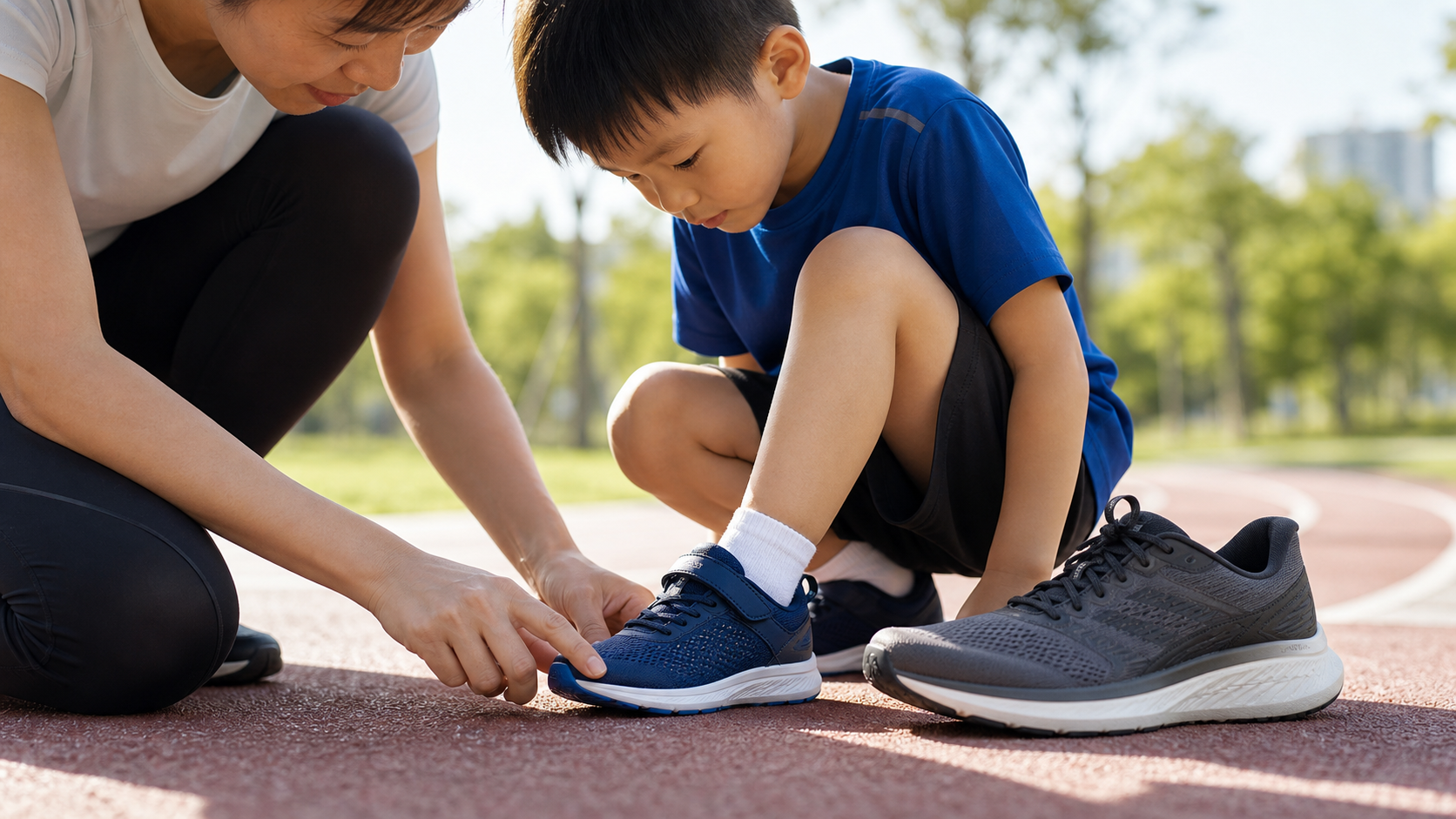
A good children’s shoe should have a round or slightly wide and flat toe box, not a pointed or narrow one. Testing method: after putting the shoe on, press the front of the longest toe with your finger—there should be about one thumb’s width (approximately 1–1.5 cm) of space. Insufficient space can lead to hallux valgus, bruised toenails, and other problems.
Principle 2: Lightweight but with Adequate Cushioning
Children’s leg strength is relatively weak compared to their body weight, making shoe weight an important consideration in shoe selection. It’s generally recommended that children’s running shoes weigh no more than 250 grams (in big kid sizes). At the same time, the midsole needs to provide moderate shock absorption to handle the impact from children’s running and jumping.
Principle 3: Balance Between Flexibility and Support
Children’s shoes don’t need to emphasize high stability like adult shoes (motion-control models), but they do need:
- Soft, flexible upper materials that don’t restrict toe movement
- Stable heel counter to prevent excessive ankle rolling
- A “twist” test for the outsole: grip the toe and heel and twist in opposite directions—a good children’s shoe should bend naturally in the forefoot area, not be stiff throughout the entire sole
Principle 4: Breathability and Moisture Management
Taiwan’s climate is hot and humid, and children’s feet have active sweat glands, so upper breathability is a non-negotiable condition in shoe selection. Running long-term in non-breathable shoes can easily lead to athlete’s foot, toenail infections, and other issues.
Purchasing Process and Common Mistakes
Proper Measuring and Fitting Process
- Measure feet in the evening: Foot size changes slightly throughout the day; measuring in the evening is most accurate
- Measure both feet: Most people have slight differences between their two feet; use the larger foot as the baseline
- Try on with thin running socks, not just any socks
- Measure while standing, not sitting, because the foot naturally spreads out when standing
- Let the child walk around the store for 5 minutes to feel how the shoes actually fit
Common Shoe Selection Mistakes
- “Buy a bigger size so they can wear them longer”: Shoes that are too large cause the foot to slide inside, wearing down the heel and toes and affecting gait
- “Brand or appearance first”: Children’s running shoes should prioritize function, with style as a secondary concern
- “Using children’s sizes of adult running shoes”: The midsole firmness and arch design of adult running shoes are not developed for children’s foot shapes
- “Wearing the same pair for running, ball sports, and daily use”: Different activities have different requirements for shoes; if conditions allow, it’s recommended to use separate pairs
Shoe Selection Priorities by Age Group
- Ages 3–6: Lightweight, slip-resistant, easy to put on and take off (Velcro), flexible outsole
- Ages 7–10: Increased shock absorption, correct forefoot flex point, start paying attention to width options
- Ages 11–15: Consider whether arch support is needed (recommend assessing foot type first); the balance between weight and cushioning becomes more important
Practical Recommendations
- Re-measure your child’s foot length every 3–6 months—children’s feet grow quickly, and old shoes soon no longer fit
- Mileage limits for running shoes: The midsole lifespan of typical children’s running shoes is about 400–500 km; if there is obvious deformation or pain, replace them immediately
- Not recommended to pass running shoes down between siblings: Every child’s foot shape is different, and shoes worn by a previous child have already molded to someone else’s foot shape, which can actually create pressure points for the new wearer
- Let the child say whether they’re “comfortable or not”—the child’s own feel is the most direct indicator in shoe selection; parents shouldn’t over-dominate the decision
Conclusion
A well-fitting pair of running shoes has an impact on a child’s running experience that goes far beyond what one might imagine. They aren’t just tools that protect the feet; they directly influence how a child feels about running—comfortable shoes make running easy and enjoyable, while ill-fitting shoes turn every step into torture. Investing in a pair of running shoes that truly match children’s foot physiology is one of the most worthwhile things parents can do for their child’s running journey.
Related Reading
- Running Shoe Selection for Older Runners: The Logic of Choosing Shoes for Fallen Arches and Cushioning Needs
- Road Running Shoe Buying Guide: Correct Matching of Foot Types (Flat, Normal, High Arch) with Shoe Models
- Choosing Running Shoes: Differences Between Cushioned, Stability, and Racing Shoes
- The Science of Running Shoe Selection: Foot Type Analysis, Cushioning Needs, and Who Carbon Plate Shoes Suit
單車 一日北高 ( 雙城 ) 肥宅雙人瘋狂行 紀錄片 REACTO
10 年前
#公路車 #Fitting 靠人工智慧APP 幫你調整單車
6 年前
一日北高/長距離團騎 常見問題補充篇 / 組團或跟團的眉角 / 壯車友容易被瘦車友慢性拉爆 / 原來屁股痛可能是這個原因...? / 風場配速法 / 公路車 / CT Yeh
2 年前
Vision Metron RS 37碳幅條輪組 (非SL)官網沒有的 低調開箱 / 這重量太銷魂了 / 公路車 / CT Yeh
6 個月前
摔車後補裝備: 好市多新款單車安全帽& Specialized Romin 北高整路屁股都不痛的坐墊 | 一千元居然有MIPS | CT Yeh | 公路車
4 年前
白沙屯媽祖進香在家走!UREVO 坡度自調走步機 / 可連接訓練遊戲APP MyWhoosh / 邊看直播邊走起來 / CT Yeh
11 個月前
一日北高常見問題大集合 | 攻略 | 路線 | 訓練 | 補給 | 自行車 單車 | 一日雙城 | 雙塔 | TWB北高360 | 屁股痛
6 年前
#PUSHBIKE 原來這麼好玩! 小朋友 滑步車 初體驗 超可愛
6 年前