Maintaining Riding During Travel or Business Trips: Strategies for Minimal Training Volume Retention
Introduction
The business trip culture in Taiwan’s workplace, annual leave travel, or family itineraries often create unexpected gaps in a cyclist’s training plan. How much fitness do you lose after two weeks off the bike? What about three weeks? If your only option during travel is a hotel gym bike, can you maintain your training level?
This article draws on the concept of “Minimum Effective Dose for Maintenance” to show you how to preserve most of your established fitness base with the least time investment during travel or business trips.
How Fast Fitness Declines After Stopping Training: Not as Fast as You Think
First, the good news: after you stop training, your fitness doesn’t disappear dramatically within a few days. Research shows:
| Detraining Period | Decline in Aerobic Capacity (VO₂max) | Decline in Muscle Strength |
|---|---|---|
| 1 week | Virtually no change | Virtually no change |
| 2 weeks | Approximately 3–6% | Approximately 2–5% |
| 3–4 weeks | Approximately 6–12% | Approximately 5–10% |
| 4–8 weeks | Up to 20% | Approximately 10–15% |
The decline in mitochondrial density and capillary density only becomes noticeable roughly 10–14 days after stopping training. In other words, a one-week business trip requires almost no special concern; only when the break exceeds two weeks should you consider a “maintenance strategy.”
The Minimum Effective Dose Principle
Sports science research on the “minimum training volume needed to maintain fitness” (Hickson et al. and subsequent studies) reaches an encouraging conclusion:
To maintain established aerobic fitness, you only need one-third of your original training volume, but you must preserve the original training intensity.
Specifically:
- If you normally ride 6 hours per week, you only need 2 hours per week (including 1–2 high-intensity sessions) to maintain fitness for 3–4 months
- Training frequency can be reduced (from 5 sessions/week down to 2 sessions/week)
- Training volume can be reduced (significantly cutting long Zone 2 rides)
- But intensity cannot be reduced: if you switch entirely to easy Zone 1–2 riding, fitness loss will accelerate
Maintenance Training Plans During Travel
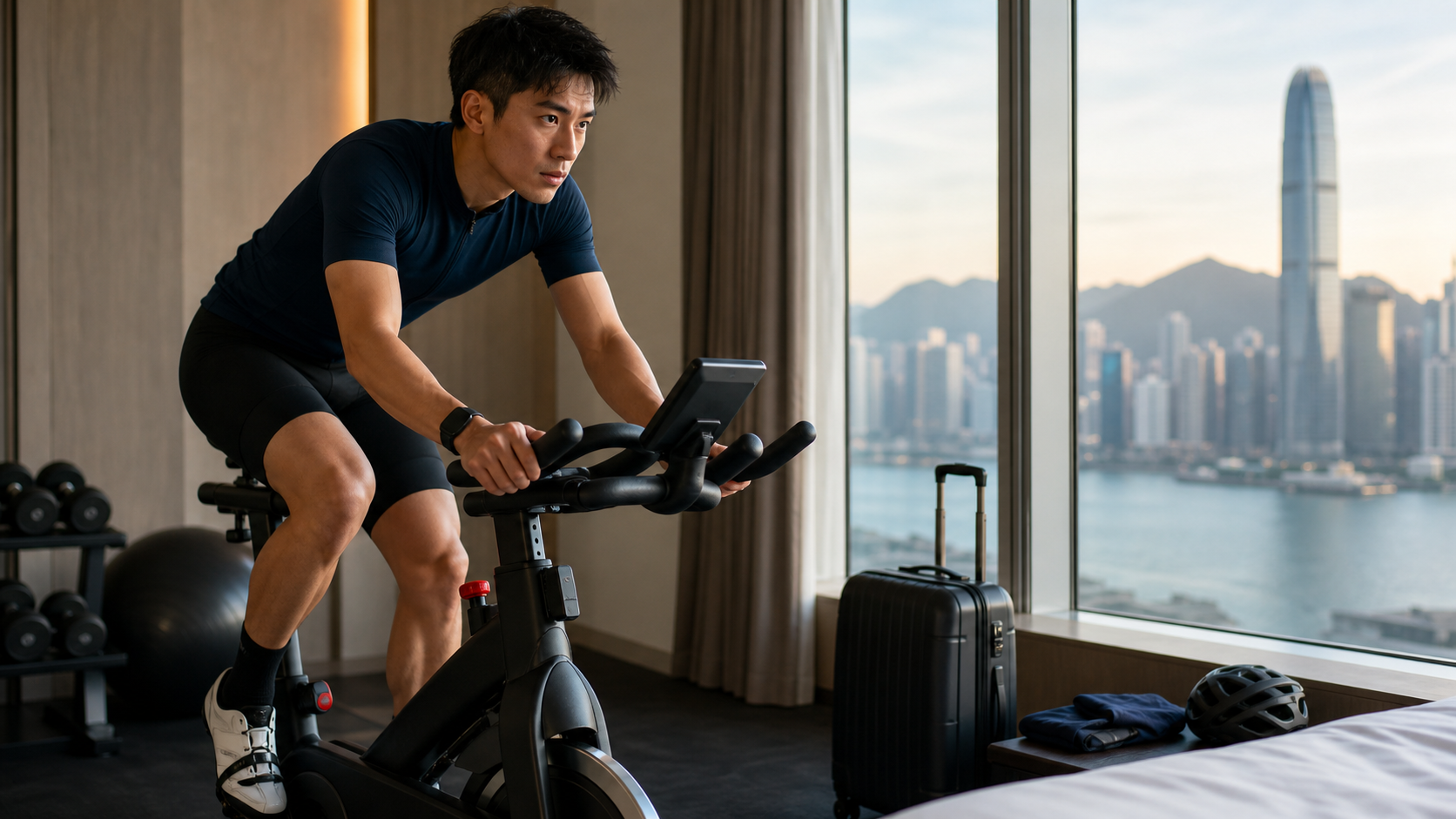
Option 1: Hotel Gym Stationary Bike (Most Versatile)
Suitable for most business hotel scenarios:
Short High-Intensity Session (20–30 minutes, 2 times per week):
- Warm-up: 5 minutes easy riding (RPE 3)
- Main set: 4×4 minutes high intensity (RPE 8–9), with 2 minutes recovery between intervals (RPE 3–4)
- Cool-down: 5 minutes easy riding
This session takes only 25 minutes and effectively maintains aerobic capacity and neuromuscular pedaling efficiency.
Option 2: City Running as a Substitute for Cycling (Maintaining Aerobic Capacity)
If the hotel has no bike, running can substitute to maintain your aerobic base:
- Running provides aerobic stimulus comparable to cycling (though the muscle groups are not identical)
- 20–30 minutes per session, including 10–15 minutes at Zone 3–4
- 2–3 sessions per week is sufficient
Option 3: Bringing Training Aids
For cyclists seriously preparing for races:
- Mini resistance bands: can be used for squats, glute bridges, and other exercises to maintain hip and leg muscle strength
- Wahoo KICKR HEADWIND fan + a simple trainer (suitable for driving business trips): bring a trainer and ride your own bike in the hotel room
Special Considerations for Cross-Time-Zone Business Trips
Long-haul business trips (e.g., Taipei ↔ USA, Taipei ↔ Europe) involve jet lag issues:
- 1–2 days after arrival: avoid scheduling high-intensity training; easy rides or walks help adjust to the time difference
- Prioritize natural light exposure: getting natural light during the day is the fastest way to reset your circadian rhythm; combine it with light outdoor activity
- 2–3 days after returning to Taiwan: likewise, avoid immediate high intensity; let your body adjust to the time difference before resuming training intensity
Riding While Traveling: Options for Combining Business with Leisure
If the travel destination allows it, here are practical options for Taiwanese cyclists:
- Folding bikes or travel bikes: some cyclists choose to bring a lightweight folding bike (such as a Brompton) or disassemble and pack their bike in a case
- Bike rental services: many tourist cities (Tokyo, Osaka, Kyoto, Bali) offer road bike or touring bike rental services
- YouBike-style shared bikes: suitable for city sightseeing; although the intensity is low, it works as Zone 1 active recovery
Strategy After Returning to Training
When you return to training after a trip, avoid the “make-up session” mentality at all costs:
- Detraining of 1 week or less: continue with your original plan; no adjustment needed
- Detraining of 2 weeks: focus on Zone 2 for the first 3–4 days, then resume normal intensity sessions from day 5
- Detraining of 3–4 weeks: use a 2-week transition period to rebuild your aerobic base before introducing high intensity
- Do not try to “make up” all the lost mileage on your first long ride back home: this is the biggest source of injury
Practical Advice
- Create a “travel version training plan” before you leave: know exactly which days are training days and which days are true rest days
- Don’t travel with guilt: the occasional training break allows your body more complete recovery, which is beneficial in the long run
- Treat travel as an active recovery week: lots of walking and exploring the city also count as beneficial low-intensity physical activity
- Reduce training volume by 20% in the first week after the trip ends: give your body a buffer instead of immediately going all out
Conclusion
Maintaining fitness during travel is far easier than most cyclists imagine. You don’t need to bring an entire trainer setup on a business trip, nor do you need to sacrifice all your leisure time while traveling. Just two short high-intensity sessions per week can preserve the vast majority of your fitness gains over several weeks of travel. Use the “Minimum Effective Dose Principle” wisely to achieve a sustainable balance between work, life, and cycling.
Related Reading
- Swim Training During Vacation: A Minimal Workout Plan to Maintain Feel for the Water During a 2-Week Trip
- Minimum Training Volume for Maintaining Swimming Fitness: How Many Sessions Per Week to Avoid Regression
- Alternative Training Options During Injury: Strategies to Avoid Losing Too Much Fitness
- The Science of Detraining: How Long Without Riding Before VO₂max Starts to Decline?
摔車後補裝備: 好市多新款單車安全帽& Specialized Romin 北高整路屁股都不痛的坐墊 | 一千元居然有MIPS | CT Yeh | 公路車
4 年前
滑雪新手們慘摔學習全紀錄(請開字幕),滑雪好好玩 | Snowboard + Ski | 岩原 スキー場 | 滑雪APP使用 | GoPro Max
6 年前
靠單車減肥35公斤 心得分享與整理
7 年前
單車 一日北高 ( 雙城 ) 肥宅雙人瘋狂行 紀錄片 REACTO
10 年前
JJSC南台灣單車走春三日行 DAY 1 / 強度 x 美食 x 節慶體驗 / 公路車 CT Yeh
5 個月前
太平山單車員工旅遊 | 這樣玩CP值最高!| 公路車
5 年前
南竿 單車 | 老婆公路車首航 | 偽出國體驗 | 4K 高畫質 | 綠色騎跡低碳輕旅遊 | #公路車
5 年前
西進武嶺 免費訓練分析服務 Intervals | 練不夠還是練過頭?你哪一種類型選手?AI模型告訴你! | 備戰神器 | 公路車 訓練 | CT Yeh
4 年前