Introduction
For swimmers looking to break through speed plateaus, resistance training is an indispensable component. The swimming drag chute and the drag sock/resistance net are two common tools for increasing water resistance. By artificially increasing water drag, swimmers train in a high-resistance environment; once the resistance device is removed, they can feel a noticeable improvement in speed—the same principle behind sprinters using resistance bands in training. This article will provide an in-depth comparison of the characteristics of both tools to help swimmers make the right choice.
The Principle and Design of the Drag Chute
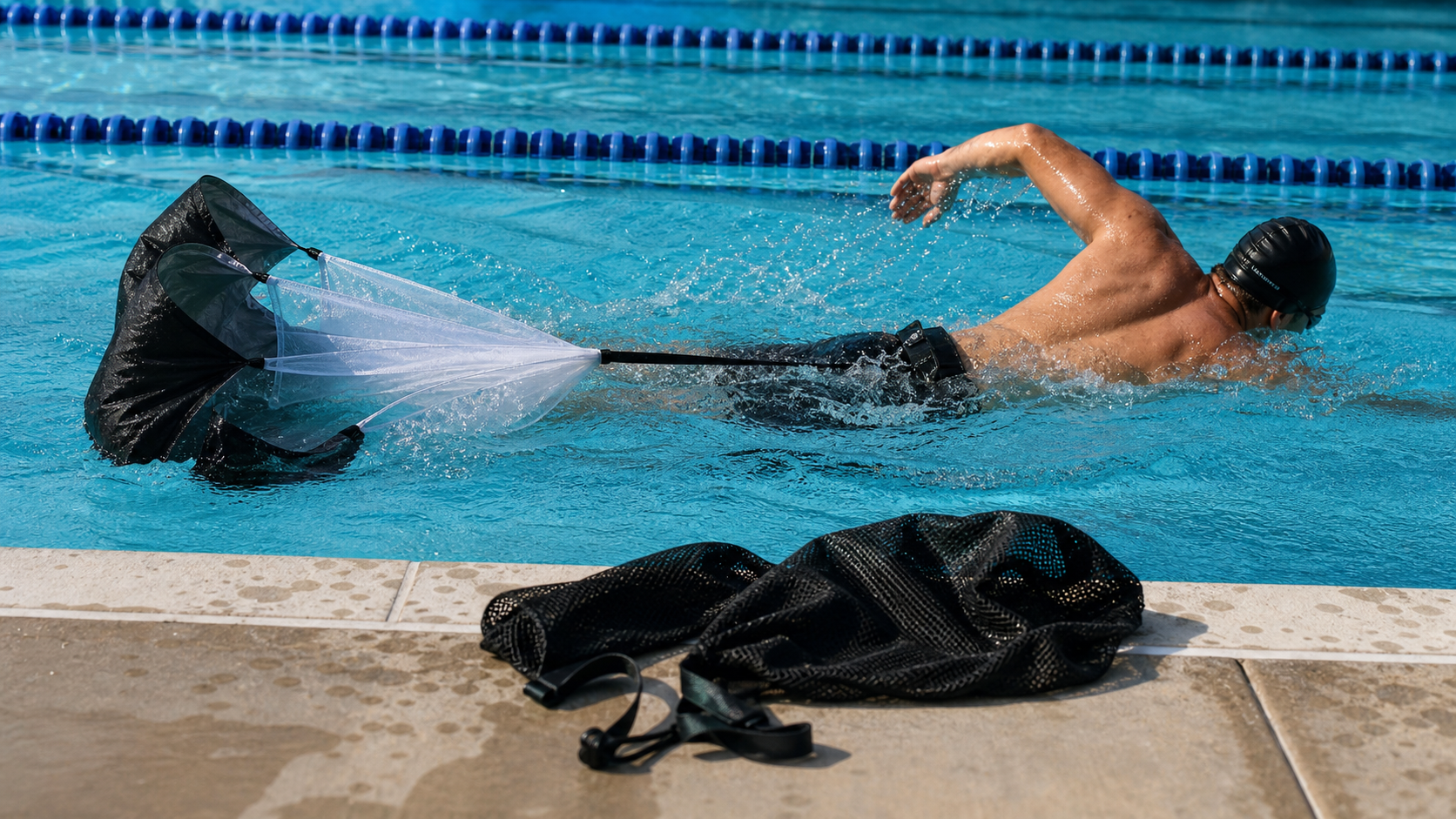
The swimming drag chute is inspired by the parachute. A deployable chute-shaped device is attached to the swimmer’s waist, and as the swimmer moves forward, the chute opens and generates substantial water resistance.
Key features of the drag chute:
- Adjustable resistance: Most drag chutes feature a drawcord that allows you to adjust how much the chute opens, thereby controlling the level of resistance
- Resistance increases with speed: The faster you swim, the greater the resistance (a quadratic relationship), making it ideal for power training
- Best for high-intensity intervals: Most effective in short-distance sprints (25m–100m)
- Attachment position: Secured to the swimmer’s waist with a belt, without interfering with arm movements
Disadvantages of the drag chute:
- The chute requires a certain speed to fully open; at low swimming speeds, the resistance effect is less noticeable
- Turning requires special technique to avoid the chute tangling
- Its larger size makes storage and transport less convenient
The Principle and Design of the Drag Sock
The drag sock is a mesh cover worn over swim trunks/a swimsuit, which increases water resistance by enlarging the body’s effective cross-sectional area. Some designs are two-piece: an inner swimsuit plus an outer mesh resistance suit.
Key features of the drag sock:
- Evenly distributed resistance: Resistance is applied evenly across the body rather than concentrated at the rear
- Fixed resistance level: Unlike the drag chute, resistance remains relatively stable regardless of speed
- Suitable for aerobic training: The constant resistance makes it better suited for longer-distance aerobic sessions
- Does not affect turns: More convenient than the drag chute for use in longer-distance training
| Feature | Drag Chute | Drag Sock |
|---|---|---|
| Resistance characteristics | Increases with speed (dynamic) | Relatively fixed (static) |
| Best training type | Short sprints, explosive power | Long-distance aerobic, endurance |
| Ease of use | Moderate (care needed on turns) | High (does not interfere with movement) |
| Adjustability | High (multi-level adjustment) | Low (fixed at purchase) |
| Suitable level | Advanced swimmers | Intermediate and above |
| Price range | NT$400–1,200 | NT$200–600 |
Comparison of Training Benefits
Training benefits of the drag chute:
The drag chute primarily enhances speed through the principle of “overload training.” Specific benefits include:
- Strengthening the muscle groups required for propulsion (latissimus dorsi, deltoids, etc.)
- Improving the ability to maintain stroke technique under fatigue
- After removing the resistance, swimmers typically feel an immediate and noticeable boost in speed
- Increasing the psychological intensity of training, suitable for competitive athletes
Training benefits of the drag sock:
- Improves overall muscular endurance for long-distance swimming
- Allows aerobic training to achieve higher metabolic intensity at a lower heart rate
- Trains the body to maintain stable swimming posture under greater resistance
- Suitable as a foundational conditioning tool for triathletes
Usage Precautions
Before using resistance training equipment, the following must be noted:
- Warm up thoroughly: Swim at least 300–400m to warm up before putting on resistance equipment
- Technical foundation: It is recommended to have a certain level of technical proficiency (able to swim 400m freestyle without stopping) before introducing resistance training
- Manage training volume: The distance covered during resistance training should not exceed 40% of the total training volume
- Monitor the shoulders: If you feel shoulder discomfort, stop immediately and assess the situation
- Avoid combining equipment: It is not recommended to use a drag chute together with paddles simultaneously; excessive resistance can easily lead to shoulder injury
Practical Recommendations
- Trying resistance training for the first time: Start with the drag sock, as its resistance is more predictable and the difficulty is relatively lower
- Competitive swimmers aiming to break through speed plateaus: The drag chute paired with short-distance intervals (4×25m, 8×50m) yields the best results
- Triathletes: Use the drag sock for mid-distance aerobic training to help build swimming muscular endurance
- Equipment pairing: Follow resistance training with unresisted speed sprints to experience the “contrast effect”
Conclusion
Both the swimming drag chute and the drag sock are effective advanced training tools; the choice between them depends on your training goals. Competitive swimmers pursuing explosive speed are better suited to the drag chute, while long-distance swimmers and triathletes focusing on muscular endurance are better matched with the drag sock. Whichever you choose, it must be built on a solid swimming technique foundation and follow the principle of gradual progression to safely and effectively improve swimming performance.
Related Reading
- Swimming Drag Chute vs. Resistance Band: An Analysis of Professional Auxiliary Tools for High-Intensity Training
- Drag Chute Selection and Training Application: Evaluating Resistance Settings and the Benefits of In-Water Resistance Training
- Swimming Resistance Training: Designing Workouts with Band Swimming, Drag Chutes, and Resistance Bands
- Swimming Resistance Training: Integrating Paddles, Drag Chutes, and Pull Buoys into Your Workout Plan
訓練台體驗) 2019台北自行車展 三大家 訓練台體驗 Tacx Neo Flux 2 Xepdo Apx Wahoo Kickr
7 年前
CT 喇低賽) 武嶺牽車 才是王道 西進牽車四小時內秘訣 攝手位置 如何判斷 防抽筋小秘訣
7 年前
一日北高前的西濱集訓 | 跟著11小時軍團 | 300W踩不動的大逆風 | 輪車破風差幾瓦?
6 年前
3D 列印車褲墊 / 舒適改善? / 無痕 x 分區壓縮 / ATK & Decider系列 / JE22黑科技 / #公路車 #CTYEH
11 個月前
西進武嶺 免費訓練分析服務 Intervals | 練不夠還是練過頭?你哪一種類型選手?AI模型告訴你! | 備戰神器 | 公路車 訓練 | CT Yeh
4 年前
洗單車神器 吹水機! 實際洗車用用看 暴力洗鍊條大法 | 公路車 | CT Yeh
4 年前
一日北高前的高裝檢 | 北高 360 | 挑戰11小時的裝備 | 一日雙塔 | 補給
6 年前
RAMP FTP Test 直播 究竟能撐到幾瓦 訓練台 Gravat Zwift
6 年前