Introduction
Who hasn’t lost track of how many laps they’ve swum while swimming? During long-distance continuous training, focusing on maintaining proper swimming form while also counting laps is a real challenge for many. The swimming lap counter is a small auxiliary tool designed to solve this problem. Lap counters on the market are mainly divided into two types: mechanical (typically worn on the finger, pressed after each lap to count) and electronic (automatically detecting turns or manually pressed), each with its own suitable applications and limitations. This article will compare the characteristics of both in detail and provide practical purchasing advice.
Design and Features of Mechanical Lap Counters
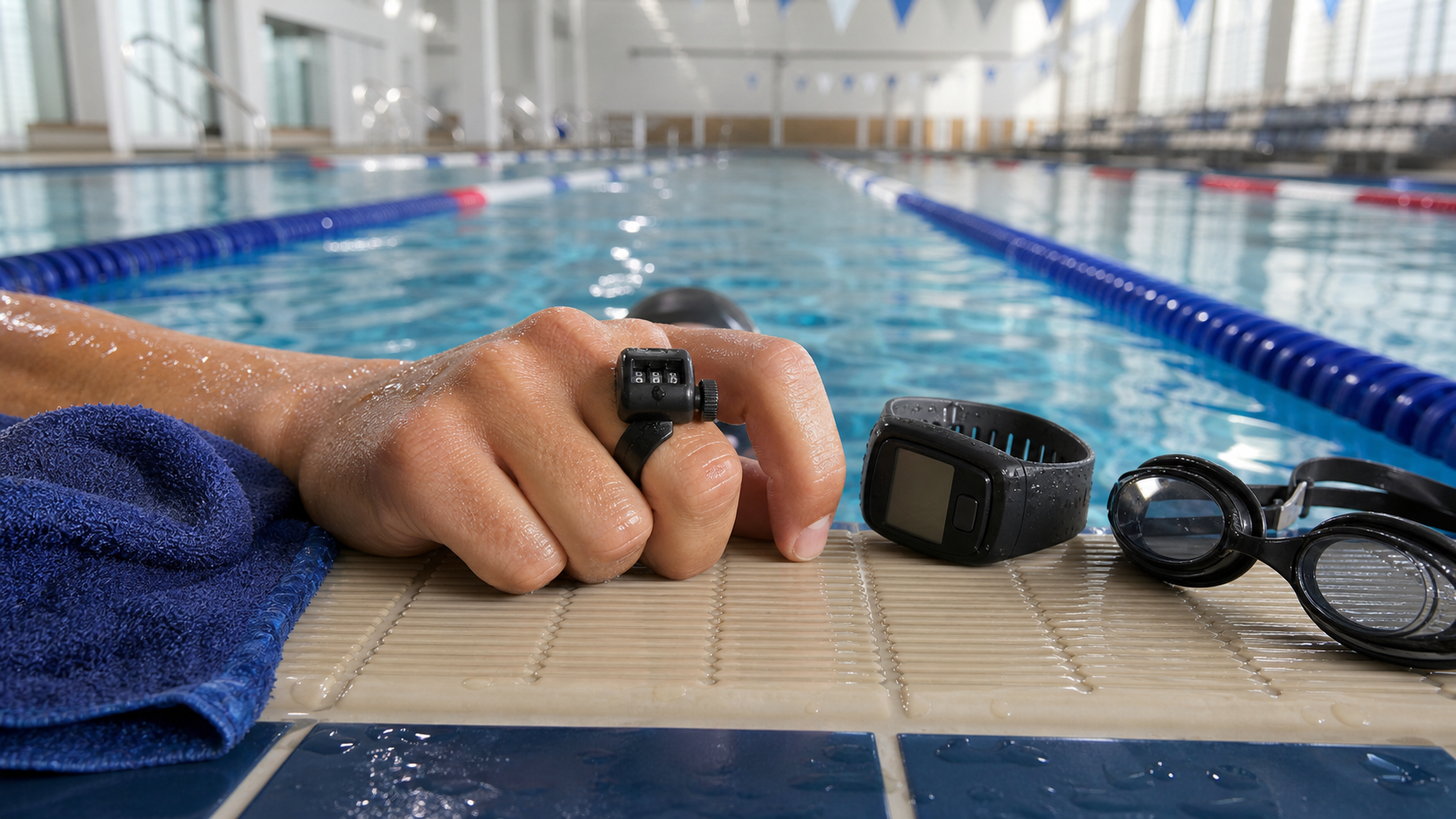
Mechanical lap counters are the most traditional and common design, typically a ring-shaped device worn on the finger with a numbered dial on the surface. After completing each lap, you press it with your thumb or another finger to advance the count.
Design Features:
- No battery required; the structure is extremely simple and durable
- Purely mechanical counting, unaffected by the aquatic environment
- Ring-style design slightly interferes with normal stroke mechanics
- The number display requires looking down to check while in the water
Advantages:
- Absolutely durable: The mechanical structure is water-resistant, with no risk of battery depletion or circuit failure
- Intuitive operation: Press once per lap; no need to learn any settings
- Extremely low price: Available for NT$100–300
- Ready to use with no preparation required
Disadvantages:
- Wearing it on the finger may affect the “feel of the water” during the catch phase, especially for technique-sensitive swimmers
- You must remember to press it at every turn; easy to forget when distracted
- Can only count laps; cannot record time or other training data
- Some models require a firmer press, which can be difficult to operate with wet fingers
| Feature | Mechanical | Electronic |
|---|---|---|
| Requires battery | No | Yes |
| Automatic lap counting | No (manual press) | Some models yes |
| Timing function | No | Yes (some models) |
| Water resistance | Excellent | Good (IP rating varies by model) |
| Learning curve | Low | Moderate |
| Price | NT$100–300 | NT$300–1,500 |
| Lifespan | Long (5+ years) | Moderate (depends on battery and water resistance) |
Design and Features of Electronic Lap Counters
Electronic lap counters are primarily designed as “wristband-style” devices, similar to a simplified sports watch, displaying real-time lap count and timing. Some models can even automatically detect turns to count laps.
Main Types:
- Manual-press electronic models: Functionally identical to mechanical counters, but with an electronic display replacing the mechanical dial, usually with a built-in timing function
- Auto-sensing models: Feature a built-in accelerometer that detects the motion characteristics of a swimmer’s turn and automatically counts laps
- Built-in lap counting in swim training watches: Sports watches from Garmin, SUUNTO, etc., automatically handle lap counting in their swim modes
Notes on Auto-Sensing Models:
Automatic lap-counting technology still has a certain rate of miscounting. Common issues include:
- Breaststroke or backstroke turn mechanics differ from freestyle, which may trigger false counts or missed counts
- When a swimmer turns without clearly touching the wall, the sensor may not correctly identify the turn
- Particularly slow or non-standard turns may be ignored
It is recommended to test the accuracy over a few laps before relying on the automatic lap-counting function.
Considerations by Use Case
Different training scenarios have different requirements for lap counters:
Long-distance aerobic training (2000m and above):
Manual-press lap counters (mechanical or electronic) are the most reliable. While automatic lap counting is convenient, correcting a miscount during a long-distance session is difficult. It is recommended to choose an electronic model with a “target lap setting” function that vibrates or sounds an alert when the set number of laps is reached.
Interval training (multiple short-distance sets):
Electronic timing models are more practical, as they can simultaneously record the time of each set, making it easy to track pace across sets.
Open-water swimming:
Open water typically has no fixed concept of laps, so lap counters are of limited use in this setting. A sports watch with GPS functionality is a more suitable tool.
Special Design: Swim Lap-Counting Wristbands
In recent years, a product category between lap counters and training watches has emerged—the “swim lap-counting wristband.” Its features include:
- Recording lap count
- Split timing
- Syncing data to a phone app via connection after training
- Typically priced between NT$600–1,500
This type of product suits swimmers who don’t want to invest in a full sports watch but need more functionality than simple lap counting.
Practical Recommendations
- Recreational swimmers who only need simple lap counting: A mechanical lap counter is sufficient—NT$100–200 solves the problem
- Trainers who also need timing: Choose an electronic model with a timing function, budget NT$300–600
- Swimmers who already own a sports watch: Check whether the watch has a swim lap-counting function (most Garmin/Polar/SUUNTO models do); no need to purchase a separate lap counter
- Those who dislike finger accessories: Choose a wristband-style electronic lap counter that doesn’t affect stroke feel
- Auto-counting models: Test them in the pool before purchasing to confirm accuracy before deciding whether the higher price is worth it
Conclusion
The swimming lap counter may seem trivial, but it can significantly reduce the cognitive burden of “which lap am I on” during long-distance training. With its extremely low price and zero-maintenance requirement, the mechanical lap counter is the best choice for beginner swimmers; electronic models offer richer timing and data features, making them suitable for advanced swimmers with systematic training needs. Choose the right tool so that every turn you make in the water is accurately counted toward your training progress.
Related Reading
- Swimming Lap Counters vs. Pool Stopwatches: A Functional Comparison and Buying Guide for Lap-Counting Tools
- Swim Watch Buying Comparison: In-Depth Review of Garmin Swim 2 vs. Apple Watch Ultra Swimming Features
- Pacing in Swim Races: A Strategic Comparison of GPS Timing vs. Perceived Effort Pacing
- Swimming Stroke Rate vs. Distance Per Stroke: Optimization Strategies for DPS and SR
鉅齒紋輪組!? ControlTech MEG-T50 EVO 碳纖維幅條輪組/ 功率對比實驗 / 公路車 / CT Yeh
2 年前
入門車錶王者 iGPSPORT BSC100S 一千元的售價! 超大螢幕、連續兩趟北高的續航、藝術般的APP! Bryton Garmin 兩王地位撼動? | 公路車 | CT Yeh
3 年前
2022 前十五大自行車錶 !? 兩萬名車友大數據統計 | 你的上榜了嗎? | 菁英車友都用哪些錶? | Bryton Garmin 誰能拔得頭籌?| 車錶推薦 | 公路車 CT Yeh
4 年前
2025 自行車錶排行榜 兩萬車友大數據 / Garmin Bryton 排名會大洗牌嗎? / 全新的碼表前身分析 /公路車 / CT Yeh
1 年前
Garmin Edge 1050 旗艦車錶 全台首測!/ 環法冠軍指定 / 對比Edge 1040改進哪些? / 公路車 / CT Yeh
2 年前
類空拍神器 Feiyu Pocket 2s (有優惠連結)三軸穩定 運動攝影機 開箱!比GoPro 還強的滑順視角!三小時長時間錄影 行車記錄器 | 環花東365實測 | 公路車 CT Yeh
4 年前
Apple Watch 3 值得 買嗎!? 實測 單車車錶 遙控相機 Zwift 心律連線 Apple Pay 全聯買菜 GoPro 遙控
8 年前
全台首發神車錶! iGPSPORT iGS630 兩趟一日北高的續航! 超強導航、功率訓練、超人性APP! Garmin & Bryton 有對手了嗎? | 公路車 |CT Yeh
3 年前