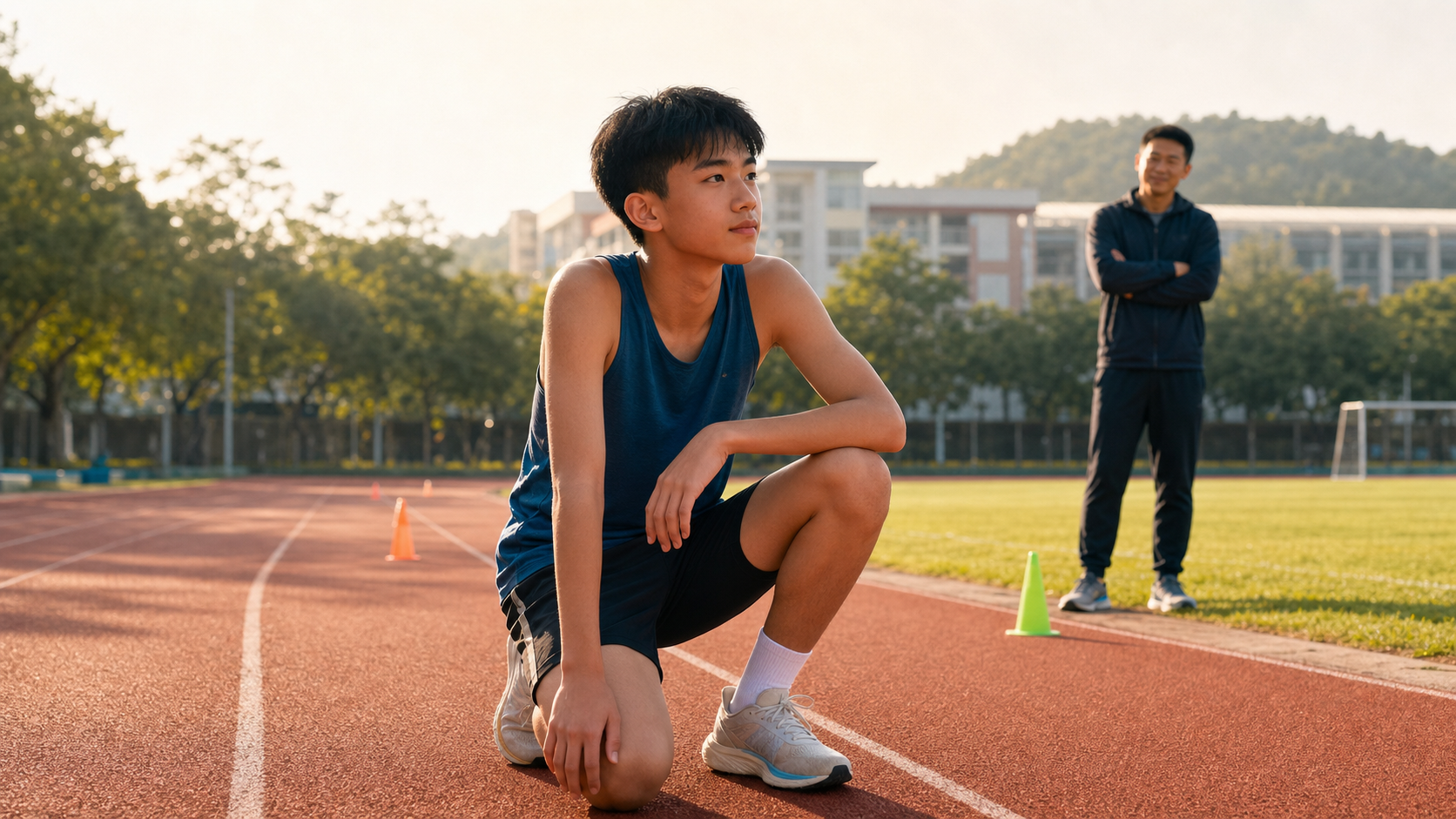
Introduction
“Your last 800-meter time was 3 minutes 20 seconds; this time you need to break 3 minutes.” To a 14-year-old, such an expectation may sound like encouragement, but it could be silently eroding their love for running.
Adolescence is a critical stage for the formation of self-identity. Children at this age are extremely sensitive to evaluation, and experiences of success and failure can leave a deep imprint on their beliefs about their own abilities. In the realm of competitive sports, excessive pressure to perform may lead children to develop a “performance goal orientation” (fear of failure, avoiding negative evaluation) rather than a “mastery goal orientation” (enjoying the process of improvement, being interested in the skill itself). The latter is the psychological foundation for long-term sports participation.
This article explores, from the perspective of adolescent sports psychology, how to protect a child’s passion for running in a competitive environment.
The Main Psychological Stressors Facing Teenage Runners
Stressor One: Expectations from Parents
Taiwanese parents invest heavily in their children’s academics and extracurricular talents, and some apply the same logic to their children’s sports: signing up for training courses, requiring weekly mileage goals, and comparing their children’s results with others. This highly controlling involvement, even when well-intentioned, can have a detrimental effect on a child’s sense of autonomy.
Research shows that parents’ sideline comments have a significant impact on a child’s psychological experience:
| Type of Comment | Child’s Psychological Response |
|---|---|
| “Come on, you can do it!” | Sense of support, self-efficacy |
| “What place did you get?” | Performance anxiety, feelings of comparison |
| “You ran too slowly today!” | Shame, self-doubt |
| “Let me analyze your results for you” | Excessive external evaluation, undermines autonomy |
Stressor Two: Peer Comparison and Social Media
Modern teenagers live in a constant environment of social comparison. On platforms like Instagram and Strava, seeing peers post impressive running results can trigger feelings of “I’m not good enough,” and may even drive unhealthy overtraining in a bid to improve quickly.
Stressor Three: Fear of Failure
Some teenagers develop “self-handicapping” behaviors: deliberately reducing training before important races so that a poor result has an excuse (“I lost because I didn’t train”). This psychological defense mechanism may seem to protect self-esteem, but it actually hinders genuine progress.
Methods for Cultivating a Healthy Competitive Mindset
Establishing a “Mastery Climate” Rather Than a “Performance Climate”
Mastery Climate: Emphasizes personal improvement, effort, the learning process, and allows for mistakes.
Performance Climate: Emphasizes comparison with others, rankings, and win/loss outcomes.
Research consistently shows that adolescents trained in a mastery climate have significantly better long-term sports participation rates, intrinsic motivation, and mental health outcomes than their peers trained in a performance climate.
Coaches and parents can start by changing their language:
- “How much did you improve compared to last time?” (rather than “What place did you get?”)
- “What part of today are you most satisfied with?” (rather than “You didn’t run well today”)
- “What do you think you could do better next time?” (rather than drawing conclusions for the child)
The Art of Goal Setting
Help teenage runners set process goals rather than only outcome goals:
- Outcome goal: “Run the 800 meters in under 2 minutes 50 seconds”
- Process goals: “Fully recover before starting the next interval set,” “Control the pace in the first 400 meters and don’t start too fast”
Process goals are things the child can control; they have higher achievement rates, generate a stronger sense of accomplishment, and provide better protection for motivation.
The Post-Race Conversation Framework
After a race, the way parents talk with their child is crucial. It is recommended to follow the principle of “emotions first, analysis second”:
- First acknowledge the child’s effort and courage (regardless of the result)
- Ask the child how they feel and let them speak first
- If the child wants to analyze the result, discuss it together; if they don’t, let it go
- Don’t discuss shortcomings on the day of the race; let the child process their emotions first
Concrete Ways to Keep Running “Fun”
- Mix in non-competitive running: trail runs, route exploration, running photography—let running be more than just a timed competition
- Regularly ask your child “Does running make you happy?” and take their answers seriously
- Celebrate non-performance milestones: three consecutive months of training, completing a first half marathon, helping a teammate finish a workout
- Allow “unstructured runs”: occasionally run without a watch, without tracking distance, just to enjoy the feeling of moving
Practical Advice
- Parental sideline code of conduct: give only encouragement, not coaching—let the child’s race belong to the child
- Avoid over-asking about training details; excessive attention creates pressure. Trust the coach and the child’s process
- Pay attention to the child’s life outside of running, and avoid making running the sole focus of family relationships
- If the child consistently shows signs of burnout or avoidance, consider a short break and engaging in other activities they enjoy, rather than forcing them to continue
- Consult a sports psychologist: Taiwan already has some sports science centers offering adolescent sports psychology consultation services; don’t hesitate to seek help if needed
Conclusion
Competition is a catalyst for athletic improvement, but it can also be the fire that burns out a child’s passion for sports. The art of parents and coaches lies in striking the delicate balance that makes competition a driving force rather than a source of pressure. When we can say, “You did your best, and that’s enough. Next time, we’ll figure it out together,” in that moment, the child learns not just how to run faster, but how to face all of life’s challenges and setbacks with a healthy mindset.
Related Reading
- Cultivating Motivation in Teenage Runners: Ways to Help Kids Fall in Love with Running
- Adolescent Sports Psychology: Building Proper Competitive Motivation and Resilience Training
- The Psychological Development of Teenage Swimmers: Competitive Pressure and Building Confidence
- How Parents Can Support Without Overreaching: Training Volume Limits, Psychological Pressure, and Communicating with Coaches
#PUSHBIKE 原來這麼好玩! 小朋友 滑步車 初體驗 超可愛
6 年前
CT 喇低賽) 單車 比賽總是沒照片? 攝影師的觀點大公開 姿勢就是力量! 請加速1.25倍收看
7 年前
西進武嶺 免費訓練分析服務 Intervals | 練不夠還是練過頭?你哪一種類型選手?AI模型告訴你! | 備戰神器 | 公路車 訓練 | CT Yeh
4 年前
Live) 備戰2019彰化經典百K 賽前攻略 (已完賽請看新影片
7 年前
一日北高前的高裝檢 | 北高 360 | 挑戰11小時的裝備 | 一日雙塔 | 補給
6 年前
JE22 百里任務體驗,心跳不能過150,三小時內有可能...? 沒有天時地利難度有多高? / 公路車 / CT Yeh
1 年前
一日北高/長距離團騎 常見問題補充篇 / 組團或跟團的眉角 / 壯車友容易被瘦車友慢性拉爆 / 原來屁股痛可能是這個原因...? / 風場配速法 / 公路車 / CT Yeh
2 年前
2019 柯P 超越北高 第一集團實錄 (11小時實錄請參考另一部影片) 一日雙城 一日北高 NeverStop Taiwan Long Distance Cycling Challenge
7 年前