Sleep Needs of Adolescent Runners: The Importance of Adequate Sleep for Athletic Performance and Growth
Introduction
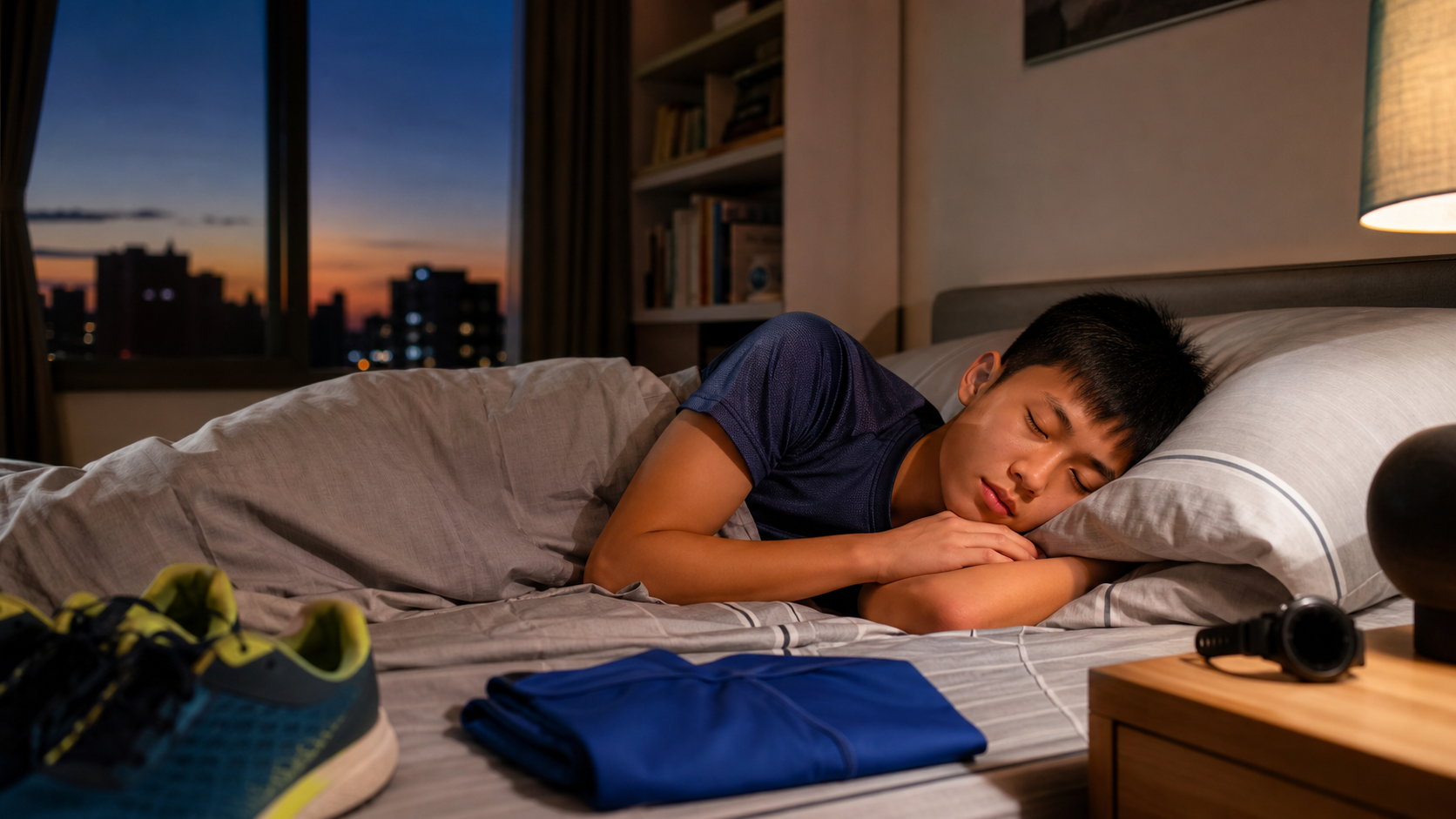
Sleep problems among Taiwanese adolescents are a widespread but chronically underestimated health issue. According to domestic surveys, the average daily sleep duration for Taiwanese junior high school students is approximately 7.2 hours, dropping to around 6.5 hours for senior high school students—while the actual requirement for adolescents is 8–10 hours. This sleep deficit already has a significant impact on regular students, but for adolescent runners who must also manage training recovery, the cost is even more severe.
Many adolescent runners (and their parents) believe that sleep is something “outside of training” and has no direct bearing on running performance. In fact, sleep is not merely rest—it is the primary time window during which the body carries out repair, growth hormone secretion, and neural memory consolidation. No matter how much training time a sleep-deprived runner puts in, it is difficult to achieve the expected rate of improvement.
This article provides an in-depth analysis of the scientific link between sleep and adolescent running performance, and offers practical sleep improvement strategies for Taiwanese families.
The Relationship Between Sleep and Growth Hormone
Growth Primarily Occurs During Sleep
Growth hormone (HGH) is the core hormone that drives longitudinal bone growth, muscle protein synthesis, and fat metabolism in adolescents. Its secretion has a key characteristic: approximately 70–80% of daily growth hormone secretion is concentrated in the deep sleep stages of sleep (NREM stages 3 and 4), especially in the first two hours after falling asleep.
This means that staying up late or fragmented sleep directly deprives the body of the primary window for growth hormone secretion. A child who trains hard at running but only sleeps 6 hours per night will have muscle repair and physical development efficiency that is only half—or even less—of that of well-rested peers.
The Multifaceted Impact of Sleep on Running Performance
| Aspect of Performance Affected by Sleep | Specific Consequences of Sleep Deprivation | Positive Benefits of Adequate Sleep |
|---|---|---|
| Reaction time | Increased by 15–30% | Quick starting reactions, precise sudden stops |
| VO₂ max | Decreased by 3–5% | Improved aerobic endurance performance |
| Subjective fatigue | Feels more tired at the same pace | Longer sustainable training sessions |
| Injury risk | Increased by up to 1.7 times | Correct movement coordination, fewer mistakes |
| Immune function | Increased risk of colds | Better training consistency |
| Mood and motivation | Irritability, resistance to running | Positive and proactive training attitude |
A well-known study followed Stanford University swimmers and extended their sleep to 10 hours per night. After just six weeks, the athletes showed significant improvements in reaction time, mood, and technical performance. Although it was a swimming study, the same principles apply to running.
Sleep Challenges for Taiwanese Adolescent Runners
The Main Sleep Killers
Taiwanese adolescents face a rather unique set of sleep stressors:
Academic pressure: The workload, cram schools, and exam preparation in junior and senior high school often mean children cannot even begin preparing for bed until after 11 PM.
3C device use: The blue light from phones and tablets suppresses melatonin secretion, making it difficult to fall asleep. Research shows that using a phone 1 hour before bed can delay sleep onset by 30–60 minutes.
Early school start: Some schools in Taiwan hold morning training sessions starting at 6 AM. If a child goes to bed at 11 PM, their daily sleep duration falls below 7 hours.
Pre-race anxiety: Nervousness the night before a competition affects sleep quality, and many adolescents toss and turn before important races.
Strategies for Optimizing Adolescent Runners’ Sleep
Building the Foundations of Sleep Hygiene
- Consistent bedtime and wake-up time: Maintain a difference of no more than 1 hour even on weekends to stabilize the circadian rhythm
- “Screen-free time” 1 hour before bed: Put down the phone and replace it with reading, light stretching, or a bath
- Bedroom environment: Cool (18–22°C), dark, and quiet to facilitate deep sleep
- Avoid sleeping immediately after training: The sympathetic nervous system remains active after high-intensity training; it is recommended to wait at least 2 hours after finishing a session before going to bed
Practical Adjustments for Taiwanese Families
- Communicate with the school about morning training times: If a child needs to train in the early morning, bedtime should be moved earlier accordingly
- Weighing cram school commitments: If a child is simultaneously participating in track training and heavy cram school attendance, parents need to help assess priorities to avoid both compressing sleep time
- Limits on weekend “catch-up sleep”: Sleeping 1–2 extra hours on weekends can partially make up for a sleep deficit, but more than 2 hours can disrupt the circadian rhythm
Pre-Race Sleep Strategies
- One week before the race: Try to go to bed 30 minutes earlier to “bank” extra sleep
- What to do if you can’t sleep the night before: Tell the child that “quiet rest” already provides most of the recovery benefit, and don’t let anxiety about not sleeping make things worse
- Early wake-up on race day: If the race requires waking up earlier than usual, gradually adjust the wake-up time in the days leading up to it to avoid a sudden early start
Daily Sleep Requirement Guidelines for Adolescents
- Children aged 6–12: 9–12 hours per day recommended
- Adolescents aged 13–18: 8–10 hours per day recommended
- Additional needs on training days: An extra 30–60 minutes recommended after high-intensity training
Practical Recommendations
- Have children track their own sleep: Use a simple log to record bedtime, wake-up time, and perceived sleep quality
- Parents lead by example: The sleep culture of a family is shaped by the adults; if parents stay up late themselves, it is difficult to demand that children go to bed early
- Don’t trade sleep time for training time: The habit of “I’ll just do one more set before bed” is the biggest obstacle to performance improvement
- Pay attention to sleep quality, not just duration: If a child still feels fatigued after 9 hours of sleep, evaluate for sleep apnea or other sleep disorders
Conclusion
Beyond training, nutrition, and psychology, sleep is the most powerful “passive training” tool for adolescent runners. Every night of deep sleep is the body quietly repairing the day’s micro-damage, secreting the day’s growth hormone, and consolidating the running techniques learned that day. Helping adolescents protect their sleep is helping their bodies maximize the benefits of every training session—this is the most effortless yet most effective performance-enhancing strategy, and it is a matter that every responsible parent and coach should take seriously.
Related Reading
- Sleep for Adolescent Athletes: The Necessity of 9–10 Hours of Sleep for Growth and Training Recovery
- Sleep and Road Running Recovery: The Scientific Impact of Sleep Quality on Repair
- Sleep and Running Recovery: Growth Hormone Secretion and Muscle Repair During Deep Sleep
- The Impact of Sleep Quality on Cycling Training Adaptation: The Relationship Between Deep Sleep and Growth Hormone Secretion
一日北高/長距離團騎 常見問題補充篇 / 組團或跟團的眉角 / 壯車友容易被瘦車友慢性拉爆 / 原來屁股痛可能是這個原因...? / 風場配速法 / 公路車 / CT Yeh
2 年前
西進武嶺 免費訓練分析服務 Intervals | 練不夠還是練過頭?你哪一種類型選手?AI模型告訴你! | 備戰神器 | 公路車 訓練 | CT Yeh
4 年前
一日北高前的高裝檢 | 北高 360 | 挑戰11小時的裝備 | 一日雙塔 | 補給
6 年前
CT暗黑廚房) 車友必備 宇宙無敵鮮蚵湯 幫助訓練恢復 天然食補 好市多 超肥鮮蚵 破PR
7 年前
一日北高 11小時 賽後心得分享篇 | TWB北高360 | 一日雙城 | 單車 | 公路車
6 年前
Live) 備戰2019彰化經典百K 賽前攻略 (已完賽請看新影片
7 年前
2019 夏季KOM 5小 完賽心得 準備攻略 東進武嶺 夏季登山王之路 Taiwan KOM Challenge
7 年前
台灣旅行團參加 第7回まえばし赤城山ヒルクライム大会 雙視點
8 年前