The Cross-Training Benefits of Swimming and Other Sports: Transfer of Aerobic Capacity Across Disciplines
Introduction
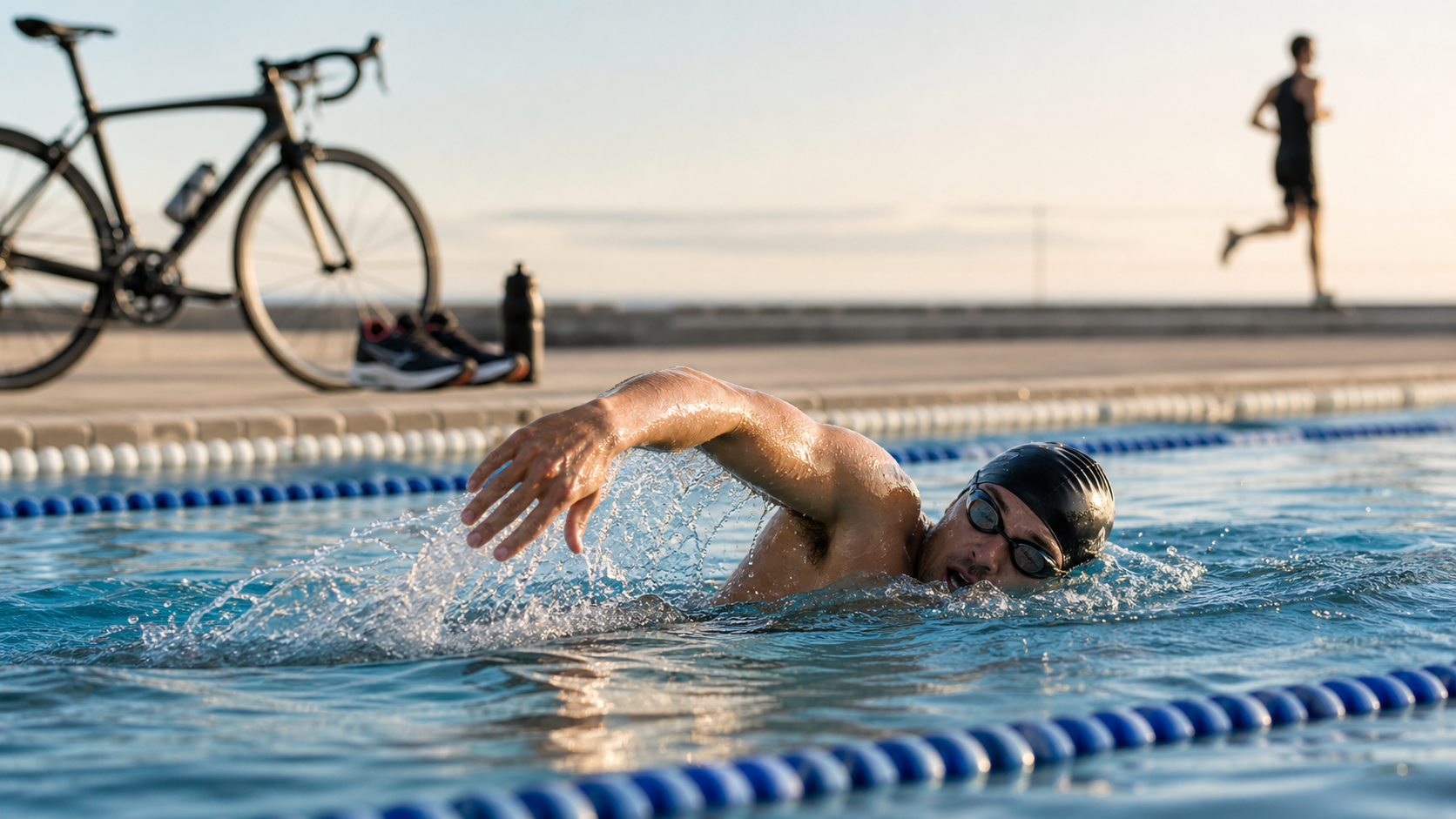
The recent boom in triathlon in Taiwan has led more and more people to train in swimming, cycling, and running simultaneously. Whether these three sports share a “common physiological foundation” that allows fitness gains from one sport to “transfer” to another is the core question of cross-training science. The answer is: yes, but with clear limitations. Understanding the mechanisms and boundaries of aerobic capacity transfer across disciplines can help you plan your training more intelligently.
The Physiological Basis of Aerobic Capacity Transfer
Adaptations from any aerobic exercise are partly “central” (central), occurring at the level of the heart, lungs, and blood; and partly “peripheral” (peripheral), occurring within specific muscle groups.
Central adaptations (the transferable component):
- Increased heart volume and stroke volume
- Increased blood volume and red blood cell count
- Increased maximal cardiac output
- Improved pulmonary ventilation capacity
These adaptations are carried out by the cardiorespiratory system and do not depend on specific muscle groups, so they can be partially transferred between different aerobic activities.
Peripheral adaptations (the harder-to-transfer component):
- Increased mitochondrial density in specific muscle groups
- Increased muscle capillary density
- Enhanced fat oxidation enzyme activity
- Neuromuscular coordination patterns
Peripheral adaptations are highly “movement-specific” (movement specificity). The aerobic capacity developed in the latissimus dorsi through swimming training offers almost no direct benefit to the quadriceps required for running.
Swimming’s Unique Position in Cross-Training
Among the three major aerobic sports, swimming has the most distinctive cross-transfer characteristics:
| Comparison Aspect | Swimming → Running | Swimming → Cycling | Running → Swimming |
|---|---|---|---|
| Cardiorespiratory base transfer | Moderate | Moderate | Moderate |
| Muscle specificity overlap | Low (upper vs. lower limbs) | Low–Moderate | Low (lower vs. upper limbs) |
| Technical transfer | Almost none | Almost none | Almost none |
| Overall VO₂max transfer | 40–60% | 40–60% | 40–60% |
Research data: For athletes who switched to swimming after a running injury, studies show that maintaining about 6 weeks of swimming training preserves 60–75% of running VO₂max, while a purely sedentary control group loses 10–15%. Swimming’s cardiorespiratory maintenance benefit is significantly better than inactivity, but it falls far short of the maintenance effect of continuing to run.
The Scientific Basis for Swimming as Injury Rehabilitation Training
The most important application of swimming in cross-training is during the recovery period after land-based sports injuries:
Indications for using swimming to replace running/cycling:
- Lower-limb stress fractures (swimming completely eliminates impact)
- Knee cartilage issues (buoyancy protects the joints)
- Plantar fasciitis (no weight-bearing load)
- Lower back pain (horizontal posture reduces lumbar spine pressure)
Aqua Jogging:
Using a buoyancy belt to simulate running motion in deep water is a way to transfer running adaptations better than pure swimming, because the muscle groups and movement patterns used are closer to land-based running while maintaining zero impact. Research shows that 6 weeks of aqua jogging preserves running VO₂max better than general swimming.
Triathlon Swimming Training Strategies
For triathletes, swimming is not just cross-training—it is the first leg of the race. However, the swim segment (typically 1500m or 3800m) accounts for the smallest proportion of total race time (10–15%), yet demands the highest cardiorespiratory output, and the fatigue state after completion directly affects subsequent cycling and running performance.
Triathlon-optimized swimming training principles:
-
Technical efficiency first: At the same swimming speed, better technique (less drag) consumes less energy, preserving more energy for the later stages. Reducing drag offers the highest return on investment.
-
Brick Training: Practicing the immediate transition from swimming to cycling allows the neuromuscular system to adapt to the “liquid → solid” movement mode switch.
-
Appropriate breathing training: Open-water swimming (waves, no lane lines) differs significantly from the pool and requires dedicated practice of breathing frequency and directional awareness.
Swimming as Cross-Training for Cyclists
For this site’s cycling readers, the cross-training value of swimming lies in:
- Cardiorespiratory maintenance: When training volume is insufficient (e.g., rainy season, inconvenient urban cycling), swimming can maintain the aerobic base
- Upper-body balance: Cycling relies heavily on the lower limbs; swimming can balance upper-body (back, shoulder) strength
- Active recovery: Easy swimming (50–60% of maximum heart rate) serves as active recovery for skeletal muscles, promoting blood circulation without accumulating fatigue
- Mental variety: Changing the training environment reduces training monotony
Practical Recommendations
-
Actively use swimming during injury recovery: During lower-limb injuries, 45–60 minutes of swimming or aqua jogging per day can significantly slow the loss of cardiorespiratory capacity and shorten the “re-adaptation period” after recovery.
-
Do not expect swimming to directly improve running speed: The purpose of cross-training is to “maintain” fitness or “strengthen” weaknesses, not to “replace” the main discipline. After returning to your primary sport, targeted specific training is still required to improve performance.
-
Plan swimming into your schedule: 1–2 sessions of 45 minutes of swimming per week is sufficient to gain the benefits of cardiorespiratory maintenance and upper-body strengthening, without needing to dramatically increase training volume.
-
Open-water practice: If triathlon is your goal, do not only train in the pool. Do open-water swimming at least a few times per month (such as suitable beaches or lakes across Taiwan) to adapt to real race conditions.
Conclusion
The transfer of aerobic capacity across disciplines is real, but it has clear physiological limits. Swimming’s unique advantage in cross-training lies in its low impact, allowing an injured body to still perform high-quality aerobic training, while its upper-body-oriented movement pattern complements the gaps left by running and cycling, creating a beneficial synergy for overall athletic ability. Using swimming’s cross-training benefits wisely can help you go further and longer in any sport.
Related Reading
- The Cardiorespiratory Cross-Benefits of Swimming and Cycling: Transfer of Aerobic Fitness Across Disciplines
- The Science of Cross-Training: Can Different Sports Really Help Each Other? Coaches Explain Aerobic Transfer, Injury Replacement, and Specificity Interference
- Motor Skill Transfer: Can Training in One Sport Really Help Another?
- Cross-Discipline Training for Swimmers: The Supporting Role of Running and Cycling
抖肩舞 台灣x日本交流版 (台灣 vs 前橋) 赤城山登山賽 coincidance
8 年前
[防寒衣體驗] 鐵人魂 三鐵 防寒衣試穿會 於松運 深水游泳池 鯨魚池
8 年前
3D 列印車褲墊 / 舒適改善? / 無痕 x 分區壓縮 / ATK & Decider系列 / JE22黑科技 / #公路車 #CTYEH
11 個月前
福隆鐵人團練隨拍
8 年前
西進武嶺 免費訓練分析服務 Intervals | 練不夠還是練過頭?你哪一種類型選手?AI模型告訴你! | 備戰神器 | 公路車 訓練 | CT Yeh
4 年前
一起升級!海鷗盃LSD團練...JJSC Zone2招待 騎到手抖 / 公路車 / CT Yeh
1 天前
靠單車減肥35公斤 心得分享與整理
7 年前
大家都在開箱的...單車用藍芽對講耳機真的有幫助嗎? SENA BiKom 20 長距離旅遊 & 海鷗繞圈賽 實際體驗心得 / 公路車 / CT Yeh
9 個月前