Introduction
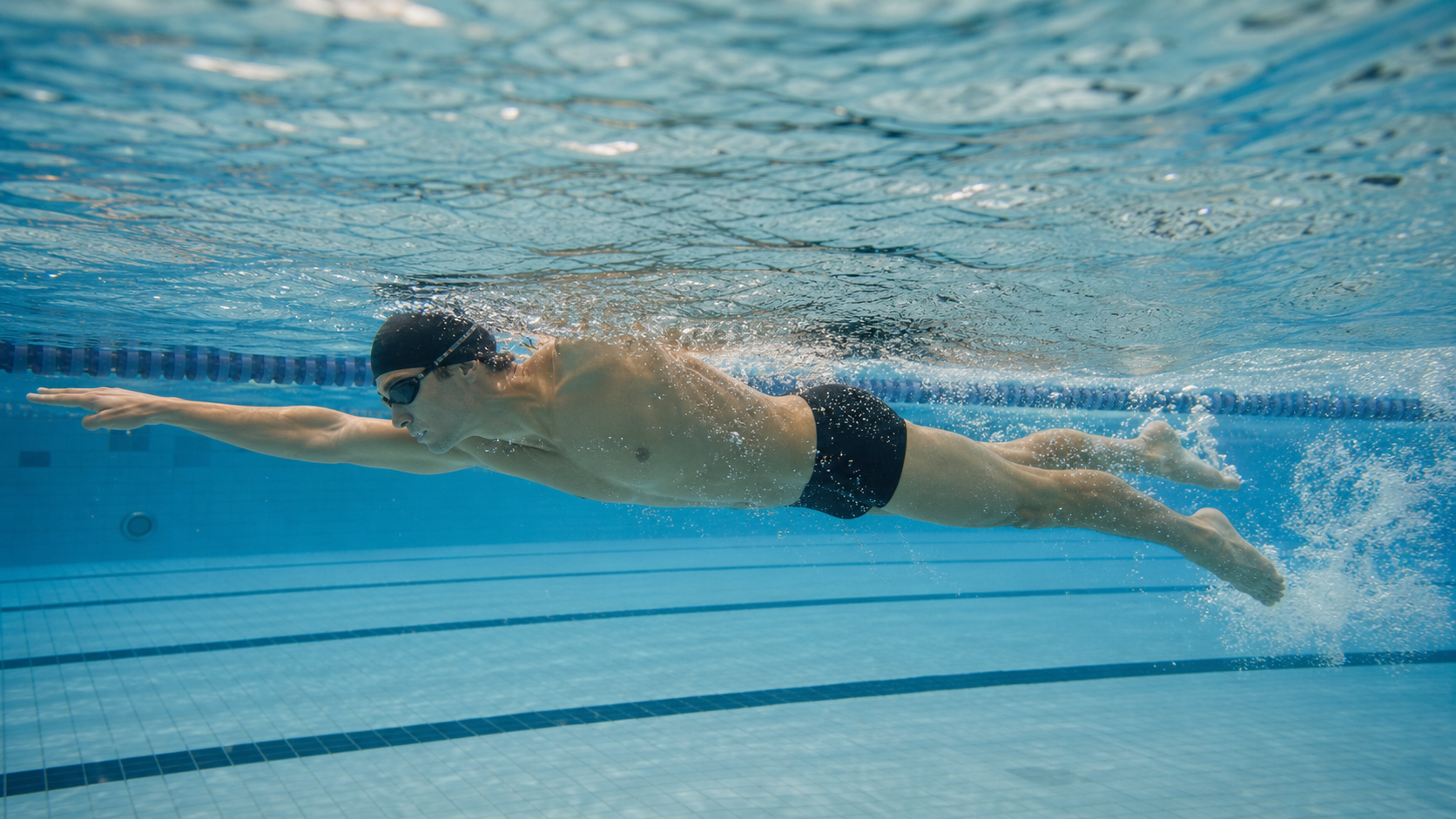
The flutter kick is a key source of propulsion in freestyle, and it also plays a major role in keeping the body horizontal in the water. Yet many swimmers find their hips and legs constantly sinking while kicking — they kick hard and end up with a lot of splash and tired legs, but no real improvement in propulsion. The root of this problem usually isn’t the legs themselves, but insufficient core activation.
Diagnosing Sinking Hips
How do you know if you have a sinking-hips problem? Here are the common signs:
| Sign | Explanation |
|---|---|
| Kicking creates a lot of splash | The kick’s range of motion is too large, with the feet breaking the surface and slapping |
| Getting more tired without getting faster | A lot of energy is spent “lifting” the legs instead of driving the body forward |
| Legs feel sore after 100 meters | The front of the thighs and the calves are absorbing too much vertical load |
| Underwater video shows the legs lower than the head | The body forms a visible downward slope |
Analyzing the Causes of Sinking Hips
Core Muscles Not Activated
The core muscles (transverse abdominis, multifidus, and pelvic floor) are responsible for maintaining trunk rigidity and lumbar spine position. When these muscles aren’t properly activated, the lumbar spine over-arches (the lower back sags), and the hips naturally sink. This is the most fundamental cause.
Head Position Too High
As discussed elsewhere, the head acts as the body’s lever fulcrum. When the head is lifted, the hips and legs naturally sink — even a strong core has trouble fighting against this leverage physics.
Kicking from the Knee Instead of the Hip
A correct kick should originate from the hip joint, with the thigh driving the lower leg in a whip-like motion. Many beginners kick primarily from the knee, and this repeated bending of the leg increases drag and fails to transfer force efficiently.
Stiff Ankles
When ankle mobility is insufficient, the top of the foot cannot fully extend (plantar flexion), which sharply reduces kicking efficiency. Swimmers with stiff ankles are often described as “kicking as if wearing boots.”
Core-Activation Drills (On Land)
Drill 1: Diaphragmatic Breathing Activation
Lie on your back with knees bent and the abdomen relaxed. Let your belly naturally expand as you inhale, then gently draw your navel toward your spine as you exhale (without holding your breath). This sensation of activating the transverse abdominis is exactly the core stability foundation needed for swimming. Practice for 10 minutes daily.
Drill 2: Dead Bug
Lie on your back with your arms extended toward the ceiling and your knees bent at 90 degrees, lifted off the floor. Keeping the core engaged, slowly extend your right arm overhead and your left leg forward at the same time, hold for 5 seconds, then return and switch sides. This exercise mimics the coordination of opposite limbs used in swimming, while strengthening core stability.
Drill 3: Prone Swimming Simulation (Superman Variation)
Lie face down with your arms extended forward and your abdomen slightly lifted off the ground (core engaged). Alternately raise opposite arm and leg, mimicking the coordination pattern of freestyle stroke and kick. Avoid letting the lower back over-arch.
Core-Activation Drills (In the Water)
Drill 1: Streamline Kicking (Core-First)
With both arms extended forward in a streamline position, kick with the sensation of initiating the movement “from the hips.” The focus isn’t on how wide the legs swing, but on keeping the lower back flat. Imagine a taut cord running through your abdomen, pulling your lumbar spine straight and up.
Drill 2: Wall-Supported Kicking
Hold onto the pool edge with your face down and practice kicking. Without the pressure of moving forward, you can focus on sensing: Is your lower back staying flat? Are your legs staying in line with your lower back? Are your ankles relaxed and fully extended while kicking?
Drill 3: Side Kick
Lie on your side in the water (with the lower arm extended forward and the upper arm resting along the body), and kick forward in this side-lying position. This position helps you feel the relationship between your body’s horizontal line and the kick, and is one of the drills most recommended by coaches for developing core awareness.
Practical Tips
- Land first, then water: Before starting in-water practice, first confirm the sensation of core activation on land, then bring that same sensation into the water.
- Daily ankle stretching: Squat down so the top of your foot presses toward the floor, gently pressing your knee down, holding for 30 seconds each time to improve ankle mobility.
- Warm up before swimming: During your in-water warm-up, do 100–200 meters of streamline kicking first to reawaken the sensation of core activation.
- Avoid over-relying on the kick: Don’t try to make up for speed by kicking harder — solve the underlying posture issue first, and let the kick simply maintain body balance.
Conclusion
Sinking hips result from a combination of factors, but core muscle activation is the most critical solution. Through on-land drills like the dead bug and prone swimming simulation, along with in-water side kicking, swimmers can gradually build accurate body-position awareness. Remember: good swimming posture isn’t achieved by “muscling through” — it’s maintained through correct activation.
Related Reading
2016/05/13 單車 冷水坑下滑
10 年前
一日北高常見問題大集合 | 攻略 | 路線 | 訓練 | 補給 | 自行車 單車 | 一日雙城 | 雙塔 | TWB北高360 | 屁股痛
6 年前
一日北高/長距離團騎 常見問題補充篇 / 組團或跟團的眉角 / 壯車友容易被瘦車友慢性拉爆 / 原來屁股痛可能是這個原因...? / 風場配速法 / 公路車 / CT Yeh
2 年前
CT 喇低賽) 單車 比賽總是沒照片? 攝影師的觀點大公開 姿勢就是力量! 請加速1.25倍收看
7 年前
單車 梅山36灣 坡度介紹 路段介紹 空拍 (相關遊記影片,請參考說明或我的頻道喔,歡迎訂閱)
6 年前
下次拍照前要查清楚啦🤣 #cycling
7 個月前
CT 喇低賽) 武嶺牽車 才是王道 西進牽車四小時內秘訣 攝手位置 如何判斷 防抽筋小秘訣
7 年前
西進武嶺 免費訓練分析服務 Intervals | 練不夠還是練過頭?你哪一種類型選手?AI模型告訴你! | 備戰神器 | 公路車 訓練 | CT Yeh
4 年前