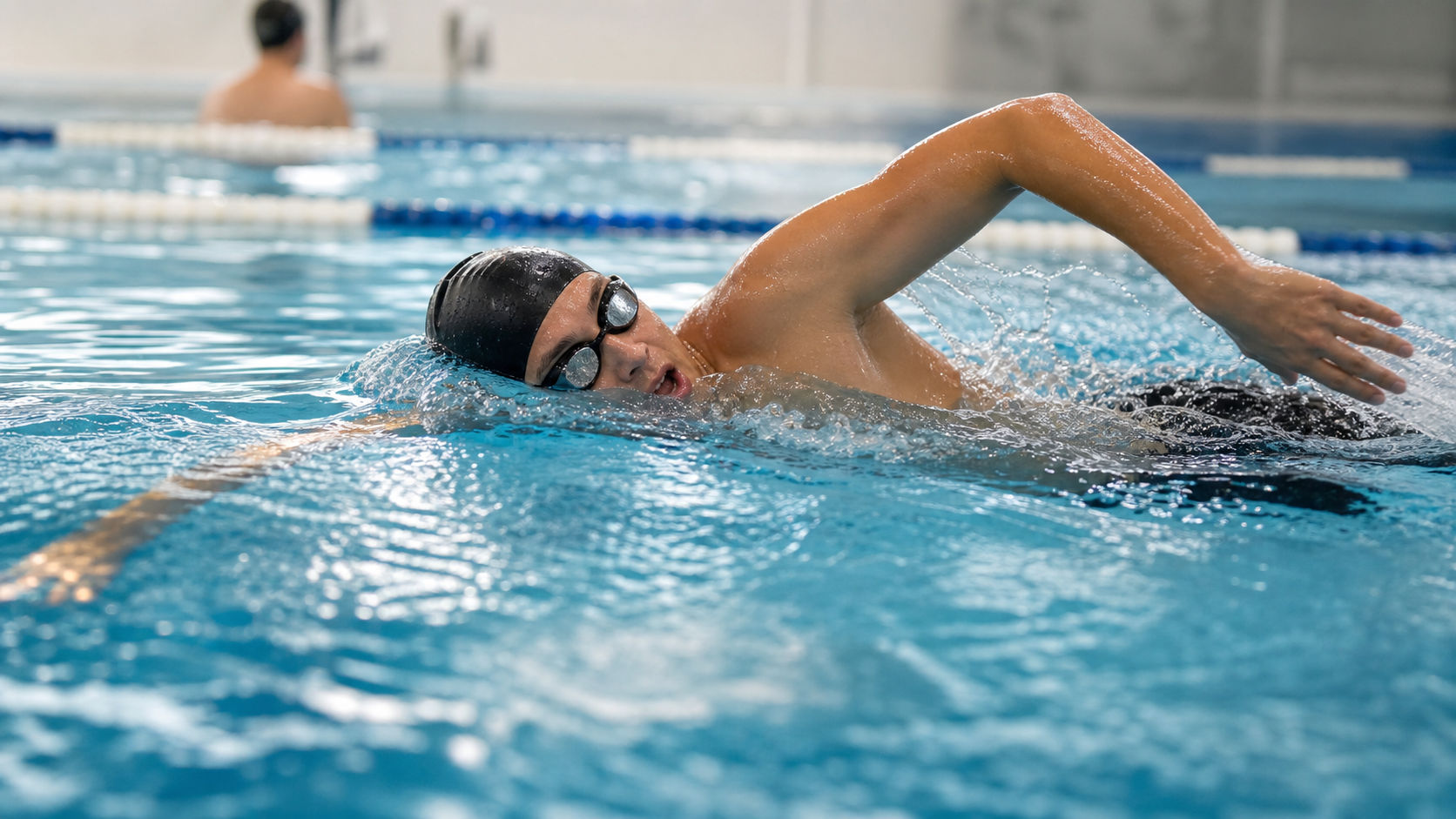
Introduction
Breathing is one of the most technically demanding aspects of freestyle. Many swimmers roll their bodies excessively when breathing, breaking their streamline and even causing the entire stroke to fall apart. More commonly, because swimmers habitually breathe to one side, the technical quality on each side develops unevenly, ultimately affecting overall speed and energy distribution. This article will explore the causes of excessive body roll and provide a systematic training approach for bilateral breathing.
What Is “Excessive Roll”?
Body roll in freestyle is a normal and necessary technical movement, with an ideal roll angle of approximately 30-45 degrees (measured from the horizontal plane). Exceeding this range—especially rolling past 70 degrees when breathing—enters the realm of “excessive roll.”
| Item | Normal Roll | Excessive Roll |
|---|---|---|
| Roll angle | 30-45 degrees | 70 degrees or more |
| Breathing method | Mouth clears the water at the side of the body | Entire face turns upward |
| Opposite arm | Maintains forward extension after entry | Sculls outward or sinks |
| Stroke rhythm | Remains steady | Noticeable pause |
Causes of Excessive Roll
Compensation from Breathing Anxiety
Worried about not getting enough air, swimmers try to get their mouths as far from the water as possible, which naturally triggers excessive roll. This is the most common psychological cause.
Insufficient Core and Hip Control
When the core is weak, the rotational movement triggered by breathing becomes “uncontrolled”—the body doesn’t just rotate at the shoulders; the hips and legs follow with a large roll as well.
Solidified One-Sided Breathing Habits
Swimmers who have long trained breathing to only one side often become overly dependent on that side, making each breathing motion more exaggerated than necessary to ensure they “safely get air.”
Consequences of Excessive Roll
- Opposite arm entry drifts off course: When the body rolls heavily toward the breathing side, the opposite hand’s entry position easily deviates from the correct track.
- Reduced kicking efficiency: When the body rolls excessively, the feet follow the sideways rotation, dispersing kicking power.
- Disrupted speed and rhythm: Excessive roll creates a noticeable pause, breaking the overall stroke rhythm.
Bilateral Breathing Training Plan
Why Do You Need Bilateral Breathing?
Bilateral breathing means breathing every three strokes (the 3-1-3 pattern), allowing the body to alternate breathing to both sides. Benefits include:
- Forcing balanced technical development on both sides, eliminating left-right asymmetry
- Limiting breathing frequency, preventing the technical looseness that comes from “breathing becoming a habitual action”
- Making it easier to read opponents’ movements during races
Step 1: Slow One-Sided Confirmation
Start on your preferred breathing side, deliberately slowing down the stroke to confirm that your roll angle is moderate when breathing (the side of your body faces up, not your entire face). Use video to confirm before moving to the next step.
Step 2: Non-Dominant Side Practice
Switch to the unfamiliar breathing side and practice slowly at the same pace. Initially, it may feel very awkward, and you might even fail to get air. This is normal. The key points are:
- Keep the head rotation angle consistent with your dominant side
- Return the head to the water immediately after breathing; don’t linger at the surface
- Accept occasional water intake early on—it’s part of the learning process
Step 3: 3-Stroke, 1-Breath Drill
The formal bilateral breathing drill: take 3 strokes, then 1 breath, alternating sides. It’s recommended to start with this pattern for the first 200 meters of each session, then expand the proportion once you’ve adapted.
Practice Recommendation Table
| Week | Bilateral Breathing Proportion | Focus |
|---|---|---|
| Weeks 1-2 | First 200m of practice | Adapt to the non-dominant side |
| Weeks 3-4 | 50% of each session | Build bilateral coordination |
| Weeks 5-6 | 80% or more | Solidify the bilateral habit |
Core Techniques for Correcting Excessive Roll
- “Bite the water” technique: At the moment your mouth opens to breathe, imagine there is always a bit of water at the corner of your mouth (meaning your mouth hasn’t lifted too far from the surface), controlling the roll amplitude.
- Eyes look sideways when breathing: When breathing, direct your gaze toward the side wall of the pool, not toward the ceiling. Gaze direction is the most intuitive cue for roll angle.
- Stabilize the opposite arm’s extension: When breathing, the opposite (non-breathing) arm maintains forward extension and doesn’t start the pull too early. This “anchor point” helps the body control the roll angle.
Practical Advice
- Practice bilateral breathing at least twice a week: A one-off session won’t change long-term habits; consistent accumulation is required.
- Start with short distances: Practicing 25-meter repeats maintains movement quality better than swimming longer distances.
- Combine with core training: Do land-based core strengthening (see the previous article) in parallel to fundamentally improve rotational control.
- You can return to your dominant side for races: Bilateral breathing during training is a technical tool; in competition, decide your breathing rhythm based on actual needs.
Conclusion
Excessive roll when breathing and establishing a bilateral breathing habit are key milestones in advancing freestyle technique. Through systematic bilateral training, you can not only correct the roll problem but also develop balanced technique on both sides, laying a solid foundation for long-distance racing. Starting today, give yourself six weeks to seriously practice bilateral breathing, and you’ll discover a whole new side to your freestyle.
Related Reading
- Freestyle Flip-Turn Breathing: Breathing-Side Deflection Angle and Drag-Minimization Technique
- Head Movement in Breathing: The Destructive Impact of Lifting the Head Too High
- Freestyle Breathing Technique: Bilateral Breathing Training Methods and Race Applications
- Learning Bilateral Breathing in Freestyle: Methods, Pros, and Cons
如何把 GoPro 影片 翻轉 批次 轉正?
6 年前
#公路車 #Vo2Max #最大攝氧量 測驗 體驗 | 心肺測試
6 年前
一日北高/長距離團騎 常見問題補充篇 / 組團或跟團的眉角 / 壯車友容易被瘦車友慢性拉爆 / 原來屁股痛可能是這個原因...? / 風場配速法 / 公路車 / CT Yeh
2 年前
[教學] Premiere 影片 手震 修正 教學 防抖 單眼 影像 GoPro 穩定 Video Stabilization
8 年前
碟煞公路車 銑面器 !? 原來銑完差這麼多! 降低蹭碟機率! | TIME 公路車 保養小記錄 | CT Yeh
3 年前
風櫃嘴 衝刺慢動作回放!
8 年前
戰略) Zwift Race 如何咬在第一集團 如何評估自己要開多少推力 (請開1.5倍速看)
7 年前
一日北高前的西濱集訓 | 跟著11小時軍團 | 300W踩不動的大逆風 | 輪車破風差幾瓦?
6 年前