Swimming's Benefits for Chronic Diseases: Aquatic Exercise Prescriptions for Diabetes and Hypertension Patients
Introduction
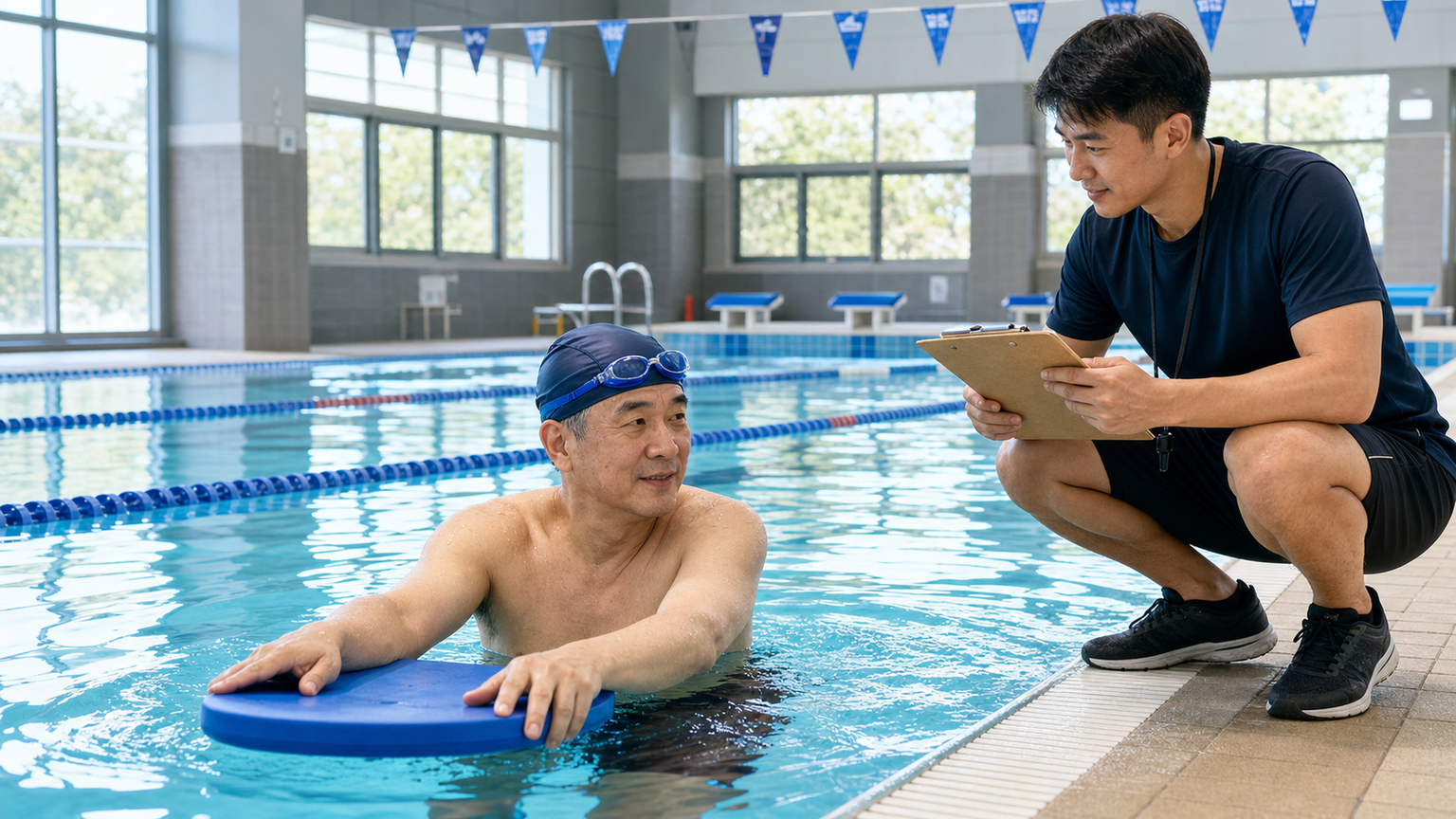
Chronic disease management has long relied on medication, but a growing body of clinical evidence shows that regular aerobic exercise can serve as an effective complement to “Exercise is Medicine.” Because swimming is performed in water, the impact on joints is far lower than running or weight training, yet it simultaneously improves cardiorespiratory endurance and burns calories, making it especially suitable for patients with type 2 diabetes and hypertension. Data from Taiwan’s Ministry of Health and Welfare shows that the domestic prevalence of diabetes exceeds 10%, and hypertensive patients number more than 5 million. How to provide safe and effective aquatic exercise prescriptions for these two major populations is an important topic in sports medicine.
Benefits of Swimming for Diabetes
One of the core problems in type 2 diabetes is insulin resistance, where skeletal muscle efficiency in glucose uptake declines. Swimming is a moderate-intensity aerobic exercise that activates GLUT-4 (glucose transporter) translocation to the cell membrane, promoting muscle glucose absorption independent of insulin. Studies indicate that moderate-intensity aquatic aerobic exercise performed three or more times per week can significantly reduce glycated hemoglobin (HbA1c) by 0.5–1.0%, an effect comparable to land-based aerobic exercise. However, for patients with peripheral neuropathy or foot ulcers, the aquatic environment can prevent worsening of wounds.
Types of aquatic exercise suitable for diabetic patients:
- Aqua walking: Water depth up to the waist; suitable for beginners, with controllable intensity
- Aqua aerobics: Using buoyancy bars or kickboards; heart rate can reach the target zone
- Slow freestyle swimming: Engages the whole body’s muscle groups; 20–40 minutes per session is recommended
- Interval swimming: 25-meter sprints followed by 30 seconds of rest, repeated for 6–10 sets; can improve carbohydrate metabolism efficiency
| Exercise Type | Intensity | Recommended Frequency | Precautions |
|---|---|---|---|
| Aqua walking | Low–moderate | 4–5 times per week | Check blood glucose before exercise |
| Aqua aerobics class | Moderate | 3 times per week | Carry candy as backup |
| Slow freestyle swimming | Moderate | 3 times per week | Pay attention to foot protection |
| Swim interval training | Moderate–high | 2 times per week | Requires physician evaluation |
Benefits of Swimming for Hypertension
Water pressure exerts a physical compressive effect on the venous system, promoting peripheral blood return and helping reduce peripheral vascular resistance. Regular long-term swimming can lower resting systolic blood pressure by 5–10 mmHg and diastolic blood pressure by 3–7 mmHg. Although the magnitude is less than that of medication, it can serve as the core of lifestyle intervention. Notably, cold water (below 26°C) may induce vasoconstriction and transiently raise blood pressure; hypertensive patients are advised to choose indoor heated pools with water temperatures of 28–32°C, and to adapt by entering the water slowly.
Hypertensive patients should avoid breath-holding breaststroke kicks or breath-hold diving, as the Valsalva maneuver can transiently and sharply increase intrathoracic pressure and blood pressure, raising the risk of cardiovascular events.
Framework for Aquatic Exercise Prescriptions in Chronic Disease Patients
According to the American College of Sports Medicine (ACSM) recommendations, aquatic exercise prescriptions for chronic disease patients should follow the FITT principle:
- Frequency: 3–5 times per week
- Intensity: Target heart rate at 50–70% of maximum heart rate (moderate intensity); can be assessed using the “talk test”—able to speak in full sentences but with slight effort
- Time: 20–45 minutes per session; beginners start with 15 minutes and gradually extend
- Type: Continuous aerobic swimming, aqua aerobics, or interval swimming
Practical Recommendations
- Check blood glucose before exercise: Diabetic patients should confirm blood glucose is between 120–200 mg/dL before entering the water; if blood glucose is below 100 mg/dL, consume carbohydrates first before exercising
- Carry fast-acting sugar sources: Keep glucose tablets or juice boxes at poolside to handle emergency hypoglycemia in the water
- Choose an indoor heated pool: Water temperature of 28–32°C to avoid cold-water-induced vasospasm
- Hypertensive patients should avoid breath-holding maneuvers: Maintain a normal breathing rhythm throughout; do not perform breath-hold diving
- Discuss medication timing with your physician: Some antihypertensive drugs (such as beta-blockers) lower maximum heart rate, requiring recalculation of the target heart rate zone
- Regular monitoring: Follow up every 3 months to recheck HbA1c and blood pressure, and evaluate the effectiveness of the exercise intervention
Conclusion
As an adjunctive therapeutic tool for chronic diseases, swimming combines whole-body aerobic benefits with the safety advantage of low impact. Through structured aquatic exercise prescriptions, diabetic and hypertensive patients can not only improve metabolic markers but also enhance cardiorespiratory fitness and quality of life. Public swimming pools are abundant across Taiwan’s cities and counties. Patients are encouraged, after evaluation by their primary physician, to actively incorporate swimming into their chronic disease management plan—making the “pool” another kind of clinic.
Related Reading
- Benefits of Swimming for Chronic Diseases: Aquatic Exercise for Hypertensive and Diabetic Patients
- Swimming and Diabetes Management: Aquatic Exercise Prescriptions for Blood Glucose Control
- Swimming Prescriptions for Diabetic Patients: Safe Ranges for Blood Glucose Control and Exercise Intensity
- Risk of Post-Swim Hypoglycemia: A Guide to Blood Glucose Monitoring During Aquatic Exercise for Diabetic Patients
CT暗黑廚房) 車友必備 宇宙無敵鮮蚵湯 幫助訓練恢復 天然食補 好市多 超肥鮮蚵 破PR
7 年前
#PUSHBIKE 原來這麼好玩! 小朋友 滑步車 初體驗 超可愛
6 年前
一日北高常見問題大集合 | 攻略 | 路線 | 訓練 | 補給 | 自行車 單車 | 一日雙城 | 雙塔 | TWB北高360 | 屁股痛
6 年前
靠單車減肥35公斤 心得分享與整理
7 年前
4K 東眼山 x 水蜜桃冰沙 百人單車約騎! 操完再吃冰 多爽快
7 年前
白沙屯媽祖進香在家走!UREVO 坡度自調走步機 / 可連接訓練遊戲APP MyWhoosh / 邊看直播邊走起來 / CT Yeh
11 個月前
[教學] Premiere 影片 手震 修正 教學 防抖 單眼 影像 GoPro 穩定 Video Stabilization
8 年前
台北大雁西飛 約騎挑戰 feat. Doris | 公路車 | CT Yeh
3 年前