Swimming and Lumbar Spine Protection: Swimming Posture Recommendations for People with Spinal Conditions
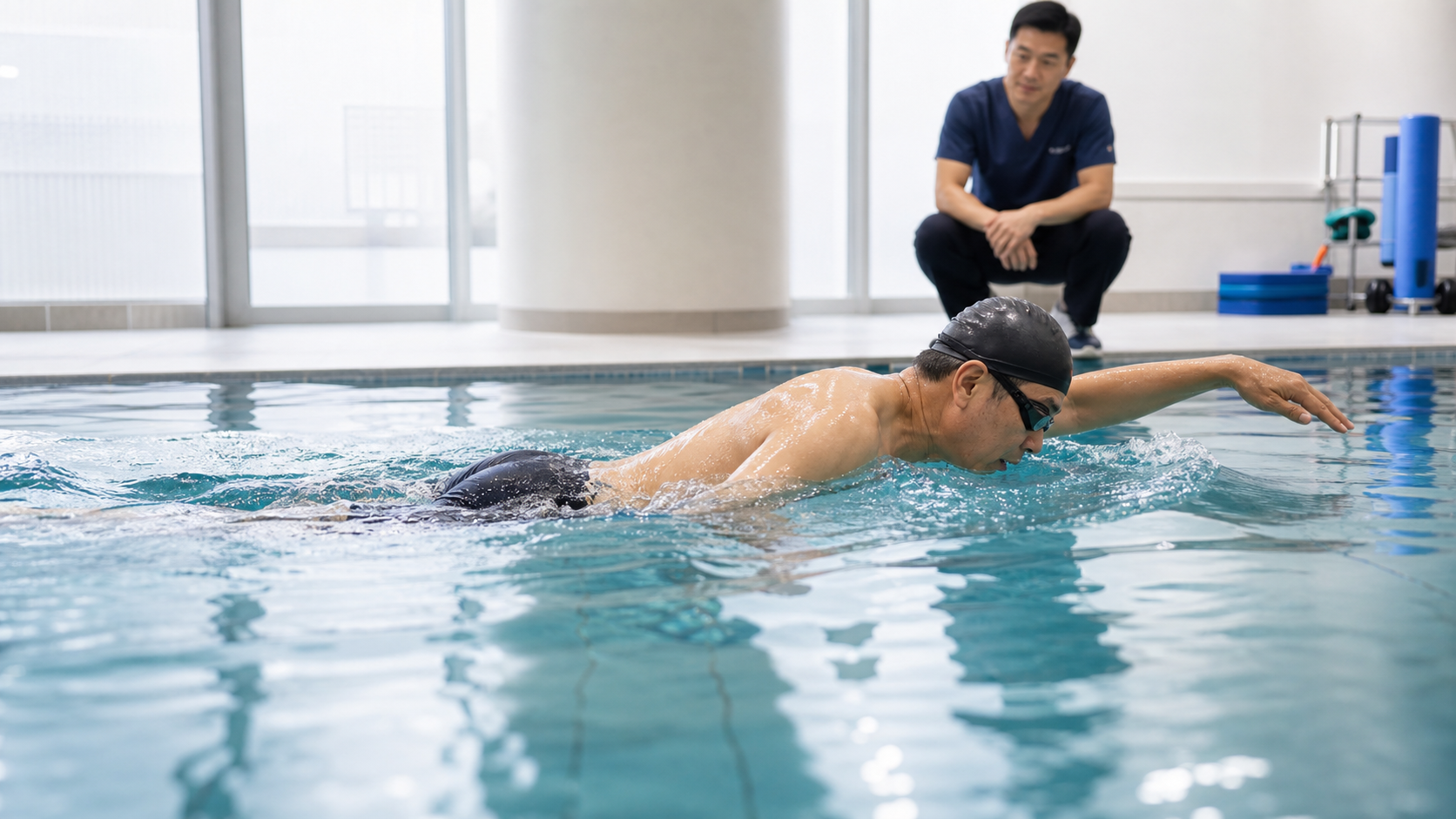
Introduction
Lumbar spine disorders are among the most common musculoskeletal problems in Taiwan. Epidemiological surveys show that at least 80% of adults will experience lower back pain at some point in their lives. From lumbar disc herniation and spinal stenosis to degenerative disc disease, these conditions often make patients reluctant to exercise. Properly designed water-based exercise, however, not only avoids harming the spine but can strengthen the paraspinal muscles and improve core stability, making it an important tool for spinal rehabilitation. Buoyancy in water can reduce effective body weight to as little as 10% of its weight on land (when immersed to the neck), substantially lowering the axial load on the intervertebral discs and giving patients who cannot exercise on land a chance to move safely in the water.
Comparing How Different Strokes Affect the Lumbar Spine
Different swimming strokes place very different types of stress on the lumbar spine, so people with spinal conditions must carefully evaluate which stroke to choose:
| Stroke | Lumbar Motion | Suitable For | Contraindications |
|---|---|---|---|
| Freestyle (Front Crawl) | Moderate rotation, mild extension | Most lumbar conditions | Severe lumbar instability |
| Backstroke | Natural neutral position, mild extension | Lumbar disc herniation | Cervical spine issues |
| Breaststroke | Strong lumbar extension, hip abduction | Mild degeneration | Spinal stenosis, disc herniation |
| Butterfly | Large-amplitude lumbar undulation | Healthy swimmers | Almost all lumbar conditions |
Breaststroke requires the most caution for people with lumbar conditions. The whip-kick motion demands significant lumbar hyperextension, which is particularly unfavorable for patients with spinal stenosis and may aggravate sciatic nerve symptoms. Butterfly, with its full-body undulating motion, subjects the lumbar spine to repeated flexion-extension shear forces and is generally not recommended for anyone with a spinal condition.
Principles of Lumbar-Protective Swimming Posture
For people with spinal conditions, correcting swimming posture matters more than choosing a particular stroke. The following core principles apply across all strokes:
Core Activation
Maintain a light, continuous contraction of the transverse abdominis while swimming (imagine drawing the navel toward the spine). This stabilizes the lumbar spine and prevents excessive anterior curvature. Many patients relax too much in the water and lose core tension, leaving the lumbar spine in a vulnerable arched position.
Head Position Management
When breathing during freestyle, avoid lifting the head too high, as this causes the lumbar spine to over-extend as well. It is recommended to use side breathing with head rotation kept within 45 degrees, or to use a snorkel to keep the face down at all times, eliminating head and neck movement during breathing entirely.
Controlling Kick Amplitude
An overly wide freestyle flutter kick (wider than body width) increases rotational torque on the lumbar spine. People with spinal conditions should keep kick amplitude within hip width and use short, quick kicks.
Using Assistive Equipment
- Pull buoy (placed between the thighs): stabilizes the hips and lets you focus on the upper-body pull, eliminating the impact of kicking on the lumbar spine
- Kickboard: people with spinal conditions should avoid using a kickboard for breaststroke kick drills, as the kickboard forces sustained lumbar extension
- Pool noodle: can support the lower back during water walking, suitable for early post-surgical rehabilitation
Guidance on Returning to Swimming After Spinal Surgery
- Lumbar discectomy (disc removal): water walking may begin 6–8 weeks after surgery; after 12 weeks, a doctor can assess whether slow freestyle or backstroke is appropriate
- Lumbar fusion (spinal stabilization): entering the water requires clearance from a rehabilitation physician 3–6 months after surgery, and breaststroke and butterfly should be avoided permanently
- After epidural injection: avoid swimming for 48 hours to prevent infection
Practical Recommendations
- Pre-swim consultation: before swimming, be sure your orthopedic surgeon or neurosurgeon reviews your imaging results and confirms which strokes are appropriate for you
- Start with water walking: people with spinal conditions are advised to walk in waist-deep water for 2–4 weeks before attempting to swim
- Never dive into the pool: the impact of diving can cause acute disc injury; enter the water gradually via the pool steps
- Prioritize backstroke: most people with lumbar disc herniation find backstroke the most comfortable and can use it as their primary training stroke
- Post-swim stretching: after swimming, perform a supine knee-to-chest stretch for 2–3 minutes to relieve tension in the lower back muscles
- Stop at the first sign of pain: if you experience leg numbness, radiating pain, or a stabbing sensation in the lower back while swimming, exit the water immediately and seek medical attention
Conclusion
The protective benefit of swimming for the lumbar spine depends on “correct posture” combined with “an appropriate stroke.” Swimming without guidance is not only ineffective — breaststroke and butterfly can even worsen a spinal condition. Through professional evaluation from sports medicine, proper posture training, and a gradual water-based rehabilitation plan, people with spinal conditions can find a way to exercise in the pool that balances safety and benefit, gradually rebuilding core strength and improving quality of life.
Related Reading
- Scoliosis and Swimming: How Aquatic Spinal Decompression Supports Scoliosis Correction
- How Swimming Improves Chronic Back Pain, and Precautions to Take
- Relieving Chronic Back Pain Through Swimming: An Aquatic Approach to Spinal Decompression and Core Strengthening
- Swimming and Joint Protection: The Best Choice for Low-Impact Exercise
[教學] Premiere 影片 手震 修正 教學 防抖 單眼 影像 GoPro 穩定 Video Stabilization
8 年前
CT 喇低賽) 武嶺牽車 才是王道 西進牽車四小時內秘訣 攝手位置 如何判斷 防抽筋小秘訣
7 年前
一日北高/長距離團騎 常見問題補充篇 / 組團或跟團的眉角 / 壯車友容易被瘦車友慢性拉爆 / 原來屁股痛可能是這個原因...? / 風場配速法 / 公路車 / CT Yeh
2 年前
靠單車減肥35公斤 心得分享與整理
7 年前
一日北高常見問題大集合 | 攻略 | 路線 | 訓練 | 補給 | 自行車 單車 | 一日雙城 | 雙塔 | TWB北高360 | 屁股痛
6 年前
抖肩舞 台灣x日本交流版 (台灣 vs 前橋) 赤城山登山賽 coincidance
8 年前
Never Stop 西進武嶺 前後雙機 完整全程錄影 訓練台 實境
8 年前
滑雪新手們慘摔學習全紀錄(請開字幕),滑雪好好玩 | Snowboard + Ski | 岩原 スキー場 | 滑雪APP使用 | GoPro Max
6 年前