Swimming and Asthma: The Impact of Chlorinated Water Environments on the Respiratory Tract and Coping Strategies
Introduction
Swimming has long been regarded by the medical community as an asthma-friendly exercise. Its warm, humid air environment is less likely to trigger bronchospasm compared to cold, dry air, and the full-body aerobic training can strengthen respiratory muscles and increase lung capacity. Many asthma patients do experience symptom improvement after swimming training. However, research over the past two decades has begun to focus on the other side of indoor pools: the cumulative irritation to the respiratory mucosa caused by chlorination byproducts (CBPs), which poses a health risk that cannot be ignored, especially for competitive swimmers and long-term indoor swimmers. Indoor swimming pools in Taiwan are used with extremely high frequency during the summer, making it particularly important for the local swimming community to understand this issue.
Generation and Types of Chlorination Byproducts
When pools are disinfected with chlorine (hypochlorous acid or dichloroisocyanuric acid), the chlorine reacts with organic matter brought in by swimmers (sweat, urine, sebum, hair, sunscreen), generating byproducts such as trihalomethanes (THMs), haloacetic acids, and trichloramine (NCl₃).
Among these, trichloramine is the substance with the most direct impact on the respiratory tract. It volatilizes from the water into the air layer above the pool, producing a pungent odor (the characteristic “chlorine smell” of swimming pools actually comes primarily from trichloramine rather than chlorine itself), and can irritate the conjunctiva of the eyes and the mucosa of the upper respiratory tract. Studies have shown that long-term exposure to high concentrations of trichloramine can increase airway epithelial permeability, inducing or aggravating airway hyperresponsiveness.
| Byproduct | Source | Main Hazard | Exposure Route |
|---|---|---|---|
| Trichloramine | Chlorine + nitrogen-containing organic matter | Respiratory irritation, airway hyperresponsiveness | Inhalation |
| Trihalomethanes | Chlorine + organic carbon | Long-term carcinogenic concerns | Inhalation, dermal absorption |
| Haloacetic acids | Chlorine + organic carbon | Skin irritation | Dermal contact, inhalation |
| Dichloramine | Chlorine + organic nitrogen | Eye and mucosal irritation | Inhalation |
Mechanisms of Swimming-Induced Asthma
Asthma patients may experience “Exercise-Induced Bronchoconstriction (EIB)” while swimming, with triggering factors including:
- Inhalation of chlorination byproducts: Trichloramine directly damages the airway epithelium, inducing inflammatory responses
- Hyperventilation: Increased breathing volume during high-intensity swimming leads to inhalation of large amounts of air containing byproducts
- Water aspiration: Small amounts of water entering the trachea trigger reflex bronchospasm
- Cold water stimulation: When water temperature is below 26°C, inhaled cold air can induce airway constriction
Research has found that the prevalence of asthma among competitive swimmers (approximately 15–20%) is significantly higher than that of the general population (approximately 8–10%), and a considerable proportion of these cases were diagnosed only after beginning systematic swimming training, indicating an association between long-term chlorinated water exposure and airway sensitization.
Coping Strategies for Safe Swimming
Pool Selection
- Prioritize outdoor swimming pools: Good outdoor ventilation prevents trichloramine accumulation
- Choose pools with saltwater electrolytic chlorination systems or UV-assisted disinfection: These reduce chemical additives and lower byproduct generation
- Observe the pool air: If you strongly detect a pungent chlorine smell, it indicates elevated trichloramine levels—choose a different time slot or venue
Personal Protective Measures
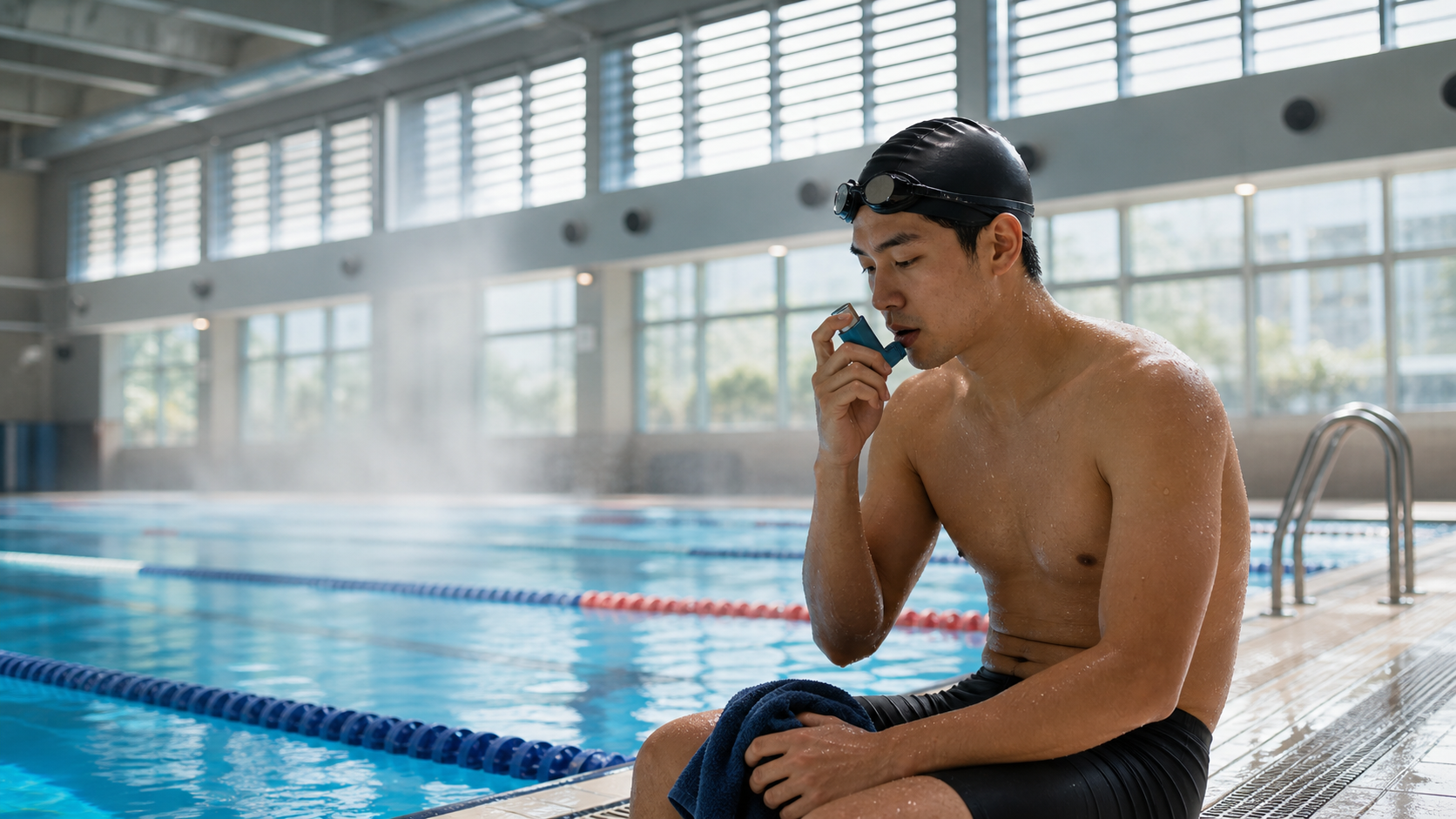
- Medication management: Asthma patients should use a short-acting bronchodilator (such as salbutamol) 15–20 minutes before swimming to prevent EIB episodes
- Adequate warm-up: Perform 10 minutes of land-based aerobic warm-up before entering the water to reduce cold air irritation to the airways
- Intensity control: Avoid sudden high-intensity swimming; start at low-to-moderate intensity to allow the airways to gradually adapt
- Swim cap and goggles: Goggles protect the conjunctiva; although they cannot directly protect the respiratory tract, they reduce overall irritation
Practical Recommendations
- Inform the lifeguard: Asthma patients should inform the on-duty lifeguard of their condition before entering the water for emergency response purposes
- Carry an inhaler at all times: Rescue inhalers should be placed within easy reach at poolside, not locked in a locker
- Avoid swimming on an empty stomach: Exercising on an empty stomach can lower blood sugar, indirectly increasing the burden on the respiratory system
- Choose off-peak hours: When fewer people are present, nitrogen-containing organic matter in the pool is lower, resulting in lower byproduct concentrations
- Shower before swimming: Showering before entering the water removes sunscreen and sweat from the skin surface, reducing sources of byproduct generation
- Regular pulmonary function monitoring: Asthma patients who swim long-term are advised to undergo annual pulmonary function testing (FEV1/FVC) to monitor airway status
Conclusion
Swimming offers both benefits and risks for asthma. Moderate aquatic aerobic training can indeed help improve respiratory control and enhance lung function; however, long-term swimming in indoor pool environments with high concentrations of chlorination byproducts may cause cumulative damage to the airways. The key lies in the dual safeguards of “environmental selection” and “medication management.” Asthma patients should develop a swimming plan under the collaborative assessment of a pulmonologist and a sports medicine specialist—neither abandoning the sport out of fear, nor neglecting potential risks out of overconfidence.
Related Reading
- Swimming and the Respiratory System: Research on the Long-Term Effects of Chlorine Exposure on the Lungs
- The Scientific Impact of Swimming on Lung Function and Asthma
- Swimming and Respiratory Health: Special Considerations for Aquatic Exercise in Asthma Patients
- Pool Water Quality Management: The Impact of Chlorine Concentration on Skin, Eyes, and Hair and Protection Strategies
2023桃園團體繞圈賽 / 海鷗繞圈賽 | 全程空拍數據版 | 公路車 | CT Yeh
2 年前
CT暗黑廚房) 車友必備 宇宙無敵鮮蚵湯 幫助訓練恢復 天然食補 好市多 超肥鮮蚵 破PR
7 年前
一日北高/長距離團騎 常見問題補充篇 / 組團或跟團的眉角 / 壯車友容易被瘦車友慢性拉爆 / 原來屁股痛可能是這個原因...? / 風場配速法 / 公路車 / CT Yeh
2 年前
洗單車神器 吹水機! 實際洗車用用看 暴力洗鍊條大法 | 公路車 | CT Yeh
4 年前
[防寒衣體驗] 鐵人魂 三鐵 防寒衣試穿會 於松運 深水游泳池 鯨魚池
8 年前
#公路車 #Vo2Max #最大攝氧量 測驗 體驗 | 心肺測試
6 年前
3D 列印車褲墊 / 舒適改善? / 無痕 x 分區壓縮 / ATK & Decider系列 / JE22黑科技 / #公路車 #CTYEH
11 個月前
2025 海鷗團體繞圈賽 網路直播 超激烈裁判長視角 / EIPC 李廷威、Waypoint 等眾多高手競爭 / feat. 卡密兒主持 / 海鷗繞圈賽
9 個月前