Introduction
Swimming is one of the sports with the most significant impact on skin health. Unlike running or cycling, swimmers’ skin is continuously immersed in chlorinated, disinfected water for anywhere from 30 minutes to several hours. Chlorine and its derivative hypochlorous acid (HOCl), while effective at killing pathogens, are destructive to the skin’s natural protective barrier. For swimmers with underlying skin conditions such as atopic dermatitis (eczema), psoriasis, or rosacea, the impact is even more pronounced. Given Taiwan’s hot and humid climate and the high frequency of swimming in summer, understanding how to protect skin integrity during and after water-based exercise holds practical significance for the broader swimming community.
The Mechanisms of Chlorine Water’s Damage to Skin
Damage to the Skin Barrier
The outermost layer of healthy skin consists of lipids, natural moisturizing factors (NMF), and tightly connected epidermal cells that form the skin barrier. The effects of chlorine chemicals at the skin contact layer are as follows:
- Dissolving sebum lipids: Chlorine’s oxidizing properties can break down key lipids such as ceramides in the stratum corneum, reducing barrier integrity
- Altering skin pH: Healthy skin has a pH of 4.5–5.5 (slightly acidic); after contact with chlorinated water, it shifts toward neutral, disrupting the antimicrobial microenvironment
- Oxidizing proteins: Chlorine causes cross-linking reactions in keratin proteins, producing a rough texture on the skin surface
- Dehydration effect: NMF becomes ineffective due to chlorination, reducing the stratum corneum’s water-holding capacity and leaving skin dry and tight
Contact Irritation from Disinfection Byproducts
Beyond free chlorine, chloramine byproducts—particularly trichloramine and dichloramine—are even more irritating to the skin than free chlorine. Studies show they can trigger “non-immunologic contact urticaria,” presenting as transient erythema and urticaria-like changes after swimming.
| Skin Condition | Trigger | Symptoms |
|---|---|---|
| Chlorine water dermatitis | Prolonged contact with chlorinated compounds | Dryness, itching, peeling, erythema |
| Contact urticaria | Trichloramine byproducts | Rash and transient welts appearing immediately after swimming |
| Swimming pool granuloma | Mycobacterial infection | Chronic granulomatous lesions on fingers/knees |
| Molluscum contagiosum | Contagious virus | Round, umbilicated small papules |
| Atopic dermatitis flare-up | Barrier disruption + chlorine irritation | Intense itching in existing eczema areas |
Swimming Impact by Skin Type
Normal skin: Post-swim dryness is the primary issue; with adequate moisturizing, most people can adapt to regular swimming.
Atopic dermatitis (eczema): Chlorine water may trigger acute flare-ups, though study results are mixed—some research shows that low-chlorine pools can reduce Staphylococcus aureus on the skin surface (an important trigger for AD patients), while high-chlorine or byproduct-rich environments clearly worsen the condition. It is recommended to discuss with your dermatologist before swimming, and immediate moisturizing afterward is essential.
Psoriasis: Low-intensity pool water contact may have a keratolytic (skin-softening) effect, but chlorine irritation can also induce the Koebner phenomenon, where new lesions appear at sites of skin irritation.
Seborrheic dermatitis: Chlorine water may disrupt the scalp’s sebum secretion balance, worsening scalp flaking.
Skin Care Protocols for Swimmers
Pre-Swim Protection
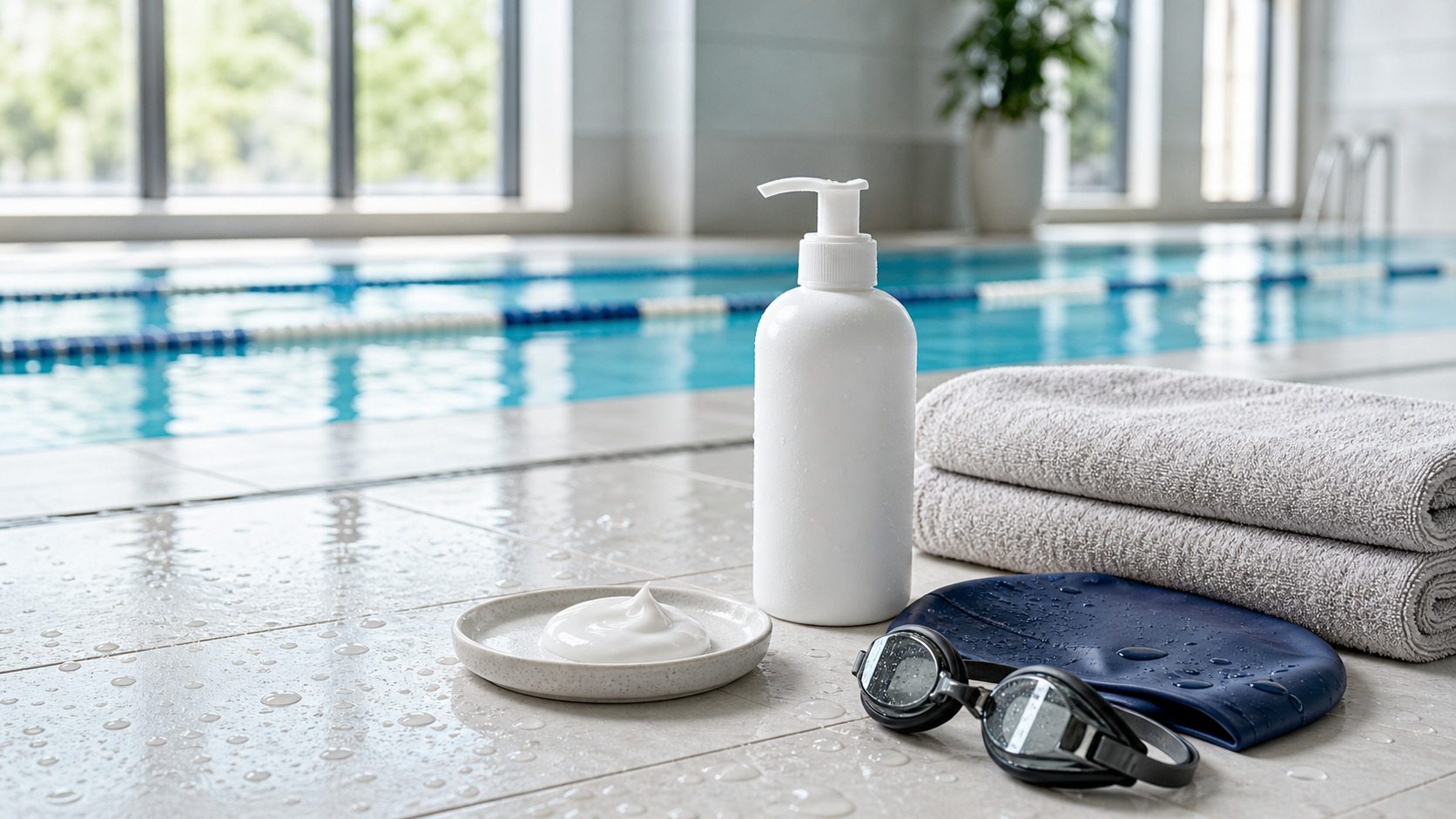
- Apply water-resistant lotion or petroleum jelly: Before swimming, apply a thin layer of water-resistant lotion (containing mineral oil or silicones) over the body to create a physical protective film, reducing direct chlorine-skin contact
- Avoid over-cleansing: Do not use strong soaps before swimming, as this can pre-damage the sebum barrier
- Shower to wet the skin: Shower before entering the pool; once skin is saturated with fresh water, it will absorb relatively less chlorinated pool water
Post-Swim Care
- Shower immediately: Rinse off with fresh water or a gentle body wash as soon as possible after swimming to shorten chlorine-skin contact time
- Gentle cleansing: Choose soap-free cleansers with a mildly acidic pH (pH 5–6) to avoid further damaging the skin barrier
- Moisturize immediately while skin is semi-dry: After patting dry with a towel while skin is still slightly damp, immediately apply a moisturizing lotion (preferably containing ceramides, hyaluronic acid, or glycerin) to lock in moisture
- Scalp care: Use a gentle, silicone-free shampoo and wash your hair immediately after swimming to prevent chlorine residue from damaging the scalp and hair quality
Practical Recommendations
- Atopic dermatitis patients should apply medication before swimming: Under a physician’s guidance, a thin layer of emollient or medicated ointment can be applied to affected areas before swimming as a protective layer
- Choose low-chlorine or saltwater pools: Some premium pools use saltwater electrolysis systems, which produce fewer chlorination byproducts and are less irritating to the skin
- Avoid swimming right after chemicals are added: Chlorine concentration is highest 1–2 hours after disinfectants are freshly added to the pool; wait for dilution before entering
- Long-haired swimmers should use silicone swim caps: Silicone caps fully protect the hair and scalp, reducing chlorine water damage
- Moisturizing is the cornerstone: Post-swim moisturizing after every session is the most important step in the entire protection strategy and should never be skipped
- Seek medical attention if skin problems persist or worsen: If persistent rashes, worsening peeling, or blisters appear after swimming, consult a dermatologist to rule out contact allergies or infectious causes
Conclusion
The skin challenges posed by swimming can be effectively managed with proper care. Pre-swim physical protection, immediate post-swim cleansing and moisturizing, and awareness of one’s individual skin condition together form a complete skin protection plan for swimmers. Whether you are a competitive athlete training daily or an office worker relaxing at the pool weekly, developing these skincare habits will keep your skin healthy throughout a long swimming career.
Related Reading
- Swimming Skin Problems: Chlorine Water Allergies, Dry Skin, and Moisturizing Strategies
- Swimming and Skin Protection: Chlorine Water’s Effects on Skin and Skincare Recommendations
- Post-Swim Skincare: Preventing Chlorine Water Damage and Moisture Repair
- Swimming and Dry Skin: Complete Post-Chlorine Care and Sun Protection Strategy
碟煞公路車 銑面器 !? 原來銑完差這麼多! 降低蹭碟機率! | TIME 公路車 保養小記錄 | CT Yeh
3 年前
洗單車神器 吹水機! 實際洗車用用看 暴力洗鍊條大法 | 公路車 | CT Yeh
4 年前
洗完單車整隻手黑的解決妙招🤣 #bike
1 年前
CT暗黑廚房) 車友必備 宇宙無敵鮮蚵湯 幫助訓練恢復 天然食補 好市多 超肥鮮蚵 破PR
7 年前
嘉義大埔、阿婆灣挑戰賽,美到以為在日本!ft. 環騎5 Cool 西拉雅188 / 公路車 / CT Yeh
7 個月前
水金九不厭五分 10度寒流冷到不願停!feat. 卡卡 / 公路車 / CT Yeh
6 個月前
2023桃園團體繞圈賽 / 海鷗繞圈賽 | 全程空拍數據版 | 公路車 | CT Yeh
2 年前
鉅齒紋輪組!? ControlTech MEG-T50 EVO 碳纖維幅條輪組/ 功率對比實驗 / 公路車 / CT Yeh
2 年前