The Therapeutic Effects of Swimming on Arthritis: Rehabilitation Applications of Water Resistance Training
Introduction
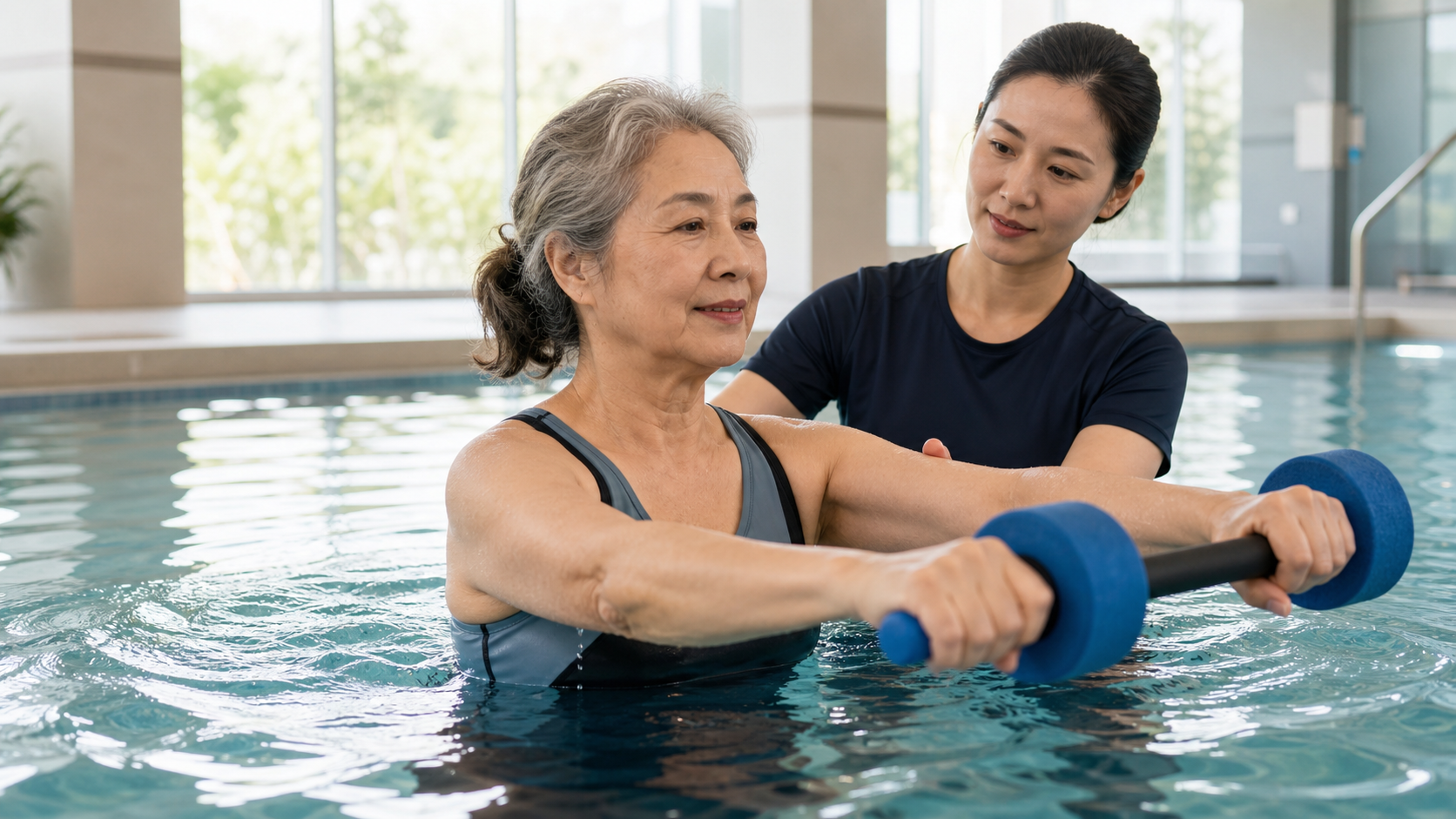
Arthritis is one of the most common chronic diseases worldwide. In Taiwan, the prevalence of osteoarthritis exceeds 50% among those aged 65 and older, while rheumatoid arthritis affects approximately 1% of the population. Inflammation, pain, and restricted mobility trap patients in a vicious cycle of “not moving because of pain, and hurting more because of not moving”—muscles around the joints atrophy from disuse, losing their supportive protection for the joints, which in turn accelerates cartilage wear. The unique advantage of water-based exercise lies in its ability to break this cycle: buoyancy removes gravitational pressure from inflamed joints, while the viscosity of water provides multi-directional, gentle resistance, allowing patients to safely perform strength and mobility training below their pain threshold.
Physical Properties of Hydrotherapy and Therapeutic Mechanisms
The Unloading Effect of Buoyancy
Depending on the depth of immersion, buoyancy in water can unload different proportions of body weight:
| Water Depth | Weight Reduction Ratio | Suitable Patients |
|---|---|---|
| Neck | Approximately 90% | Severe arthritis, early post-surgical rehabilitation |
| Chest | Approximately 75% | Moderate arthritis, post-knee replacement |
| Waist | Approximately 50% | Mild to moderate arthritis, overweight individuals |
| Mid-thigh | Approximately 30% | Mild arthritis, endurance-building phase |
Viscosity of Water Provides Functional Resistance
The viscous resistance of water is approximately 800 times that of air, and resistance is proportional to the square of movement speed—the faster the movement, the greater the resistance; the slower the movement, the lower the resistance. This property gives water-based exercise a natural “self-regulating” function: when pain is more intense, patients naturally slow down their movements, and resistance decreases accordingly, without the need to deliberately control intensity.
The Analgesic and Muscle-Relaxing Effects of Warm Water
Hydrotherapy is typically conducted in warm water at 32–36°C. The thermal effects can:
- Raise the pain threshold, reducing the perception of joint pain
- Decrease muscle tension, improving joint range of motion
- Promote local blood circulation, accelerating the clearance of inflammatory metabolites
Water-Based Exercise Applications for Different Types of Arthritis
Osteoarthritis (OA)
Knee osteoarthritis is one of the conditions most suited to water-based exercise. Systematic literature reviews show that water-based aerobic and strength training performed 3 times per week for 8–12 weeks can significantly improve WOMAC (Western Ontario and McMaster Universities Osteoarthritis Index) pain scores by 20–40%, improve functional walking speed, and the therapeutic effects can be maintained for up to 3 months after training cessation.
Suitable Water-Based Training Exercises for Osteoarthritis:
- Water walking (forward/backward, lateral, crossover steps)
- Water squats (water at waist level, holding onto the pool edge)
- Straight leg raises (holding the edge, alternating leg lifts to the water surface)
- Water cycling motion (suspended at the pool edge, legs simulating pedaling)
Rheumatoid Arthritis (RA)
Water-based exercise for rheumatoid arthritis requires particular attention to distinguishing between acute flare-ups and remission phases:
- Acute flare phase: When joints are visibly swollen and warm, water-based resistance training should be avoided; instead, gentle range-of-motion exercises in warm water are preferred
- Remission phase: More active water-based strength training can be performed, but prolonged immersion in hot water should be avoided (as it may trigger the release of inflammatory mediators)
Safety Principles for Implementing Water-Based Exercise
- Water-based exercise should be paused during the acute inflammatory phase of joints (when redness, swelling, heat, and pain are pronounced)
- After total joint replacement, patients can typically enter the water 4–6 weeks post-surgery (after the wound has fully healed), and this must be confirmed by a rehabilitation physician
- Water temperature should not exceed 36°C; high temperatures may aggravate the inflammatory response in RA and place additional strain on the cardiovascular system
- Each water-based training session is recommended to last 30–45 minutes; arthritis patients should start with 20 minutes in the initial phase
Practical Recommendations
- Seek guidance from a physical therapist: Water-based exercise prescriptions should be designed by a physical therapist trained in hydrotherapy, not self-explored
- Use water-based resistance tools: Water gloves and buoyancy ankle bands can increase resistance and enhance training benefits, but should only be used under a therapist’s guidance
- Swimming is not the same as hydrotherapy: General swimming training intensity may be too high; arthritis rehabilitation should primarily consist of structured water-based exercise programs
- Pain monitoring: Adopt the “pain traffic light” principle—no pain or mild soreness (green light) means you may continue; moderate pain (yellow light) means reduce intensity; severe pain (red light) means stop immediately
- Combine with land-based training: Water-based exercise should be alternated with low-impact land-based training (such as resistance bands or stationary cycling) to comprehensively improve muscle strength and bone density
Conclusion
Water-based exercise offers arthritis patients a therapeutic option that land-based training is hard to replace, combining the multiple mechanisms of buoyancy protection, resistance training, and thermal analgesia to achieve maximum functional recovery benefits at the lowest pain cost. Some rehabilitation clinics and physical therapy centers in Taiwan already offer hydrotherapy programs. It is recommended that arthritis patients proactively inquire and incorporate water-based exercise into their long-term rehabilitation plans to regain freedom of movement.
Related Reading
- The Healing Benefits of Swimming for Arthritis Patients: The Medical Evidence for Low-Impact Water-Based Exercise
- Swimming and Arthritis: The Best Choice for Low-Impact Exercise
- Swimming for Joint Protection: Swimming Recommendations for Patients with Degenerative Arthritis
- Swimming and Joint Protection: The Best Choice for Low-Impact Exercise
碟煞公路車 銑面器 !? 原來銑完差這麼多! 降低蹭碟機率! | TIME 公路車 保養小記錄 | CT Yeh
3 年前
CT 喇低賽) 武嶺牽車 才是王道 西進牽車四小時內秘訣 攝手位置 如何判斷 防抽筋小秘訣
7 年前
西進武嶺 免費訓練分析服務 Intervals | 練不夠還是練過頭?你哪一種類型選手?AI模型告訴你! | 備戰神器 | 公路車 訓練 | CT Yeh
4 年前
3D 列印車褲墊 / 舒適改善? / 無痕 x 分區壓縮 / ATK & Decider系列 / JE22黑科技 / #公路車 #CTYEH
11 個月前
水金九不厭五分 10度寒流冷到不願停!feat. 卡卡 / 公路車 / CT Yeh
6 個月前
Never Stop 西進武嶺 前後雙機 完整全程錄影 訓練台 實境
8 年前
[教學] Premiere 影片 手震 修正 教學 防抖 單眼 影像 GoPro 穩定 Video Stabilization
8 年前
[防寒衣體驗] 鐵人魂 三鐵 防寒衣試穿會 於松運 深水游泳池 鯨魚池
8 年前