Swimming and Stroke Rehabilitation: The Neuroplasticity Benefits of Water Walking and Supported Swimming
Introduction
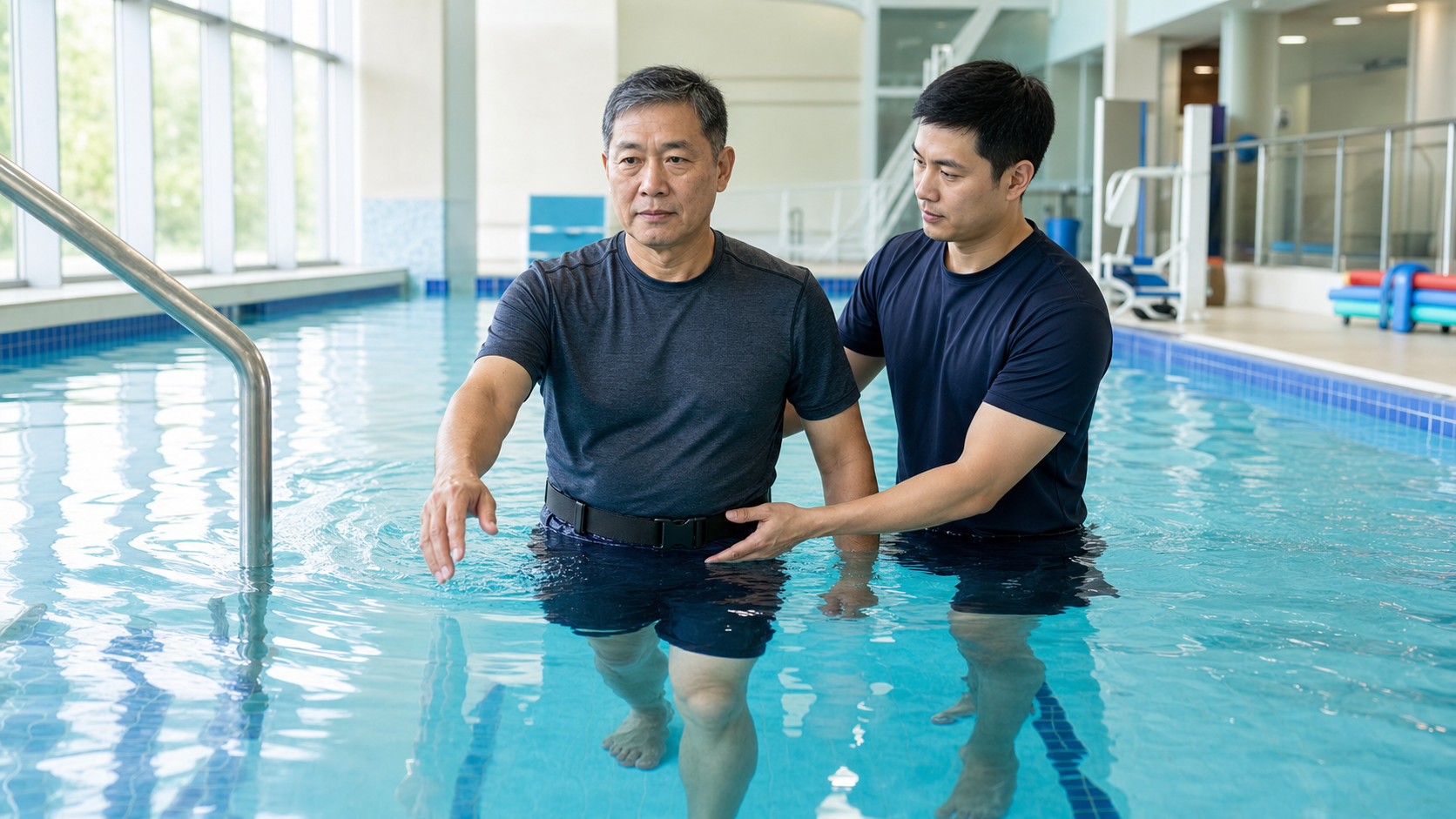
Taiwan sees approximately 30,000 new stroke patients each year, and stroke is the leading cause of adult disability. The goal of post-stroke rehabilitation is to promote neuroplasticity, reshaping neural circuits through repetitive movement training to restore lost motor and sensory functions. Traditional rehabilitation is conducted on land, but for patients with severe hemiplegia or those whose lower-limb function has not yet recovered, balance issues make land-based training fraught with fall risk. The buoyancy of the aquatic environment provides a safer training space, allowing patients to attempt movements they cannot yet perform independently on land while in a weight-reduced state—this is the core advantage of aquatic stroke rehabilitation.
The Unique Value of the Aquatic Environment for Stroke Rehabilitation
Buoyancy Provides Safe Weight-Relieved Training
When hemiplegic patients practice walking on land, the unaffected side must bear nearly all of the body weight, leaving limited training opportunities for the affected lower limb. Aquatic buoyancy reduces body weight by 50–90% depending on water depth, enabling the affected lower limb to complete standing and walking movements under lower load while accumulating the repetitive stimulation needed for neural remodeling.
Sensory Stimulation from Water Promotes Proprioceptive Re-education
The continuous flow of water provides tactile stimulation to the skin surface, and hydrostatic pressure acts uniformly across the body. These sensory inputs can activate the brain’s sensory cortex, helping to improve the sensory deficits and proprioceptive impairments commonly seen after stroke. The integration of sensory and motor training is a key principle of neurological rehabilitation.
The Anti-Spasticity Effect of Warm Water
Post-stroke spasticity is a major obstacle to functional recovery. Warm water at 32–34°C can reduce muscle tone and alleviate the degree of spasticity, allowing patients to perform movement training with more relaxed muscles, thereby improving training quality and efficiency.
| Aquatic Rehabilitation Advantage | Mechanism | Corresponding Post-Stroke Problem |
|---|---|---|
| Buoyancy weight relief | Reduces gravitational load | Weakness in the affected lower limb |
| Sensory stimulation | Skin tactile input + hydrostatic pressure | Sensory deficits, proprioceptive impairment |
| Thermal effect | Reduces muscle tone | Spasticity |
| Multi-directional resistance | Equal viscous resistance | Upper and lower limb coordination training |
| Psychological safety | Low fall risk | Fear of falling, lack of movement confidence |
Aquatic Training Programs for Stroke Rehabilitation
Phase 1: Aquatic Standing and Balance Training (water level up to the neck)
- Standing in water with minimal assistance from the therapist
- Weight-shift training: holding the pool edge with both hands, alternately shifting body weight between the affected and unaffected sides
- Static balance challenges: gradually reducing hand support to train independent balance
Phase 2: Aquatic Walking Training (water level up to the chest)
- Walking parallel to the pool edge: holding the pool rim, performing forward and backward walking
- Lateral walking: training hip abductor muscles to improve gait stability
- High-knee walking: strengthening the affected-side hip flexors to improve swing-phase gait
- Diagonal walking: training upper and lower limb coordination
Phase 3: Functional Swimming (based on individual capability assessment)
- Supine float training: relaxed back-floating with therapist support to promote whole-body sensory integration
- Supported freestyle: using a pull buoy to secure the legs, focusing on upper-limb pulling movements to train upper-limb strength and coordination
- Affected-side priority training: if the affected side is the upper limb, targeting active pulling movements with the affected upper limb
Appropriate Timing and Contraindications for Aquatic Rehabilitation
Conditions suitable for starting aquatic rehabilitation:
- Vital signs are stable and the acute phase (usually within 2 weeks after stroke) has passed
- No open wounds or skin infections
- No incontinence issues (or waterproof incontinence pants can be used)
- Ability to follow basic instructions
Contraindications:
- Active deep vein thrombosis (DVT)
- Severe cardiopulmonary dysfunction that cannot tolerate hydrostatic pressure
- Fever or acute infection
- Severe dysphagia (risk of drowning)
Summary of Research Evidence
Systematic literature reviews (2019–2023) show that stroke patients who undergo aquatic rehabilitation demonstrate significant improvements in balance ability (Berg Balance Scale scores), walking speed, and activities of daily living (Barthel Index). Some studies also indicate that aquatic rehabilitation is superior to land-based training alone in terms of gait improvement.
Practical Recommendations
- Led by a physical therapist: Aquatic stroke rehabilitation must be conducted under the guidance of a physical therapist trained in hydrotherapy, with safety as the top priority
- Family assistance: Family members learning aquatic assistance techniques (basic Halliwick Technique movements) can increase the possibility of home-based training
- Integration with land-based rehabilitation: Aquatic training should be coordinated with comprehensive rehabilitation programs including land-based therapy, occupational therapy, and speech therapy
- Patient goal setting: Focus on functional goals (e.g., “being able to walk to the bathroom independently”) rather than merely counting repetitions of movements
- Progress documentation: Record movement performance at each session to assess neurological recovery progress and serve as the basis for adjusting the training plan
Conclusion
Aquatic rehabilitation offers stroke patients functional training opportunities that are difficult to achieve through land-based training alone. Through buoyancy, sensory stimulation, and thermal effects, it promotes neuroplasticity and functional recovery in a safe environment. As rehabilitation medicine develops in Taiwan, aquatic rehabilitation resources are gradually increasing. Stroke patients and their families should proactively discuss with their rehabilitation physicians whether aquatic rehabilitation is suitable for inclusion in their recovery plan, making the pool another healing space for regaining quality of life.
Related Reading
- Swimming for Post-Stroke Rehabilitation: The Current Status of Aquatic Physical Therapy in Taiwanese Hospitals
- Aquatic Rehabilitation Therapy: A Scientific Approach to Recovery After Orthopedic Surgery Using Swimming
- The Healing Benefits of Swimming for Arthritis Patients: The Medical Basis of Low-Impact Aquatic Exercise
- The Therapeutic Effects of Swimming on Arthritis: Rehabilitation Applications of Aquatic Resistance Training
CT暗黑廚房) 車友必備 宇宙無敵鮮蚵湯 幫助訓練恢復 天然食補 好市多 超肥鮮蚵 破PR
7 年前
摔車後補裝備: 好市多新款單車安全帽& Specialized Romin 北高整路屁股都不痛的坐墊 | 一千元居然有MIPS | CT Yeh | 公路車
4 年前
Nepest NOVA 碳條輪組:輕量、空力、舒適一次滿足!/ 公路車 / CT Yeh
7 個月前
[防寒衣體驗] 鐵人魂 三鐵 防寒衣試穿會 於松運 深水游泳池 鯨魚池
8 年前
大武山後門26%歡樂陡坡!JJSC南台灣單車行Day2 / 被颱風追著跑 / 公路車 / CT Yeh
2 年前
[教學] Premiere 影片 手震 修正 教學 防抖 單眼 影像 GoPro 穩定 Video Stabilization
8 年前
水金九不厭五分 10度寒流冷到不願停!feat. 卡卡 / 公路車 / CT Yeh
6 個月前
風櫃嘴 衝刺慢動作回放!
8 年前