Introduction
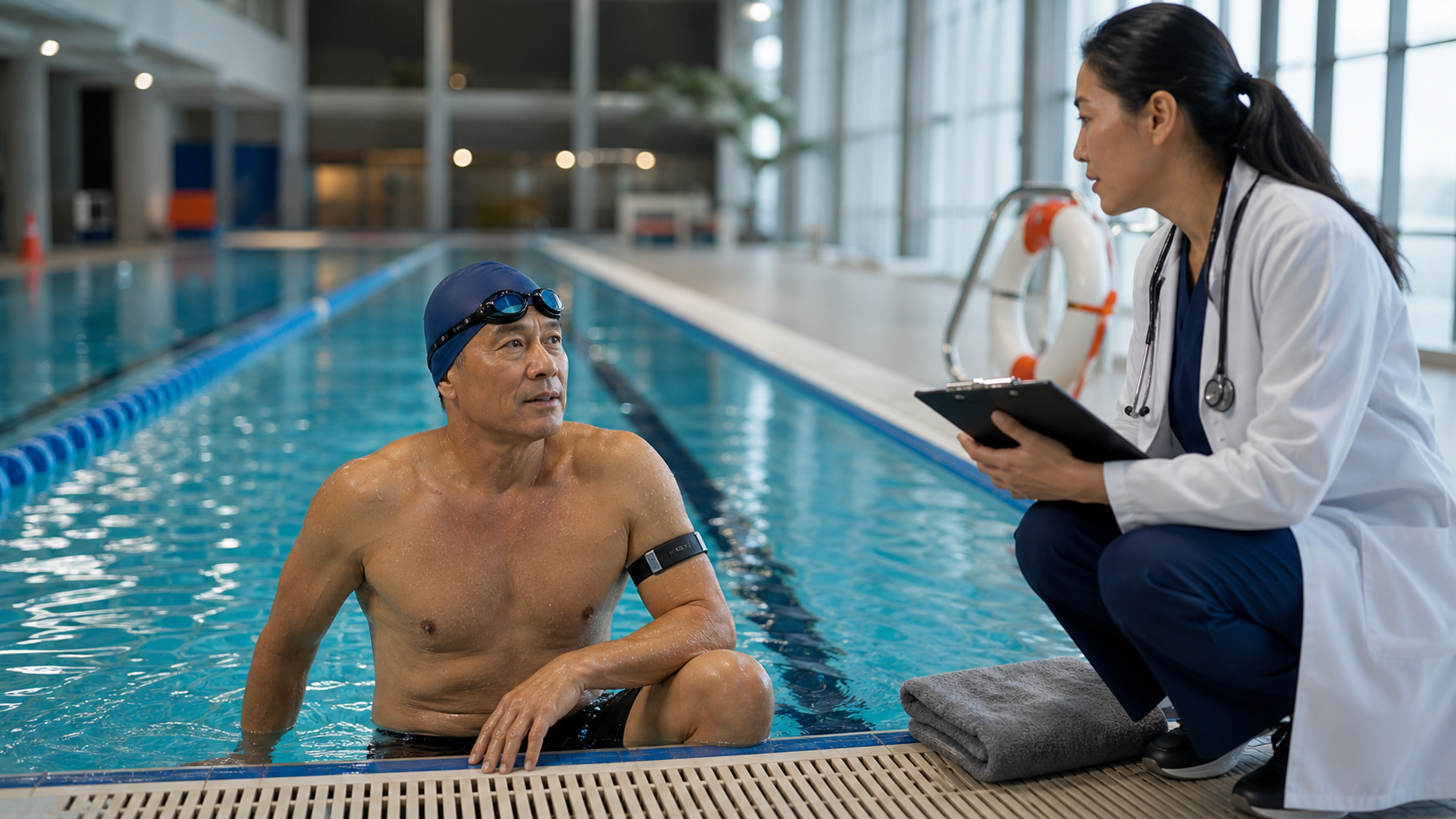
In Taiwan, more than 20,000 people die from heart disease each year, and heart disease has long been a fixture among the nation’s top ten causes of death. For cardiac patients whose condition has stabilized, regular aerobic exercise is a core strategy in cardiac rehabilitation, reducing the risk of recurrent events and improving cardiorespiratory fitness and quality of life. As a low-impact, full-body aerobic exercise, swimming has well-supported long-term protective benefits for the heart. However, the hydrostatic pressure effects, horizontal body position, temperature changes, and intensity fluctuations involved in swimming pose physiological challenges to the heart that differ from land-based exercise. Cardiac patients must undergo a comprehensive medical evaluation before returning to the pool.
The Special Effects of Swimming on the Cardiovascular System
The Venous Return-Enhancing Effect of Hydrostatic Pressure
When immersed in water, hydrostatic pressure exerts a physical squeezing force on peripheral veins, pushing a large volume of blood from the limbs toward the central circulation. Studies show that when the neck is submerged, central blood volume can increase by approximately 700 ml, leading to:
- Increased preload: The volume of blood pumped by the heart with each contraction increases
- Cardiac output rises by 30–50%: Even during resting immersion
- Relatively lower heart rate: In water, heart rate is typically 10–15 beats per minute lower than land-based exercise at the same intensity (the “swimming heart rate” phenomenon)
For people with normal cardiac function, this increase in preload is easily accommodated. However, for patients with reduced left ventricular function (EF < 40%) or severe valvular disease, a sudden large influx of venous return may trigger acute heart failure symptoms.
The Effect of Water Temperature on the Heart
| Water Temperature | Cardiovascular Response | Cardiac Risk |
|---|---|---|
| < 20°C (cold water) | Strong sympathetic activation, vasoconstriction, sudden blood pressure surge | High risk, prohibited |
| 20–26°C | Moderate vasoconstriction | Moderate risk, caution required |
| 26–32°C | Mild vasodilation, optimal cardiac load | Low risk, recommended range |
| > 36°C (hot water) | Extensive vasodilation, blood pressure drop | Syncope risk, avoid prolonged immersion |
Assessment of Swimming Suitability by Heart Disease Type
Stable Coronary Artery Disease (Stable Angina)
Patients with stable cardiac function (EF ≥ 50%), well-controlled symptoms, and no acute events for more than 6 months can generally swim safely within a cardiac rehabilitation framework. An exercise ECG is required to rule out exercise-induced myocardial ischemia.
Post-Myocardial Infarction
Timing for swimming after acute myocardial infarction:
- General swimming: At least 4–6 weeks after the acute event, and after passing an exercise stress test (echocardiography or nuclear cardiology assessment to evaluate residual ischemia)
- High-intensity swimming: At least 3 months after the acute event, after completing a cardiac rehabilitation program
Heart Failure
Patients with stable heart failure (NYHA class II–III, EF ≥ 35%) may consider low-intensity water-based exercise, but should be aware that hydrostatic pressure may worsen pulmonary congestion. This must be done under strict medical supervision. Swimming is prohibited for patients with NYHA class IV or EF < 30%.
Arrhythmias
Swimming is generally safe for patients with an implanted pacemaker or defibrillator (ICD), but the device’s water resistance rating must be confirmed. If palpitations, dizziness, or a device discharge sensation occur while swimming, the patient should leave the water immediately and seek medical attention.
Safety Principles for Cardiac Patients Swimming
Pre-Exercise Evaluation (Required)
- A recent echocardiogram (to confirm EF and valvular function)
- Exercise ECG or cardiopulmonary exercise testing (CPET)
- Written clearance from a physician
Precautions While Swimming
- Entry method: Use steps to enter the water slowly; diving is prohibited, allowing the body to gradually adapt to the hydrostatic pressure effects
- Intensity control: Target heart rate should be 50–70% of maximum heart rate; those taking beta-blockers should use the “talk test” instead of heart rate calculation
- Avoid breath-holding and underwater swimming: Breath-holding maneuvers (Valsalva maneuver) cause significant blood pressure fluctuations and are prohibited for cardiac patients
- Choose a temperature-controlled pool: Water temperature should be maintained at 26–32°C
- Swim with a companion: Never swim alone, and the swimming facility should be equipped with an AED
Practical Recommendations
- Join a cardiac rehabilitation program: Major hospitals in Taiwan offer cardiac rehabilitation courses, some of which include water-based training components; supervised exercise is strongly recommended
- Learn self-pulse monitoring: Understand your resting heart rate and target heart rate for swimming, and monitor it at all times
- Bring medication to the water’s edge: Sublingual nitroglycerin should be placed within easy reach at poolside, not in a locker
- Recognize warning symptoms: If chest tightness, chest pain, severe breathlessness, dizziness, or extreme fatigue occur while swimming, leave the water immediately, rest, and seek medical attention
- Cardiac follow-up every 3 months: Schedule regular follow-up visits to monitor cardiac function and confirm the safety of your swimming plan
Conclusion
The long-term protective benefits of swimming for the heart are well established, but for cardiac patients returning to the pool, what is needed is not courage but careful medical evaluation and systematic preparation. With assessment by a cardiologist and the support of a cardiac rehabilitation team, most patients with stable heart disease can swim safely and gain the dual benefits of improved cardiorespiratory function and enhanced quality of life.
Related Reading
- The Scientific Benefits of Swimming for Cardiovascular Health
- The Scientific Benefits of Swimming for Cardiovascular Health: What the Research Says
- Swimming and Heart Health: Research on the Benefits of Long-Term Aerobic Swimming for the Cardiovascular System
- Safety Considerations for Older Swimmers: Precautions for Patients with Heart Disease and Hypertension
一起升級!海鷗盃LSD團練...JJSC Zone2招待 騎到手抖 / 公路車 / CT Yeh
1 天前
西進武嶺 免費訓練分析服務 Intervals | 練不夠還是練過頭?你哪一種類型選手?AI模型告訴你! | 備戰神器 | 公路車 訓練 | CT Yeh
4 年前
[教學] Premiere 影片 手震 修正 教學 防抖 單眼 影像 GoPro 穩定 Video Stabilization
8 年前
#公路車 #Vo2Max #最大攝氧量 測驗 體驗 | 心肺測試
6 年前
JE22 百里任務體驗,心跳不能過150,三小時內有可能...? 沒有天時地利難度有多高? / 公路車 / CT Yeh
1 年前
CT暗黑廚房) 車友必備 宇宙無敵鮮蚵湯 幫助訓練恢復 天然食補 好市多 超肥鮮蚵 破PR
7 年前
一日北高/長距離團騎 常見問題補充篇 / 組團或跟團的眉角 / 壯車友容易被瘦車友慢性拉爆 / 原來屁股痛可能是這個原因...? / 風場配速法 / 公路車 / CT Yeh
2 年前
2023桃園團體繞圈賽 / 海鷗繞圈賽 | 全程空拍數據版 | 公路車 | CT Yeh
2 年前