Swimming and Cognitive Health in Older Adults: The Preventive Benefits of Water Aerobics for Dementia
Introduction
Dementia is one of the most severe health challenges facing older adults worldwide. Taiwan currently has approximately 320,000 people living with dementia, and with an aging population, this number is projected to exceed 460,000 by 2031. Alzheimer’s Disease accounts for 60–70% of dementia cases, and no curative treatment currently exists. However, “exercise” as a primary prevention strategy for dementia has gained substantial scientific support over the past decade. Swimming, as one of the most accessible aerobic exercises for older adults—being joint-friendly, carrying a low fall risk, and offering strong social engagement—has drawn increasing attention from geriatric medicine and neuroscience researchers. This article consolidates the scientific evidence on swimming’s effects on cognitive health in older adults, providing medical evidence and practical recommendations for Taiwan’s senior swimming community.
The Scientific Mechanisms Behind Exercise’s Brain-Protective Effects
The Key Role of BDNF (Brain-Derived Neurotrophic Factor)
One of the most important neuroprotective mechanisms of aerobic exercise is promoting the brain’s secretion of BDNF (Brain-Derived Neurotrophic Factor). BDNF acts as “fertilizer” for neurons, promoting the generation of new neurons (neurogenesis), enhancing synaptic plasticity, and protecting existing neurons from apoptosis. Animal studies have shown that regular swimming significantly elevates BDNF levels in the hippocampus—the key region responsible for memory and learning—and human studies consistently demonstrate increased serum BDNF concentrations following aerobic exercise.
Improved Cerebral Blood Flow and Vascular Health
Swimming’s cardiovascular training benefits can directly improve blood supply to the brain:
- Increased aerobic fitness → higher cardiac output → greater cerebral blood flow
- Lowered blood pressure and improved lipid profiles → reduced small-vessel hardening, preventing “vascular dementia”
- Improved vascular endothelial function → enhanced cerebral microcirculation efficiency
Anti-inflammatory Effects
Chronic low-grade inflammation is considered a significant contributor to the pathological progression of Alzheimer’s disease. Regular moderate-intensity aerobic exercise has pronounced anti-inflammatory effects, reducing serum markers such as IL-6 and TNF-α, thereby providing indirect protection to the brain.
| Brain-protective mechanisms of exercise | Specific benefits | Impact on dementia |
|---|---|---|
| Increased BDNF secretion | Neurogenesis, synaptic strengthening | Slows the rate of cognitive decline |
| Enhanced cerebral blood flow | Adequate oxygen supply | Reduces risk of vascular dementia |
| Anti-inflammatory effects | Reduced neuroinflammation | Slows Alzheimer’s pathological progression |
| Maintenance of hippocampal volume | Protection of the memory center | Reduces the rate of memory decline |
| Social interaction | Cognitive stimulation and emotional connection | Delays social withdrawal and depression |
Swimming’s Unique Advantages for Cognitive Function in Older Adults
Cognitive Stimulation Through Multi-Sensory Integration
Swimming is an activity requiring high-level neural coordination: respiratory rhythm control, spatial orientation, coordination of left and right limbs, and integration of visual and vestibular senses. The stimulation this complex neuromotor coordination provides to the brain is far richer than that of simple treadmill walking. Research shows that “exercises with high movement complexity” offer greater cognitive protection than simple, repetitive exercises.
Low Fall Risk Enables Sustained Exercise in Older Adults
Older adults often limit land-based exercise due to fear of falling, consequently reducing their aerobic activity levels. Swimming’s low fall risk allows older adults to maintain regular aerobic exercise habits, and this “exercise continuity” is crucial for long-term cognitive health protection.
Additional Benefits of Social Interaction
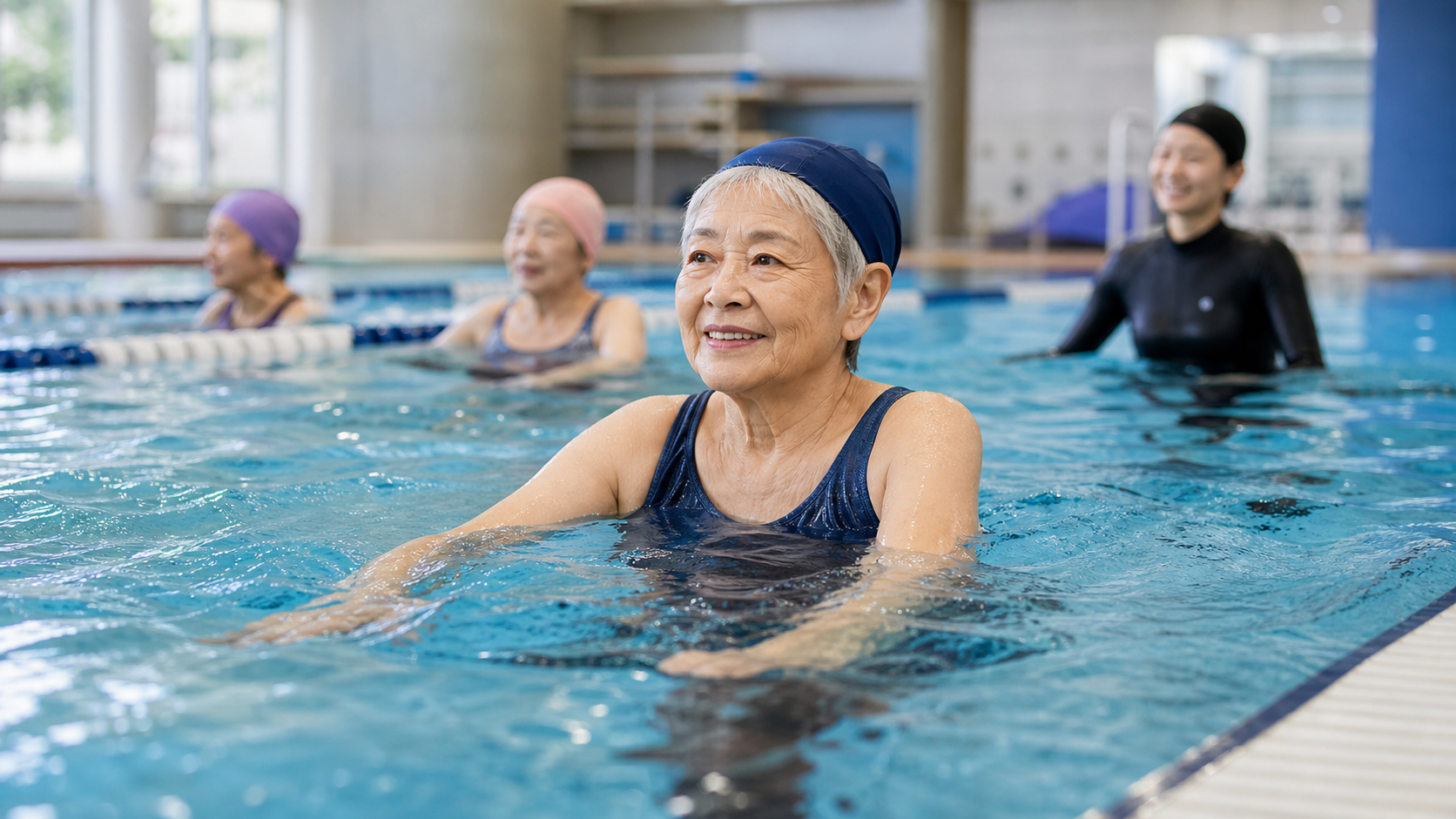
The pool environment naturally provides social opportunities—Aqua Aerobics is one of the most popular classes for seniors at many public swimming pools in Taiwan. Social interaction itself is a recognized protective factor against dementia, offering cognitive stimulation, emotional support, and a sense of meaning in life.
Safety Considerations for Senior Swimmers
- Gradual Water Entry: Older adults have weaker thermoregulation; they should enter the water slowly, especially when water temperature differs significantly from the ambient environment
- Fall Prevention Measures: Non-slip flooring around the pool area is especially important; older adults should wear non-slip slippers when moving around
- Swimming with a Partner: Seniors with cognitive issues should not swim alone
- Regular Medical Evaluation: Older adults taking multiple medications should consult their physician before swimming to confirm medication-exercise interactions
Water-Based Cognitive Training Programs Suitable for Seniors
Researchers have begun exploring water-based exercise combined with cognitive tasks (“cognitive-motor training”), for example:
- Performing memory training during water aerobics (reciting numbers, movement sequences)
- Dual-task walking in water (walking while performing oral cognitive tests)
- Aqua Dance classes: learning movement sequences, combining musical memory with rhythmic coordination
Preliminary studies suggest that such “Dual Task Training” for both body and mind may offer greater cognitive benefits than aerobic training alone.
Practical Recommendations
- Water aerobics 3 times per week: 30–45 minutes per session, at moderate intensity (slightly breathless while speaking), represents the optimal exercise dose supported by current literature
- Join senior water aerobics classes: Group classes combine exercise benefits with social stimulation, offering the best combination for cognitive health
- Continuously learn new strokes or movements: Attempt learning new swimming strokes or water-based movement techniques to increase cognitive stimulation
- Pair with land-based cognitive activities: Reading, language learning, chess, and similar activities combined with swimming form a comprehensive dementia prevention strategy
- Swim with family members: Family participation strengthens seniors’ social support networks and motivation to maintain exercise
- Start early: Dementia prevention should begin in middle age (45–65 years); do not wait until symptoms appear to take action
Conclusion
Swimming is not merely an exercise for strengthening the body—it may be a powerful tool for protecting brain health. In the context of Taiwan’s rapidly aging society, promoting swimming habits among older adults carries not only personal health benefits but also profound social and healthcare economic significance. Encouraging seniors to enter the pool is not just about maintaining physical fitness; it is about depositing a precious cognitive reserve for the brain, resisting the erosion of dementia, and keeping the later years of life clear and vibrant.
Related Reading
- Health Benefits of Swimming for Older Adults: A Water-Based Prescription for Slowing Aging
- Cognitive Benefits of Swimming: Research on Regular Swimming and Hippocampal Neurogenesis
- Health Benefits of Swimming for Seniors: Joint-Friendly Aerobic Training
- Swimming’s Improvement of Depression: Neural Mechanisms of Aerobic Exercise Promoting Serotonin Secretion
台灣旅行團參加 第7回まえばし赤城山ヒルクライム大会 雙視點
8 年前
CT暗黑廚房) 車友必備 宇宙無敵鮮蚵湯 幫助訓練恢復 天然食補 好市多 超肥鮮蚵 破PR
7 年前
白沙屯媽祖進香在家走!UREVO 坡度自調走步機 / 可連接訓練遊戲APP MyWhoosh / 邊看直播邊走起來 / CT Yeh
11 個月前
近視雷射三個月後悔嗎?單車族/工程師必看,Smart TransPRK 術後血淚史與後遺症全公開 / CT Yeh
4 個月前
抖肩舞 台灣x日本交流版 (台灣 vs 前橋) 赤城山登山賽 coincidance
8 年前
秘境雪場 日本 八甲田 冰樹探險與滑雪體驗 ft. Q老師 & 運動生活
7 年前
一起升級!海鷗盃LSD團練...JJSC Zone2招待 騎到手抖 / 公路車 / CT Yeh
2 天前
水金九不厭五分 10度寒流冷到不願停!feat. 卡卡 / 公路車 / CT Yeh
6 個月前