Introduction
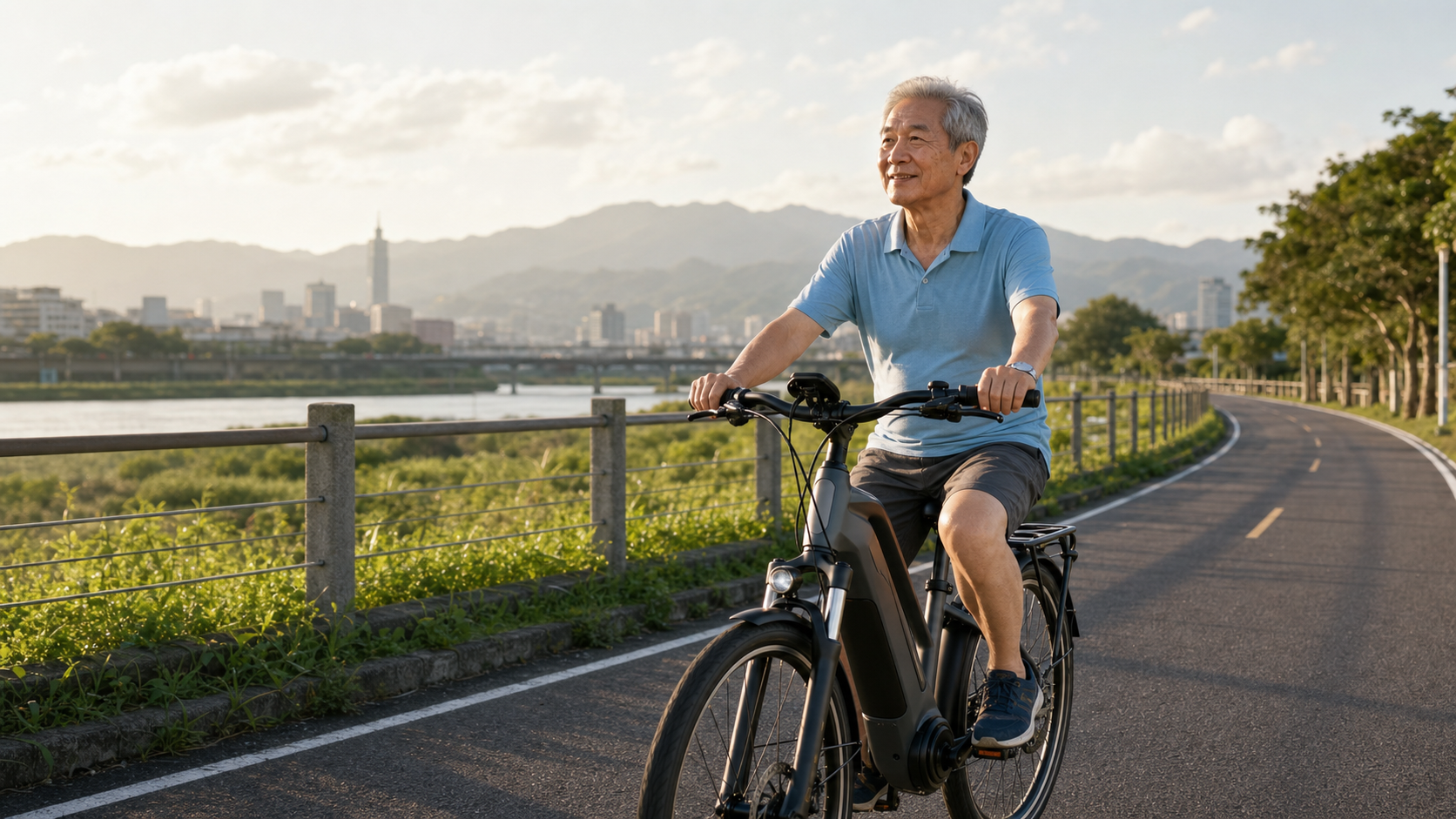
67-year-old Mr. Chen was an avid cyclist before retirement, riding road bikes across Taiwan since his 30s. But five years ago, knee arthritis forced him to hang up his bicycle—every time he pedaled for more than 20 minutes, his knees began to ache severely, and he could no longer enjoy that feeling of gliding freely on mountain roads.
Last year, his daughter bought him an electric-assist bicycle. Now, he rides the riverside bike path twice a week, covering 30–40 kilometers each time, with almost no knee discomfort. “It feels like ten stolen years have been given back to me,” he says.
Mr. Chen’s story is one of the most touching facets of Taiwan’s Ebike wave.
The Rapid Growth of Taiwan’s Ebike Market
The growth of electric-assist bicycles (E-bikes or Pedelecs) in Taiwan’s market over the past five years has been remarkable:
| Year | Taiwan Ebike Market Size (Estimated) | Key Growth Drivers |
|---|---|---|
| 2018 | Relatively niche | Early adopters |
| 2020 | Rapid growth | Pandemic-driven outdoor demand |
| 2021–2022 | Significant surge | Second-hand bike buying wave, retiree demographic |
| 2023–2024 | Steady continued growth | Brand diversification, falling prices |
Taiwan’s homegrown brands Giant and Merida have long made Ebikes a strategic priority product line, with both offering multiple electric-assist models designed for different use cases, ranging from urban commuting to mountain off-roading.
How Ebikes Work and the Regulations
In Taiwan, “electric-assist bicycles” are strictly defined by regulation, distinct from electric scooters (electric mopeds):
- Assist speed limit: The electric motor operates only while the rider is pedaling, and automatically stops assisting when speed exceeds 25 km/h
- Motor power limit: Maximum output does not exceed 250W
- No license required: Compliant electric-assist bikes require no driver’s license and can be ridden on regular bike lanes
- Battery capacity: Mainstream options range from 300–600 Wh, providing 60–150 km per charge
These regulations give Ebikes the same road rights as regular bicycles on Taiwan’s roads, significantly lowering the barrier to entry.
The Ebike Revolution Among Older Riders
The biggest contributors to Taiwan’s Ebike market growth are those aged 55 and above. They typically:
- Have a foundation in cycling but can no longer sustain high-intensity pedaling due to age or health issues
- Have ample time after retirement but want to maintain their mobility
- Value the social significance of “getting out,” rather than competitive performance
- Feel inadequate when facing climbs on long rides
The electric-assist system of Ebikes precisely solves these difficulties: the motor compensates on slopes, while on flat roads riders still rely on their own legs. Over the course of a ride, the load on the knees is greatly reduced, yet riders can still enjoy the freedom of cycling.
Evidence from a Medical Perspective
Multiple studies in Taiwan and internationally show that electric-assist cycling offers health benefits for older adults, including:
- Maintenance of cardiorespiratory function (exercise intensity can be adjusted via assist levels)
- Reduced knee joint stress (compared to walking or traditional bicycles)
- Increased participation in social activities
- Improved depressive symptoms (the positive effects of outdoor activity)
Not Just for Seniors: Ebike Uses Across Diverse Groups
Ebike users are far from limited to older adults; in Taiwan’s market, they also attract the following groups:
- Commuter workers: In cities with hilly terrain (such as Taipei’s Muzha, Keelung, and Taichung’s mountain areas), Ebikes solve the sweating problem
- Parent-child riding: Ebikes fitted with child seats make riding with kids no longer a physical burden
- Serious climbers: Riders who want to enjoy mountain scenery but have limited physical capacity
- Cargo delivery: Some of Taiwan’s courier and food delivery operators have begun testing Cargo Ebike deliveries
Key Considerations When Buying an Ebike
| Consideration | Description |
|---|---|
| Motor position | Mid-drive motors are more stable on climbs; rear-hub motors are lighter and more compact |
| Battery capacity | Choose based on typical riding distance; 400 Wh or above is generally sufficient for regular use |
| Assist levels | Multiple assist levels (usually 3–5) offer greater flexibility |
| Weight | Most Ebikes weigh 18–24 kg; consider stair climbing and mounting/dismounting |
| Brand warranty | Warranty service for the battery and motor is crucial; choose a brand with a local service network in Taiwan |
Practical Advice
- Test ride before buying: The feel of an Ebike differs from a traditional bicycle; be sure to decide after a test ride
- Pay attention to charging habits: Lithium batteries are best stored at 20–80% charge to extend battery life
- Regular maintenance: In addition to standard bicycle maintenance, battery connectors and motor mounting bolts need periodic inspection
- Plan charging routes: Before long rides, confirm charging points along the way or have a backup battery plan
Conclusion
Taiwan’s Ebike wave is a story about “returning.” Returning to cycling, returning to the outdoors, returning to the self that can move freely without physical limitations. For Mr. Chen, that Ebike is not just a vehicle—it’s the key to reclaiming ten lost years. Taiwan’s bicycle industry has always excelled in technology, and Ebikes have allowed that technology to truly serve those who need it most. This, perhaps, is the warmest evolution of Taiwan’s cycling culture.
Related Reading
- Taiwan Market Trends for Electric-Assist Bicycles (E-Bikes)
- Health Benefits of Electric-Assist Bicycles (E-bikes): Applications for Seniors and Rehabilitation
- Electric Bicycles and Exercise Rehabilitation: The Gentle Power of Stepping Back on the Pedals
- Electric-Assist Bicycles (E-bikes): Who Are They Suitable For
台中大雪山 膏王領騎 震到都沒畫面了 公路車
5 年前
高雄綠園道鐵路自行車道 / 外地人能輕鬆駕馭 還是整路崩潰? / 2025 全線開通 春節實地探索一次!(附GPS連結)/ 公路車 / CT Yeh
1 年前
2026 車錶排行榜!誰是最多車友正在使用?練家子最愛哪款?🏆 (2萬名車友數據) / 公路車 / CT Yeh
5 個月前
2022台北國際自行車展 訓練台 試騎心得大全 差點腿軟走出! 元宇宙武嶺!| Garmin Tacx Oreka Xpedo Wahoo | 公路車 | CT Yeh
4 年前
彰化經典百K 多視角衝刺實錄 | 范老師高鐵 NEKO's Fun Eva | 公路車
5 年前
多到選擇障礙... 換個單車把帶想一個小時 / BTP / 編織&軟木特有材質超吸睛! / 公路車 / CT Yeh
1 年前
2025 自行車錶排行榜 兩萬車友大數據 / Garmin Bryton 排名會大洗牌嗎? / 全新的碼表前身分析 /公路車 / CT Yeh
1 年前
2025 台北自行車展 逛展VLOG / 新奇商品探索 居然有這些神奇小物 / TT表演賽對戰德國91 / 巧遇 EVA 廷威 AYA 小D 四爺 夏美 松哥 .. / CT Yeh
1 年前