Differences in Bike Fit Between Time Trial Bikes and Road Bikes: The Trade-off Between Aerodynamics and Comfort
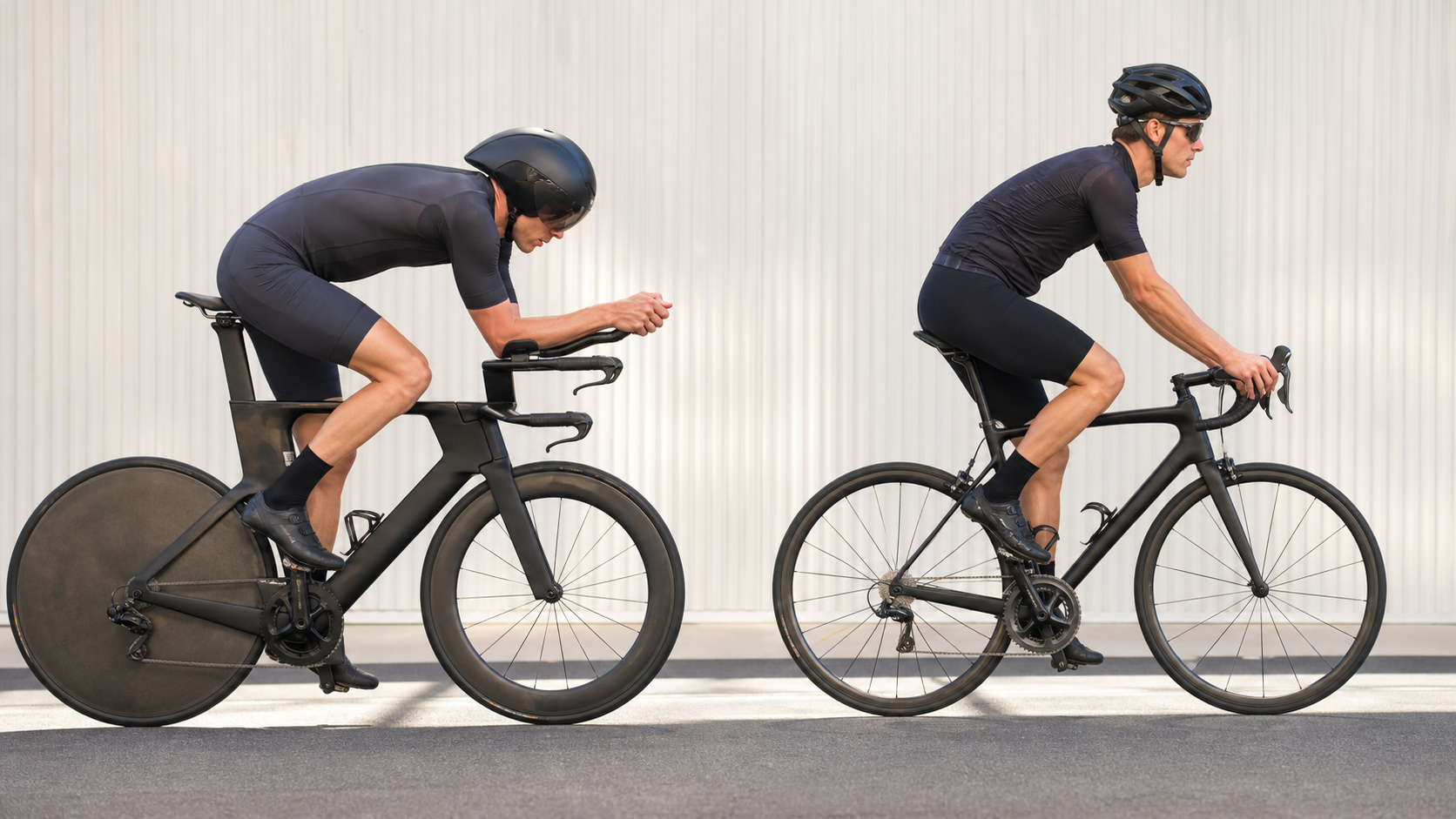
Bike Fit Differences Between Time Trial Bikes and Road Bikes: The Trade-off Between Aerodynamics and Comfort
Introduction
Time Trial Bikes (TT Bikes) and Road Bikes both look like two wheels and two pedals, but from a Bike Fit perspective, they are almost two completely different tools. The design philosophy of a road bike is “long-distance comfort and versatile handling across various terrains,” while a time trial bike is “maximizing average power output over a fixed time or distance”—these two goals lead to completely different posture requirements.
Core Difference: Hip Joint Angle
When riding a road bike, the angle between the torso and thigh (hip joint angle) typically ranges from 45–65°, leaving sufficient room for hip flexor function.
The low, tucked position of a time trial bike lowers the torso, reducing the hip joint angle to 30–45°. This extremely flexed position requires specific adjustments to compensate; otherwise, pedaling force gets “stuck” at the top of the stroke.
Compensation methods:
- Move the saddle forward (push forward 1–3cm to open up the hip angle)
- Use shorter cranks (165mm or shorter)
- Tilt the saddle nose slightly downward (to reduce compression at the top of the thigh)
Aero Bar Setup Logic
The core equipment of a time trial bike is the Aero Bar (also called TT Bar or Tri Bar), consisting of arm pads (Armpad) and extensions (Extension).
Arm Pad Height
- Lower: Torso is more horizontal, less drag, but increased cervical spine strain
- Higher: Reduced cervical spine strain, but the torso rises, reducing aerodynamic benefit
- Suggested starting point: Elbows resting at approximately handlebar height or 1–2cm lower
Arm Pad Spacing
- Narrow spacing (elbows close together): Reduces frontal area, best aerodynamics
- Wide spacing: Improved stability, suitable for long-distance triathlon riding followed by the run transition
Extension Length and Angle
- The longer the extensions, the lower the head can be tucked; but too long causes excessive back arching
- The ends of the extensions should allow the hands to extend naturally, without needing to “grip” or “brace”
Saddle Selection Differences
| Item | Road Bike Saddle | Time Trial Bike Saddle |
|---|---|---|
| Shape | Longer, with rear support | Shorter, flat front or with a nose pad |
| Purpose | Support for varied position changes | Pelvis positioning in a fixed forward-leaning posture |
| Sit bone contact | Rear sit bones bear the load | Front sit bone prominence (Ischial Rami) bears the load |
| Common models | Fizik Arione, Selle Italia SLR | Adamo TT, ISM Road |
Because time trial bikes maintain a forward-leaning position for extended periods, body weight shifts toward the pubic arch in front of the sit bones. The nose of a standard saddle will continuously compress the perineal area, so it is recommended to switch to a TT-specific saddle with a wide, flat front or a cutout design.
Special Considerations for Triathlon
Triathlon athletes need to transition to a long run after riding a time trial bike, which adds extra requirements to the Fit:
- Saddle slightly higher and further forward: Preserves quadriceps elasticity so the thighs don’t become overly fatigued when transitioning to the run
- Higher aero bars: Reduces core fatigue from extreme torso flexion, helping maintain posture during the later run segment
- More “neutral” pedaling angle: Avoids overusing the calf muscles, reserving them for the run
Limitations of Adopting an Aero Position on a Road Bike
Many amateur riders hope to achieve time trial performance by using a low position on a regular road bike, but note the following:
- Road bike frame geometry (especially Stack and Reach) is not optimized for extremely low positions
- Tucking low on standard handlebars creates an awkward wrist angle, with a high risk of ulnar nerve compression in the palm
- If pursuing aerodynamics, installing Clip-on Aero Bars is a safer compromise
Conclusion
Time trial bike Fit prioritizes maximizing aerodynamics, seeking sustainable pedaling efficiency within that framework; road bike Fit balances comfort and efficiency over long riding durations. Both bike types have their own optimization logic, and mixing the setup standards from one bike onto the other rarely yields good results. If you own both bikes, it is best to have each fitted separately—don’t try to apply the same standard to two completely different geometries.
Related Reading
- Triathlon-Specific Bikes vs. Road Bikes: Geometry, Aerodynamics, and a Purchase Decision Tree
- Triathlon Bikes vs. TT Bikes: Key Differences Between the Two Time Trial Machines
- Triathlon-Specific Bike Fit: Why a Time Trial Bike Isn’t Just a Road Bike Tilted Forward
- Installation, Adjustment, and Maintenance of Road Bike TT Bars
#公路車 #Fitting 靠人工智慧APP 幫你調整單車
6 年前
碟煞公路車 優缺點?換車一年半實際經驗分享 / 公路車 / CT Yeh
2 年前
Fitting訓練兩用功率車 ! Thinkrider ST900 完整實測!/ 坡度升降 / 鄰居測試/ smart bike/公路車/ CT Yeh
2 年前
鉅齒紋輪組!? ControlTech MEG-T50 EVO 碳纖維幅條輪組/ 功率對比實驗 / 公路車 / CT Yeh
2 年前
2026 車錶排行榜!誰是最多車友正在使用?練家子最愛哪款?🏆 (2萬名車友數據) / 公路車 / CT Yeh
5 個月前
風櫃嘴! 現實與虛擬騎乘 會有誤差嗎? 背著iPad邊騎一趟風櫃嘴實際測試一次 | 公路車 | CT Yeh
3 年前
公路車 BB培林大升級! / 備戰海鷗繞圈賽 Canyon Aerod & TIME 一起改 / MIT大廠 CEMA對鎖式陶瓷培林BB & 導輪 / 公路車 / CT Yeh
2 年前
TIME 公路車 Alpe d'Huez 21 開箱實錄! 購車/Fitting/組車/心得 | 新車入艙 | 時間的主人 CT Yeh
3 年前