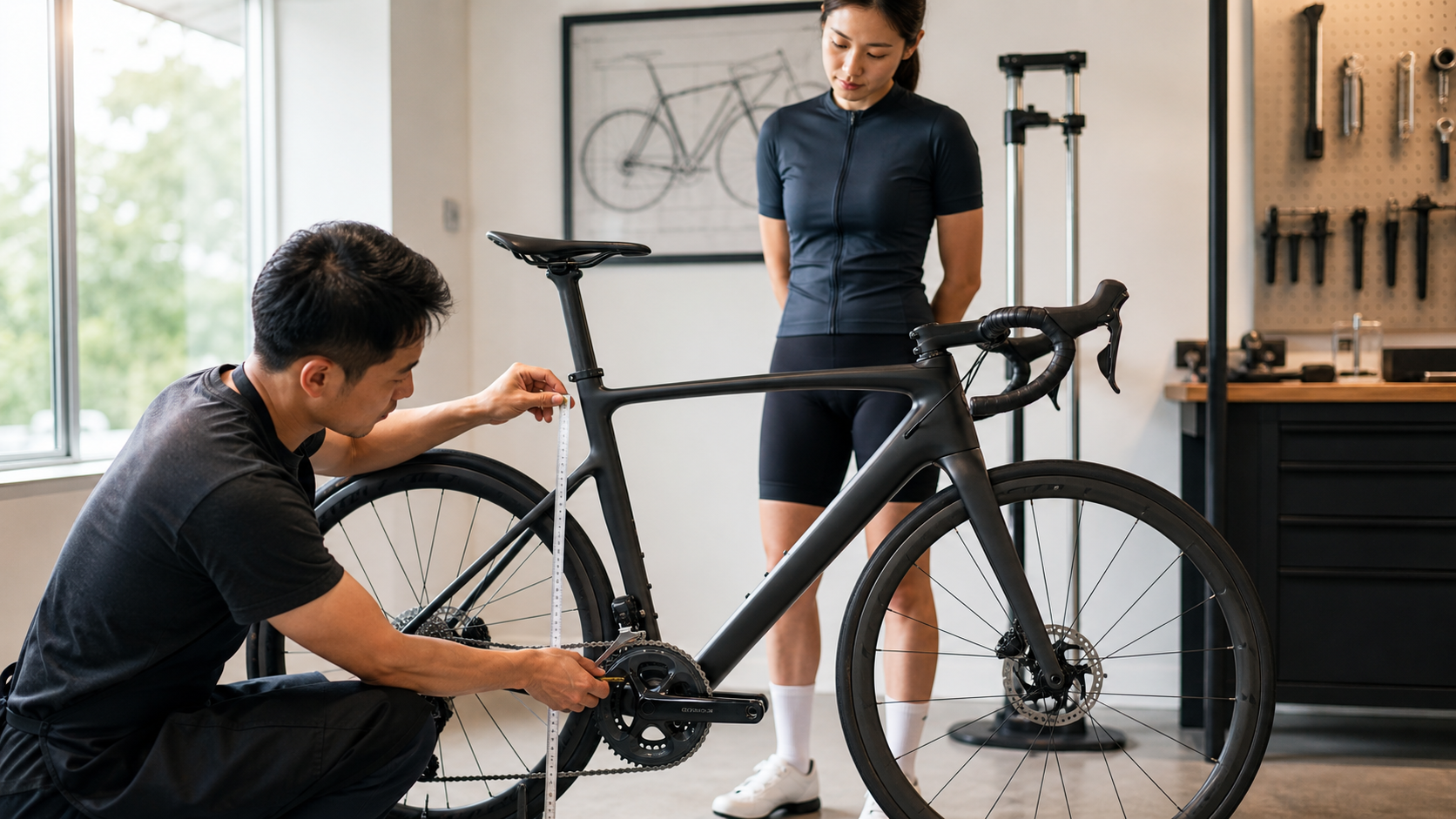
Height and Frame Size: How to Choose the Right Size Before a Test Ride
Introduction
“This bike looks great to ride—I’ll just buy it first.” That’s how many riders start down a path they later regret. Buying the wrong frame size isn’t something you can fix by swapping out a component—the gap in Stack and Reach can sometimes exceed anything that parts adjustments can compensate for. Before you commit to a test ride or place an order, spending twenty minutes understanding your own body measurements is the most worthwhile investment you can make.
Beyond “Number” Thinking: Stack and Reach
Traditional frame size labels (such as 54cm, S/M/L) lack a unified standard across brands, so relying on numbers alone can easily lead to misjudgment. Modern Bike Fit uses two more precise geometry parameters:
- Stack: The vertical distance from the center of the BB to the top of the head tube—determines how high the handlebar can be
- Reach: The horizontal distance from the center of the BB to the top of the head tube—determines the forward extension
These two numbers more objectively reflect how well a frame actually fits your body. The same size label from different brands can differ by 10–15mm in Stack/Reach.
Four Body Measurements You Need to Take
1. Height
Stand upright, without shoes, with your back against a wall.
2. Inseam
As described earlier, place a book between your legs and measure the distance from the top of the book to the floor.
3. Torso Length
The distance from the pubic symphysis (the bone at the center of your lower abdomen) to the suprasternal notch (the V-shaped dip below your neck).
4. Arm Length
The distance from the acromion (shoulder tip) to the wrist bone (radial styloid process).
Body Proportions Determine Frame Preference
| Body Characteristics | Impact on Frame Choice |
|---|---|
| Long legs, short torso | Needs a higher Stack or more spacer room |
| Short legs, long torso | Needs a longer Reach or longer Stem |
| Long arms | Standard Reach is sufficient; no need for an overly long Stem |
| Short arms | Needs a shorter Reach or short Stem |
How to Look Up Frame Sizes Across Brands
- Go to the brand’s official website and find the “Geometry Chart” page
- Locate the Stack and Reach values for each size
- Compare them with your own estimated values (approximate saddle Stack ≈ inseam × 0.883 + saddle thickness; Reach ≈ torso length + arm length × 0.6 as a rough estimate)
Or use online tools such as BikeInsights.com or geometrygeeks.bike—enter your body measurements and compare the fit of different frames, which is ideal for pre-screening before buying a bike.
Quick Checklist Before a Test Ride
When you’re standing next to the bike ready for a test ride, you can run through these quick checks:
- Stand-over check: Straddle the top tube; there should be a 2–5cm gap between your crotch and the top tube (road bikes)
- Reach for the handlebar: Lean forward and let your hands extend naturally toward the handlebar; your elbows should be slightly bent (not fully locked out)
- Sit and check: Sit on the saddle; when the pedal is at its lowest point, your knee should have a slight bend (about 25–35°)
- Check the headset spacers: If the bike comes from the factory with no spacers left to remove, you’ll have little room to raise the handlebar
What If Your Frame Size Falls “Between Two Sizes”?
This is the most common dilemma. General advice:
- Prefer the smaller size: Lengthening a Stem offers more adjustment room than shortening one, and a smaller frame is lighter
- Exceptions: If you have unusual body proportions (such as an extremely long torso) or with certain brand geometries, choosing the larger size with a short Stem can sometimes be more appropriate
- Consult a Fit technician: When in doubt, bring your body measurements to an experienced technician. An hour of consultation fees is far cheaper than replacing a frame later
Conclusion
Frame size selection is the foundation of all Bike Fit adjustments. When the foundation is right, subsequent saddle, handlebar, and Stem adjustments can all work within a reasonable range. When the foundation is wrong, even the world’s best Fit technician can’t save you. Taking the time to measure your body data, making good use of online geometry comparison tools, and doing basic proportion checks during a test ride—these three steps can dramatically reduce the odds of buying the wrong bike.
Related Reading
- The Complete Guide to Frame Size: How Stack and Reach Determine Your Riding Position
- Decoding Bicycle Frame Geometry Data: Stack, Reach, and Head Tube Angle
- Introduction to Road Bike Geometry: The Meaning of Stack, Reach, and Frame Angles
- Bicycle Size and Geometry Adjustment: How to Fix a Frame That’s Too Big or Too Small
#公路車 #Fitting 靠人工智慧APP 幫你調整單車
6 年前
單車 一日北高 ( 雙城 ) 肥宅雙人瘋狂行 紀錄片 REACTO
10 年前
Fitting訓練兩用功率車 ! Thinkrider ST900 完整實測!/ 坡度升降 / 鄰居測試/ smart bike/公路車/ CT Yeh
2 年前
Vision Metron RS 37碳幅條輪組 (非SL)官網沒有的 低調開箱 / 這重量太銷魂了 / 公路車 / CT Yeh
6 個月前
西進武嶺 自製新版AI配速表產生器 x 賽前攻略 抱佛腳! 沒有功率計也可以產生配速表嗎?有什麼其他眉角賽前要注意的呢? | 西進武嶺 / 東進武嶺 KOM 攻略 | 公路車 | CT Yeh
4 年前
Stages功率計 和 智騎 X7 Pro 訓練檯同時騎兩個 Rouvy 角色會一起進終點嗎?最後來點數據分析 | 公路車
5 年前
一日北高前的高裝檢 | 北高 360 | 挑戰11小時的裝備 | 一日雙塔 | 補給
6 年前
2025 自行車錶排行榜 兩萬車友大數據 / Garmin Bryton 排名會大洗牌嗎? / 全新的碼表前身分析 /公路車 / CT Yeh
1 年前