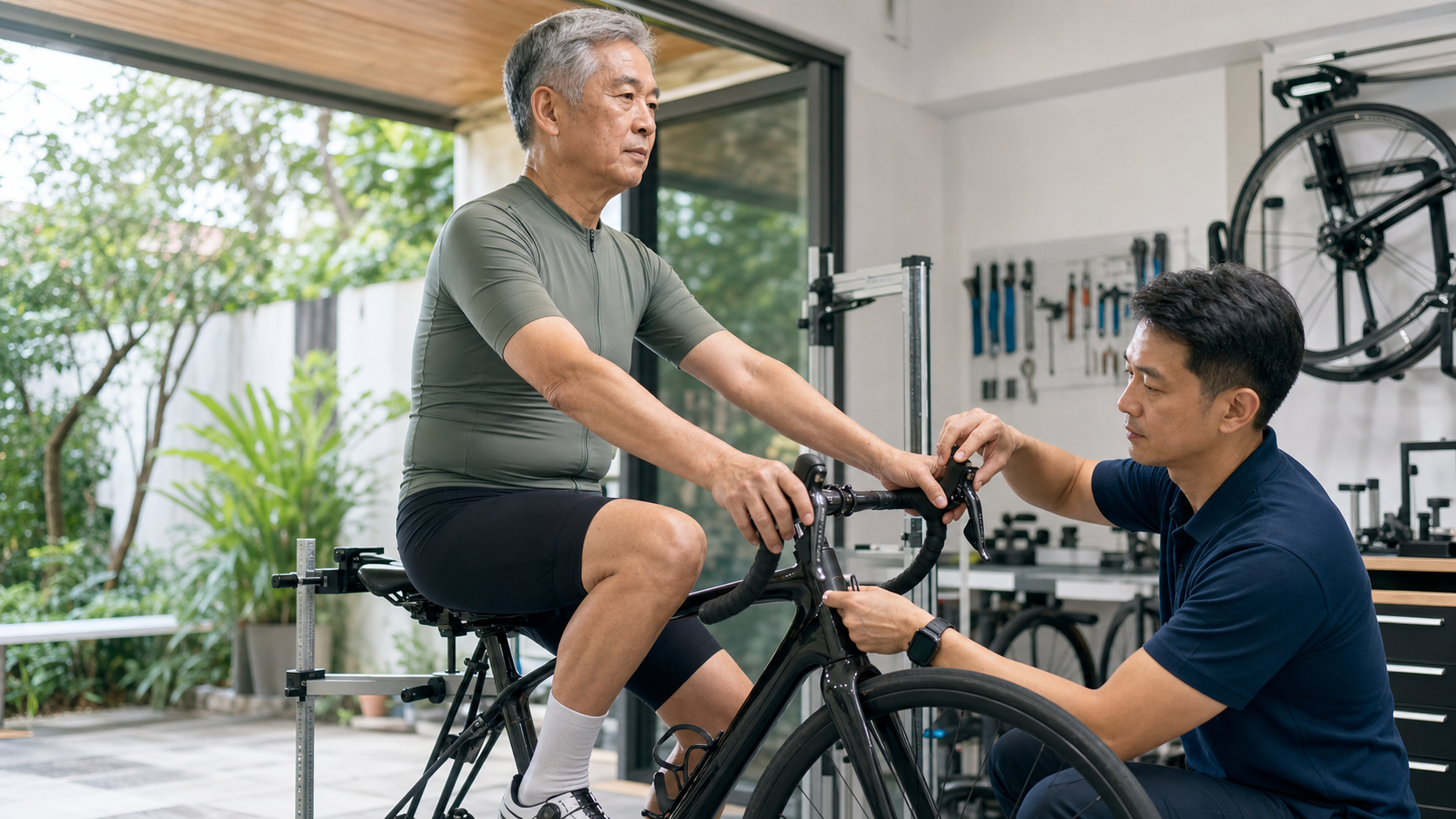
Bike Fit for Older Riders: Upper-Body Adjustment Strategies After Flexibility Declines
Introduction
In Taiwan’s cycling clubs, the proportion of riders aged 50–70 is steadily increasing, and the Bike Fit challenges this group faces are vastly different from those of younger riders. A bike set up in your younger years may no longer suit you a decade later—not because the bike has changed, but because your body has. The natural decline in flexibility, slight degeneration of spinal discs, and loss of core strength all require us to rethink our riding position setup.
Five Major Effects of Aging on Riding Posture
1. Decreased Spinal Extension
After age 40, spinal mobility declines by approximately 6–8% per decade. A low, aggressive handlebar position requires greater spinal extension capacity. Without this capacity, the body compensates by over-arching the lumbar spine, increasing pressure on the intervertebral discs.
2. Shortened Hip Flexors
Prolonged sitting at a desk combined with sustained hip flexion while cycling causes the hip flexors to shorten year after year, worsening posterior pelvic tilt. This shifts saddle pressure toward the sacrum rather than the sit bones.
3. Reduced Cervical Spine Mobility
Riders with stiff cervical spines cannot easily lift their heads to see the road ahead, forcing them to sacrifice their entire upper-body posture to achieve the necessary field of vision, which aggravates neck and back pain.
4. Decreased Core Strength
The core musculature is responsible for supporting upper-body weight, reducing the load on the hands and saddle. When core strength is insufficient, weight is transferred directly onto the handlebars and saddle, increasing strain on the wrists, shoulders, and lower back.
5. Reduced Recovery Capacity
In younger years, the same postural deviations might be “ridden through and adapted to,” but in middle-aged and older riders, connective tissue recovers more slowly, and minor injuries can easily accumulate into chronic problems.
Specific Adjustment Recommendations
Adjustment 1: Raise Handlebar Height
| Age Group | Recommended Handlebar Position Relative to Saddle |
|---|---|
| 20–35 (training-oriented) | 2–6cm lower |
| 35–50 | 0–3cm lower |
| 50–65 | 0cm lower to 2cm higher |
| 65 and above | 2–5cm higher than saddle |
How to do it:
- Add headset spacers (5mm each)
- Switch to a positive-rise stem
- If necessary, choose a frame with a taller head tube
Adjustment 2: Switch to a Shorter Stem
Shortening the stem (e.g., from 110mm to 80mm) can:
- Reduce the torso forward-lean angle
- Lower the demand for cervical spine extension
- Reduce wrist loading
Adjustment 3: Replace the Saddle
For riders with increased posterior pelvic tilt, the sacral support area at the rear of the saddle needs more cushioning:
- Choose a model with a thicker, wider rear section
- Consider designs with a central cutout to reduce nerve compression near the lumbosacral region
- Keep the saddle level or tilt it slightly nose-down to help alleviate posterior pelvic tilt
Adjustment 4: Consider Crank Length
For older riders with shortened hip flexors, shorter cranks (165mm) can reduce hip joint compression at the top of the pedal stroke. It is recommended to evaluate whether shortening is appropriate.
Core Strength Is Just as Important as Bike Adjustments
Bike adjustments only treat the symptoms; strengthening the core treats the root cause:
- Plank: 3 sets daily, starting at 20 seconds per set and gradually increasing
- Bird Dog: Trains the spinal stabilizer muscles
- Bridge: Strengthens the glutes and lower back muscles
- Yoga/Stretching Classes: 1–2 times per week, focusing on hip flexor and thoracic spine mobility
When Should You Consider a New Frame?
If the following situations persist even after adjusting components, it may be time to consider a frame with a more upright geometry:
- The handlebar stack has been built up to over 40mm of spacers and still feels too low
- Neck and back pain begins within 60 minutes of riding
- Field of vision is compromised, requiring significant head lifting to see the road ahead clearly
Bike models suitable for older riders: Endurance-geometry road bikes (such as the Trek Domane and Specialized Roubaix series) offer a higher stack and a more upright head-tube angle, making them an ideal choice for many middle-aged and older riders.
Conclusion
“Accepting that it’s time to give up the aggressive low riding position on a road bike as you age” is nothing to be ashamed of—it is a demonstration of understanding your own body and making wise choices. The core spirit of Bike Fit is to make the rider and bike work together, not to force the body to adapt to an unsuitable bike. As age advances, re-evaluating your Bike Fit setup every few years is one of the best investments for maintaining long-term cycling enjoyment and health.
Related Reading
- Bike Adjustments for Older Riders: Coping with Age-Related Changes
- Lower Back Pain While Cycling: Treatment Plans for Core Strengthening and Posture Adjustment
- Balance and Coordination for Older Cyclists: Core Training Programs to Prevent Falls
- Cycling Retirement Planning: Staying Active in Later Life Through Cycling After 50
#公路車 #Fitting 靠人工智慧APP 幫你調整單車
6 年前
一日北高/長距離團騎 常見問題補充篇 / 組團或跟團的眉角 / 壯車友容易被瘦車友慢性拉爆 / 原來屁股痛可能是這個原因...? / 風場配速法 / 公路車 / CT Yeh
2 年前
靠單車減肥35公斤 心得分享與整理
7 年前
再一組! 全碳幅條 碟煞/無內胎輪組 開箱! 到底好騎嗎? UNAAS X40 | 公路車 | CT Yeh
4 年前
一日北高常見問題大集合 | 攻略 | 路線 | 訓練 | 補給 | 自行車 單車 | 一日雙城 | 雙塔 | TWB北高360 | 屁股痛
6 年前
Garmin Edge 1040 重大韌體更新!! / 1050功能全下放!? / 坡度反應變快了嗎?/ 快速對比實測 / 公路車 / CT Yeh
1 年前
摔車後補裝備: 好市多新款單車安全帽& Specialized Romin 北高整路屁股都不痛的坐墊 | 一千元居然有MIPS | CT Yeh | 公路車
4 年前
單車 一日北高 ( 雙城 ) 肥宅雙人瘋狂行 紀錄片 REACTO
10 年前