The Adaptation Period After a Bike Fit: Muscle Relearning in the First Two Weeks Post-Adjustment
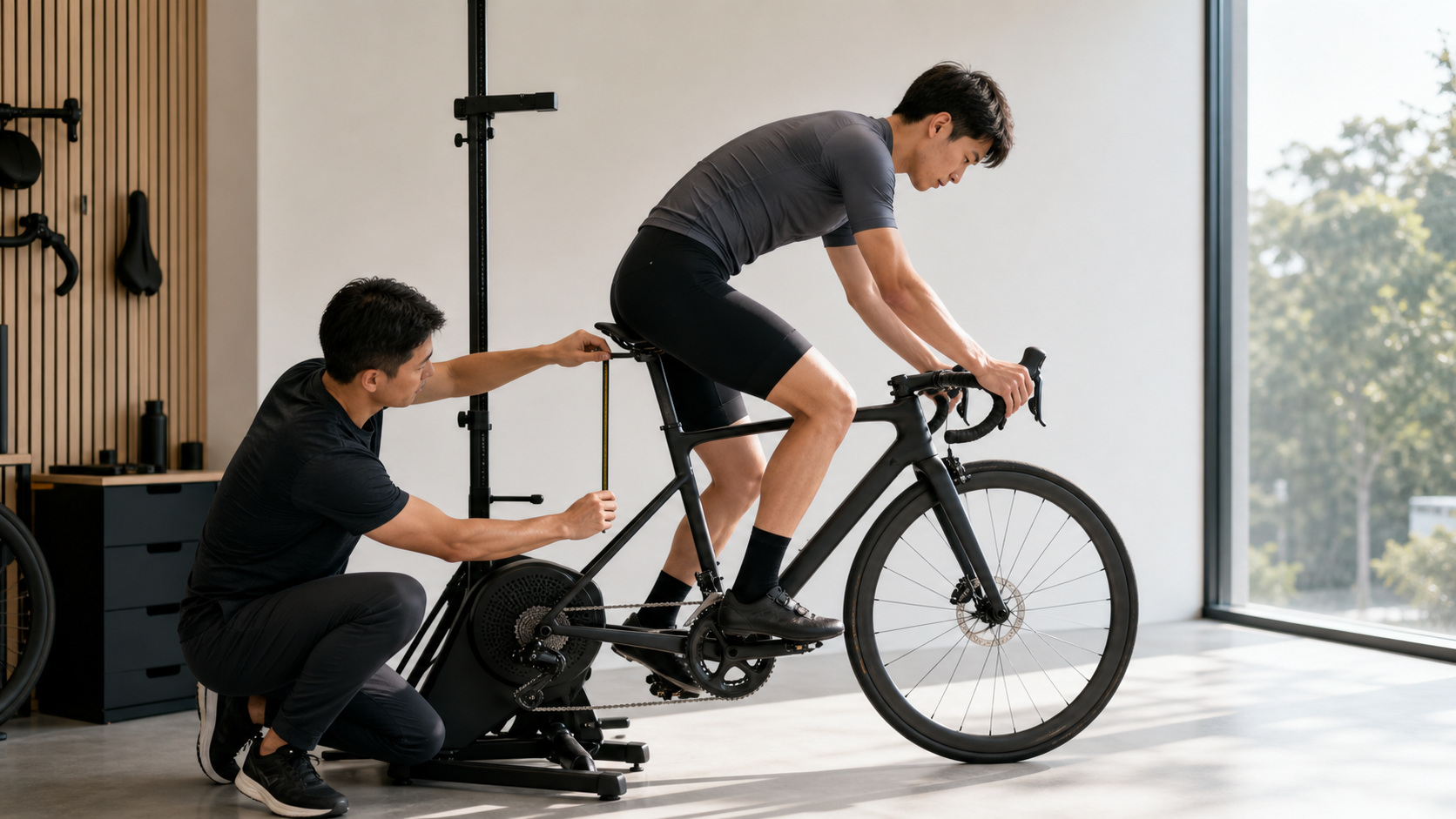
The Adaptation Period After a Bike Fit: Muscle Relearning in the First Two Weeks
Introduction
You spent several thousand dollars on a complete Bike Fit. The technician raised your saddle, shortened your stem, and repositioned your cleats. When you get off the trainer and head home for a test ride, you find the bike “feels strange”—not as comfortable or familiar as before, and some areas even start to feel new discomfort. You begin to wonder: was this fit really effective?
This feeling is almost a universal experience for every rider who undergoes a Bike Fit adjustment, and it’s completely normal. The problem isn’t the fit—it’s that your neuromuscular system needs time to relearn.
The Mechanism of Motor Memory
The body’s movement patterns are controlled by the nervous system. Repeated movements form “muscle memory”—more precisely, motor program memory stored in the cerebellum and basal ganglia.
When your riding position changes (saddle raised 5mm, stem shortened 10mm), your brain still tries to drive your muscles using the old neural signal patterns, but under the new geometric conditions, the old patterns no longer work. This conflict manifests in the first few rides as:
- Pedaling feels “hollow” or “resistant”
- The point of force application feels different from before
- Muscles that never ached before begin to fatigue
- Overall pedaling efficiency feels temporarily reduced
These are all signs of the nervous system recalibrating, not signals that the fit has failed.
The Adaptation Timeline
| Time Period | Body Response | Recommended Action |
|---|---|---|
| Days 1–3 after adjustment | Noticeable unfamiliarity, mild soreness in certain muscles | Ride easy, no more than 60 minutes |
| Days 4–7 | Unfamiliarity decreases, beginning to get used to the new position | Can resume normal training volume, avoid high intensity |
| Days 8–14 | New position becomes more natural, efficiency begins to improve | Can do moderate-intensity training, monitor for pain |
| Weeks 3–4 | Fully adapted; if the setup is correct, pain disappears | Resume full normal training, evaluate final results |
“Normal Adaptation Discomfort” vs. “Signals That Require Caution”
Normal Phenomena (Can Continue to Observe)
- Mild soreness in newly recruited muscle groups (glutes, hip flexors)—this indicates improved muscle recruitment patterns
- Pedaling feels different from before—this is an expected change
- Mild discomfort in the upper body or neck (1–3 days after adjustment)—the new support angles need time to adapt
Signals That Require Immediate Contact with Your Fit Technician
- Sharp pain in the knees (not muscle soreness, but sharp joint or ligament pain)
- Clicking sounds in the ankles or knees accompanied by pain
- Pain that worsens rather than improves after the second week
- New numbness in the hands or feet that wasn’t present before the adjustment
- Saddle pressure points completely different from before, causing severe saddle-area tenderness
Training Recommendations During the Adaptation Period
Week One
- Reduce total riding volume by 30–40%
- Avoid continuous rides exceeding 90 minutes
- Avoid steep climbs or high-intensity sprints
- After each ride, record which body parts feel affected and the severity (on a scale of 1–10)
Week Two
- Can gradually resume normal riding volume
- Do one 2–3 hour long ride to observe how the new setup performs under fatigue
- Continue recording body feedback
Auxiliary Methods to Accelerate Adaptation
1. Stretching for Newly Recruited Muscle Groups
If your glutes or hip flexors are particularly sore after the adjustment, increasing stretching for these areas can speed up adaptation:
- Glute stretch: Supine piriformis stretch—place one ankle on the opposite thigh and pull toward the chest
- Hip flexor stretch: Kneeling lunge with the rear leg flat on the ground, shifting weight forward
2. Off-Bike Core Training
Core training during the adaptation period helps the nervous system accept the new movement patterns more quickly:
- 2 sets of planks daily, 30–60 seconds per set
- 2 sets of bridges daily, 15 reps per set
3. Low-Intensity, High-Cadence Riding
On the trainer, pedal easily at 90–100rpm for 20–30 minutes, allowing the nervous system to repeatedly practice the new pedaling pattern in a low-stress environment.
Evaluation After Two Weeks
After the two-week adaptation period ends, do a self-assessment:
- Has the pain from before the adjustment decreased or disappeared? (If yes, the fit is effective)
- Has any new pain appeared under the new setup? (If yes, contact your fit technician)
- Has your subjective sense of pedaling efficiency improved? (Usually only becomes clearly noticeable in weeks 3–4)
If you still have significant discomfort after two weeks, don’t adjust the setup back to the old values on your own. Instead, bring your records back to discuss with your fit technician—specific descriptions of “where it hurts and under what movement it occurs” can help the technician quickly determine whether further fine-tuning is needed.
Conclusion
A Bike Fit is not a one-time magic fix, but a process that requires your body to cooperate and adapt. Patience and self-observation during the adaptation period are the final mile in fully realizing the benefits of the fit. Give yourself two weeks to let muscle memory rebuild, and you’ll find that afterward, the new setup is not only more comfortable but also more efficient. Every post-adjustment adaptation is an opportunity to understand your body on a deeper level.
Related Reading
- Bike Fit Basics: Why Does Riding Hurt? The Importance of Position Adjustment
- The Adaptation Period After Position Changes: A Study on Performance Recovery Timeline After Fitting Adjustments
- The Supercompensation Principle After Cycling Training: The Balance Between Fatigue and Adaptation
- The Medical Significance of Road Bike Fitting: The Injury Prevention Benefits of Position Adjustment
#公路車 #Fitting 靠人工智慧APP 幫你調整單車
6 年前
Fitting訓練兩用功率車 ! Thinkrider ST900 完整實測!/ 坡度升降 / 鄰居測試/ smart bike/公路車/ CT Yeh
2 年前
一日北高常見問題大集合 | 攻略 | 路線 | 訓練 | 補給 | 自行車 單車 | 一日雙城 | 雙塔 | TWB北高360 | 屁股痛
6 年前
單車 一日北高 ( 雙城 ) 肥宅雙人瘋狂行 紀錄片 REACTO
10 年前
一日北高/長距離團騎 常見問題補充篇 / 組團或跟團的眉角 / 壯車友容易被瘦車友慢性拉爆 / 原來屁股痛可能是這個原因...? / 風場配速法 / 公路車 / CT Yeh
2 年前
靠單車減肥35公斤 心得分享與整理
7 年前
下次拍照前要查清楚啦🤣 #cycling
7 個月前
單車AI教練!全新 ChatGPT4o 幫你分析訓練成果!排武嶺課表,分析騎車姿勢! 太神了! / 公路車 / CT Yeh / feat. 緯緯
2 年前