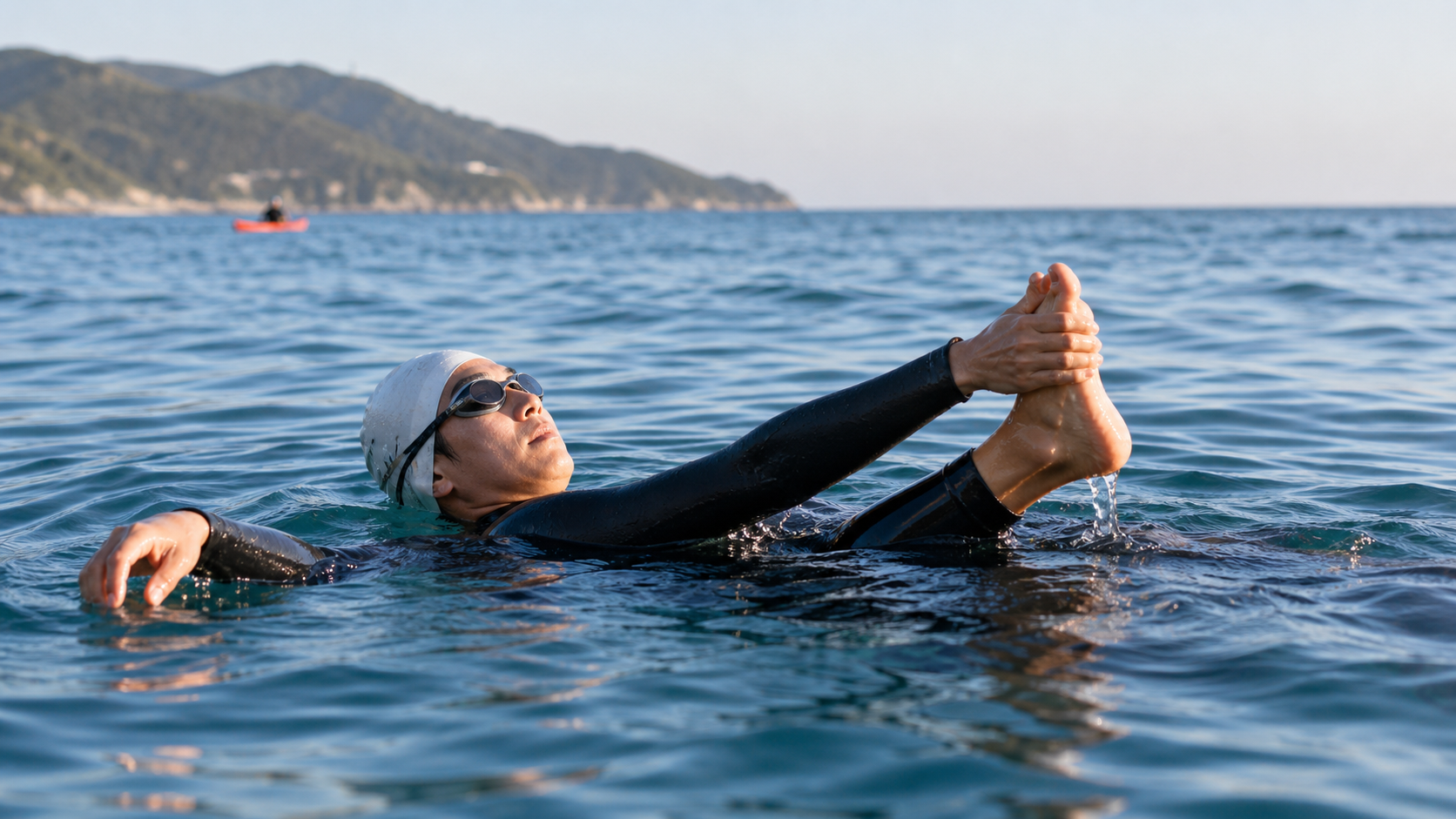
Cramp Management in Open Water: Self-Rescue Techniques for Leg Cramps
Introduction
In open-water swimming, cramping is not a question of “if” but “when.” Water temperatures along Taiwan’s east coast can drop to 18–20°C in winter, and even in summer, deep-water temperatures are significantly lower than near the surface. This temperature difference is one of the main triggers for cramps. When a cramp suddenly strikes in deep water, the intense muscle contraction accompanied by pain can cause you to lose your composure in an instant.
The goal of this article is to ensure you have a clear action plan before, during, and after a cramp occurs.
1. Common Causes of Cramps
| Cause | Explanation |
|---|---|
| Water temperature too low | Cold water constricts blood vessels in muscles, reducing blood supply |
| Electrolyte imbalance | Sodium, magnesium, and calcium deficiency after prolonged swimming |
| Muscle fatigue | Overtraining or excessive intensity during a race |
| Overtraining | Attempting long distances without adequate preparation |
| Dehydration | You sweat even while swimming in water; often overlooked |
| Gear too tight | A wetsuit that is too tight around the ankles restricts blood circulation |
2. Most Common Cramp Locations and How to Respond
Calf muscle cramp (most common):
- Roll onto your back into a back float, stop kicking, and use your arms to maintain buoyancy
- With the hand on the opposite side of the cramped leg, grab your toes and pull them forcefully upward (toward the shin), while pushing your heel outward
- Hold this stretch for 15–30 seconds until the muscle feels relaxed
- After relaxing, gently rotate your ankle to confirm the pain is gone
- When resuming swimming, rely primarily on your arms and kick gently to avoid a recurrence
Toe cramp:
- Roll onto your back and float, grab the cramped toe with your hand, and pull it backward (stretch in the opposite direction)
- At the same time, press the sole of your foot with your palm to help the muscle relax
Front thigh (quadriceps) cramp:
- The most difficult area to self-treat; after rolling onto your back, try to grab your ankle and pull your heel toward your buttock
- If you cannot resolve it on your own, immediately raise your hand and call for help
3. Basic Principles of Self-Rescue in Water
Regardless of where the cramp occurs, the core principles of self-rescue in water are:
- Do not panic: Panic leads to hyperventilation, making it even harder to control your body
- Roll onto your back and float immediately: Back floating requires no kicking, allowing your body to relax and float
- Call for help loudly: If someone or a support boat is nearby, raise one hand and shout
- Float first, then move forward: Ensure you are floating safely before considering how to deal with the cramp
- Do not dive: Attempting to dive underwater to deal with a cramp is dangerous; keep your head above the surface
4. Back Floating Technique (The Most Important Self-Rescue Skill)
Back floating is an essential skill for every open-water swimmer and should be your first response in any emergency:
- Proper posture: Extend both arms out to the sides slightly above the water, point your toes upward and relax, letting the air in your lungs support your body
- Stay still: There is no need to paddle forcefully; once relaxed, your body will float naturally (seawater is more buoyant than freshwater)
- Breathing rhythm: Breathe deeply and slowly to maintain lung volume and increase buoyancy
Every open-water swimmer should practice back floating during every training session until they can easily maintain it for more than 5 minutes.
5. Strategies for Preventing Cramps
- Warm up thoroughly: Perform 10–15 minutes of dynamic leg stretches and light jogging before entering the water
- Electrolyte replenishment: Consume a sports drink containing sodium and magnesium 30 minutes before a long-distance swim
- Acclimatize to water temperature: Do not jump suddenly into cold water; first let sensitive areas such as the neck and armpits contact the water to adapt
- Wetsuit sizing: Ensure the ankle section of your wetsuit is not too tight; if necessary, fold it over slightly at the ankle
- Supplement magnesium after races: Magnesium deficiency is a common cause of post-exercise cramps; consider taking a magnesium supplement
6. Practical Advice
Training recommendations:
- Incorporate back floating practice into your swim training to build an instinctive response in emergencies
- Practice one-arm back float paddling (with the other arm extended): simulate maintaining forward progress with one arm during a cramp
- Regularly perform “electrolyte training”: after long-distance swims, skip electrolyte replenishment and observe your body’s response to understand your own sensitivity
Conclusion
The fear of cramping in the water is often greater than the danger of the cramp itself. As long as you master the back floating technique and proper muscle stretching methods, most in-water cramps can be safely managed on your own. Practice these self-rescue techniques regularly until they become second nature, and you will be able to stay calm when it matters most.
Related Reading
- Swimming Cramps: Causes, Treatment, and Prevention of Calf and Plantar Cramps
- Exercise-Associated Muscle Cramps: The True Causes and Immediate Countermeasures
- The Complete Open-Water Swimming Safety Guide: Sight Navigation, Group Swimming, Hypothermia and Cramp Management, and Three Rules You Must Never Break
- Open-Water Safety and the Science of Hypothermia: Water Temperature, Wetsuit Limits, and Self-Rescue from Cold Shock
Never Stop 西進武嶺 前後雙機 完整全程錄影 訓練台 實境
8 年前
CT 喇低賽) 武嶺牽車 才是王道 西進牽車四小時內秘訣 攝手位置 如何判斷 防抽筋小秘訣
7 年前
[教學] Premiere 影片 手震 修正 教學 防抖 單眼 影像 GoPro 穩定 Video Stabilization
8 年前
CT暗黑廚房) 車友必備 宇宙無敵鮮蚵湯 幫助訓練恢復 天然食補 好市多 超肥鮮蚵 破PR
7 年前
一日北高常見問題大集合 | 攻略 | 路線 | 訓練 | 補給 | 自行車 單車 | 一日雙城 | 雙塔 | TWB北高360 | 屁股痛
6 年前
2016/05/13 單車 冷水坑下滑
10 年前
一日北高/長距離團騎 常見問題補充篇 / 組團或跟團的眉角 / 壯車友容易被瘦車友慢性拉爆 / 原來屁股痛可能是這個原因...? / 風場配速法 / 公路車 / CT Yeh
2 年前
單車 一日北高 ( 雙城 ) 肥宅雙人瘋狂行 紀錄片 REACTO
10 年前