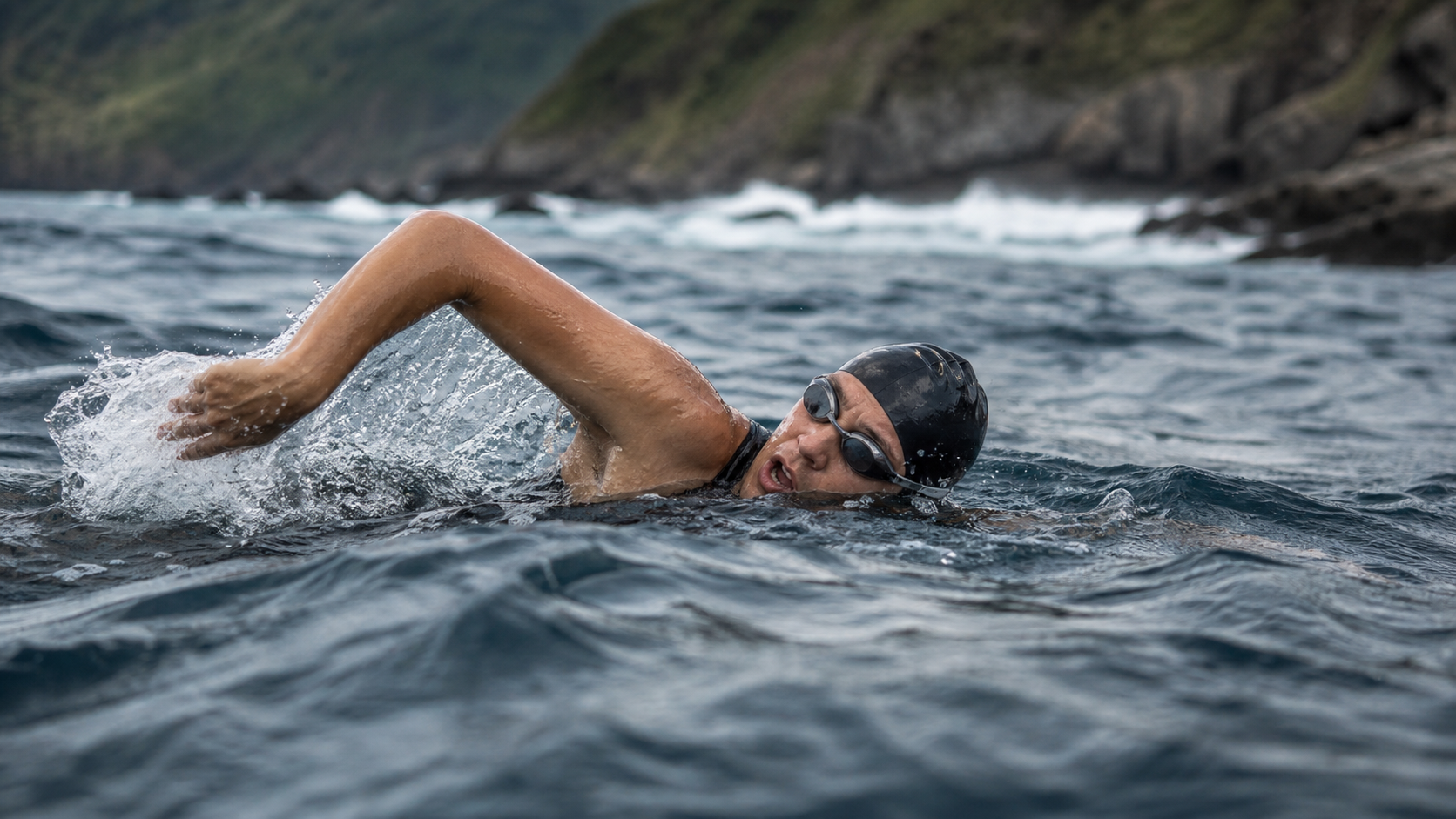
Roll Breathing in Open Water: Breath Protection Technique in Rough Sea Conditions
Introduction
No matter how skilled a swimmer is, when encountering truly rough sea conditions for the first time, they often face the same problem: inhaling seawater while breathing. Wave heights exceeding 0.8 meters, irregular wave patterns, or a wave hitting on the breathing side—these situations are not uncommon in training environments along Taiwan’s Northeast Coast or East Coast.
Standard front crawl breathing has its limitations in rough sea conditions. The advanced “roll breathing” technique allows you to find a safe breathing window in high, irregular waves, maintaining swimming continuity and safety.
1. Limitations of Standard Breathing
The standard front crawl breathing motion: rotate the head 45–60 degrees, breathing at the highest point of the body roll. This works excellently in calm water, but faces the following issues in rough sea conditions:
| Issue | Description |
|---|---|
| Breathing covered by waves | A wave hits from the breathing side just as you turn your head |
| Unstable rhythm | Irregular wave patterns make the breathing window unpredictable |
| Inhaling saltwater | Seawater rushes in the moment the mouth opens |
| Psychological stress | Fear of breathing develops after multiple choking incidents |
2. The Principle of Roll Breathing
Roll Breathing uses a greater degree of lateral body roll, lifting the head higher above the water surface and providing a wider breathing view, thereby finding a safer breathing angle:
- Increased roll amplitude: Increase the side roll from the standard 45 degrees to 60–70 degrees, keeping the face farther from the water surface
- Pause the stroke while breathing: Pause for 0.5 seconds at the highest point of the roll to extend breathing time
- Slight head extension backward: Position the mouth at the highest point of the body, creating greater distance from the water surface
- Mouth shape protection: Slightly purse the lips to prevent seawater from rushing directly in
3. Flexible Adjustment of Breathing Rhythm
In rough sea conditions, a fixed breathing rhythm strategy needs to shift to “opportunistic breathing”:
- Observe the wave cycle: Feel the rhythm of the waves’ rise and fall, identifying the “trough period” (the low point between two wave crests)
- Breathe during the trough: Breathe during the wave trough, when the water surface is calmest
- Bilateral breathing ability: Having bilateral breathing ability is an essential skill for rough sea conditions, allowing you to choose the side with smaller waves
- Breathe every 3–5 strokes: Increase the interval between breaths to wait for a suitable breathing window
4. Recovery Technique After Choking on Water
Choking on seawater is a common occurrence in open water; the key is to recover quickly rather than panic:
Immediate response steps:
- Continue stroking forward while coughing forcefully (do not stop swimming, because stopping means sinking)
- Forcefully exhale through the mouth during the next stroke cycle (expelling inhaled water through the respiratory tract)
- After 2–3 large exhalations to clear the airway, resume normal breathing
- If choking is severe and cannot be cleared, roll onto your back and float to ensure the airway is open
Psychological stabilization after choking:
- Remind yourself “swallowing a small amount of seawater is normal and not life-threatening”
- Slow down your stroke rate for 30 seconds to allow both body and mind to stabilize
5. Emergency Breathing Technique (Head-Up Breathing)
When sea conditions are extremely severe and roll breathing remains difficult, “head-up breathing” can be used as an emergency measure:
- Similar to the head-up swimming style used in water polo or swim instruction, lift the head directly above the water to breathe
- Advantages: Widest breathing view, absolutely cannot be covered by waves
- Disadvantages: Hips sink, speed drops significantly; suitable for brief use before immediately returning to standard breathing
- When to use: After multiple consecutive choking incidents or during extreme panic, use this technique to gain 3–5 normal breaths
6. The Impact of Wetsuits on Breathing
In Taiwan’s autumn and winter seasons, swimming often requires a wetsuit, which affects breathing in the following ways:
- The wetsuit neck restricts the range of head rotation, requiring early adaptation
- Higher buoyancy makes it easier to stay at the water surface, which is beneficial for breathing
- It is recommended to practice breathing movements on shore after putting on the wetsuit to confirm the head can rotate fully
7. Practical Recommendations
Training recommendations:
- Deliberately practice large-amplitude side-roll breathing in the pool to accustom your body to a 70-degree roll angle
- Practice breathing at the beach in moderate sea conditions (wave height 0.5–0.8 meters), gradually increasing sea-condition adaptability
- Conduct a “breathing stress test” with a coach or partner: splash water nearby to create waves and practice protecting your breath
Conclusion
Maintaining stable breathing in rough sea conditions is a key step in evolving from “being able to swim” to “being able to swim in the ocean.” The roll breathing technique allows you to stop passively letting the waves dictate your breathing rhythm and instead actively choose the safest breathing moment. Every successful breath in difficult sea conditions is proof of your deeper understanding of the ocean.
Related Reading
- Swimming Breathing Techniques: Pros and Cons Analysis of Side Breathing and Bilateral Breathing
- Open Water Breathing Rhythm: Long-Distance Maintenance Techniques
- Excessive Body Roll During Freestyle Breathing: Corrective Training for Bilateral Breathing
- Advanced Open Water Breathing Rhythm: The Tactical Value of Bilateral Breathing
[教學] Premiere 影片 手震 修正 教學 防抖 單眼 影像 GoPro 穩定 Video Stabilization
8 年前
#公路車 #Vo2Max #最大攝氧量 測驗 體驗 | 心肺測試
6 年前
空拍機 炸機 卡樹 救援隊出動! DJI Mavic Pro #空拍機
6 年前
風櫃嘴 衝刺慢動作回放!
8 年前
一日北高前的西濱集訓 | 跟著11小時軍團 | 300W踩不動的大逆風 | 輪車破風差幾瓦?
6 年前
如何把 GoPro 影片 翻轉 批次 轉正?
6 年前
一日北高/長距離團騎 常見問題補充篇 / 組團或跟團的眉角 / 壯車友容易被瘦車友慢性拉爆 / 原來屁股痛可能是這個原因...? / 風場配速法 / 公路車 / CT Yeh
2 年前
公路車 爬坡 破PR 紀錄 小技巧 分享
6 年前