Road Race Pace Group Culture: The Sense of Achievement in Leading Others and Community Connection
/no_think
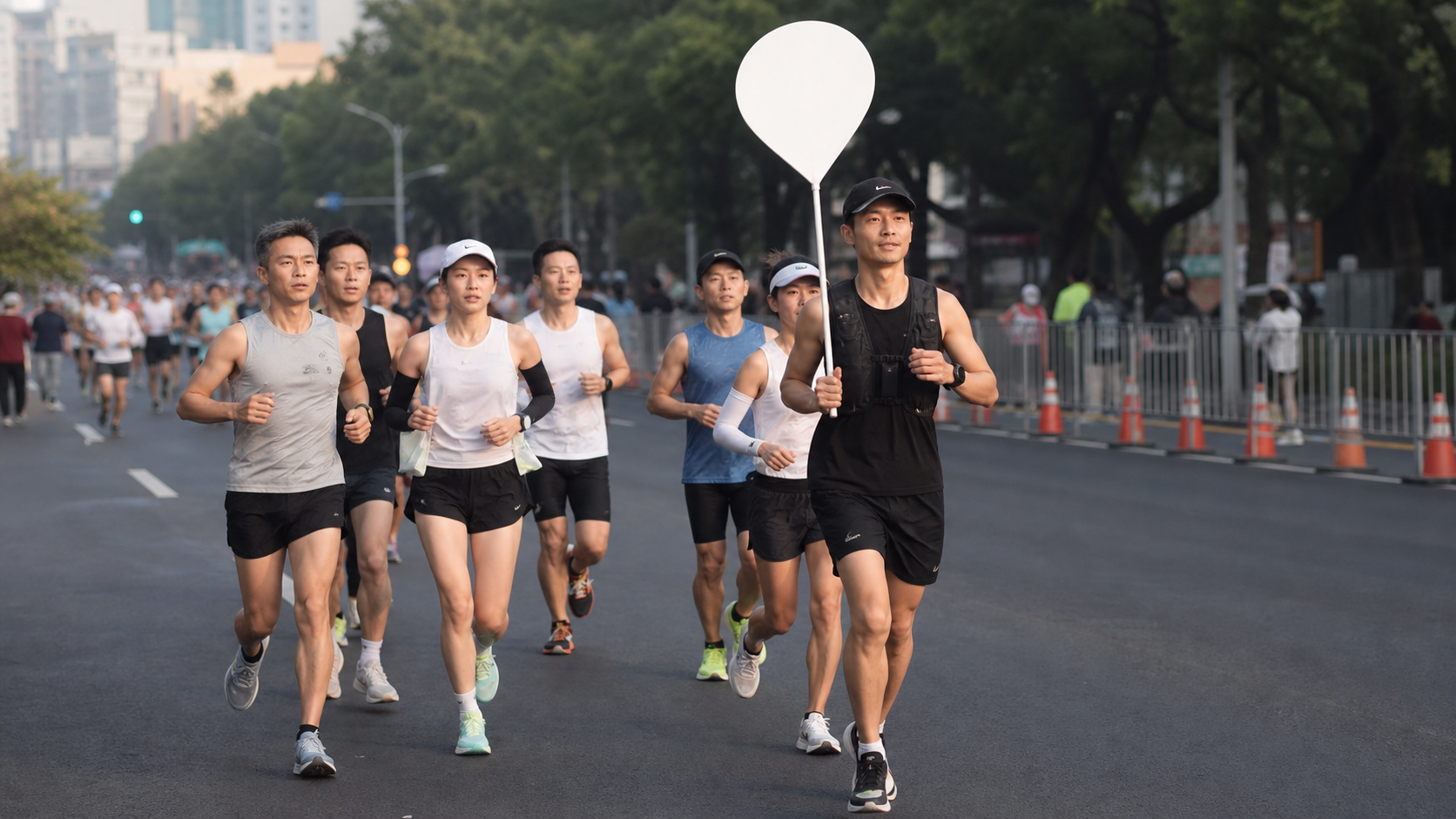
The Pacer’s Back
Thirty minutes after the marathon starts, a person holding a sign reading “4:30 Finish” runs steadily through the crowd. Seven or eight strangers stay close behind, none of them knowing each other, yet at this moment they share a single goal: keep up with that back and reach the finish line.
This scene plays out every year at major events such as the Taipei Marathon, the Taiwan Rice Bank田中馬 (Tianzhong) Marathon, and the Wan Jin Shi Marathon. A pacer is not just a functional presence; he or she is a community node, playing the roles of guide, cheerleader, mobile aid station, and emotional stabilizer over the long 42.195 kilometers.
What Is Pace Group Culture?
The so-called pace group refers to a group of runners led by one or more pacers who complete a full or half marathon at a fixed pace. Pacers are usually recruited by race organizers, though some are spontaneously formed by running communities.
The pacer systems at Taiwan’s major races are roughly as follows:
| Race | Pace Target Setting | Pacer Source | Signage |
|---|---|---|---|
| Taipei Marathon | 3:00 ~ 5:30 (groups every 15 minutes) | Recruited from running communities | Hand-held balloon signs |
| Tianzhong Marathon | 4:00 ~ 5:00 | Local running club volunteers | Vest markings |
| Wan Jin Shi Marathon | 3:30 ~ 5:00 | Running brand partnerships | Flag signs |
| Fubon Marathon | 3:15 ~ 5:30 | Recruited by sponsors | Backpack flags |
The Psychology of Running with a Pacer
What pacers bring is not just pace management, but more importantly a psychological anchoring effect.
When a runner is unsure whether they can finish within four and a half hours, having a steadily advancing pacer nearby sends a silent message: “This pace is achievable, and you can keep up.” That confidence itself is often the key to a breakthrough.
Runners in a pace group often experience the following:
- No overspeeding in the first half: Pacers will remind group members not to get carried away by excitement and run too fast
- Someone to chat with on climbs: It shifts attention away, making tough sections less unbearable
- Encouragement before the 30K wall: Pacers typically boost morale at critical psychological moments
- A collective sprint in the final 5 kilometers: The entire pace group speeds up together, amplifying the emotion at the finish
The Other Side of Leading: The Pacer’s Sense of Achievement
Many people don’t know that many pacers volunteer and receive no pay. They are runners who, above the level of ordinary runners, voluntarily slow down and serve those around them with a pace easier than their own ability.
“That sense of achievement is completely different from setting your own PB,” said a runner who served as a 4:00 pacer at the Taipei Marathon. “Seeing runners cross the finish line following you—those tears… are more moving than when you cross the line yourself.”
The skills of leading others go beyond just running steadily:
- Pace calculation: You need to account for how uphills and downhills affect pace to ensure the overall time is correct
- Observing the group’s condition: Who is gasping, who is shaking, who might need to drop out or take on fuel
- Communication skills: Knowing when to stay silent and when to say the right thing
- Energy management: You still have to run the full distance while taking care of others—both physical and mental stamina are tested
The Unofficial “Wild Pacer” Culture
Beyond official race pacers, Taiwan also has an interesting “wild pacer” phenomenon—pace groups spontaneously formed by runners during training.
Every Saturday morning at Dajia Riverside Park, and every Sunday under Rainbow Bridge, small groups quietly form at fixed times and fixed paces. These informal pace groups have no signs and no official recognition—just a few runners who tacitly maintain the same rhythm so that everyone runs better.
How to Find a Pace Group That Suits You
If you want to enhance your running experience through a pace group, here are some practical tips:
- Choose a pace group “5 minutes slower” than your goal: Don’t be greedy; first make sure you can finish the whole way with them
- Confirm the meeting point the day before the race: At major events, pacers usually gather at a specific spot in the starting corral
- Introduce yourself proactively: Tell the pacer about your condition so they know what to expect from you
- Don’t run ahead of the pace group in the first 10 kilometers: Overexcitement is the most common reason plans fall apart
- Don’t panic if you fall behind in the second half: Find nearby runners with a similar pace and keep going; don’t stop and wait
Conclusion: The Community Code of Marathon Running
Pace group culture reveals the most fascinating contradiction of the marathon: it is an individual sport, yet it is always completed collectively. The pacer is the embodiment of this contradiction—they run with their own feet, but carry the dreams of others.
Next time you see that back moving steadily forward with a time sign on the course, you’ll know that it’s not just one person—it’s the trust and commitment of an entire community.
Related Reading
- The Psychology of Running Communities: The Psychological Support of Pacer-Runner Interaction
- Road Running Pacer Guide: The Complete Strategy for Finishing Strong by Following a Pacer
- A Pacer’s Reflections: Guiding Runners to Achieve Their Goals
- Pacer-Following Techniques in Road Running: How to Use a Pacer to Reach Your Goals
Live) 備戰2019彰化經典百K 賽前攻略 (已完賽請看新影片
7 年前
2025 海鷗團體繞圈賽 網路直播 超激烈裁判長視角 / EIPC 李廷威、Waypoint 等眾多高手競爭 / feat. 卡密兒主持 / 海鷗繞圈賽
9 個月前
西進武嶺配速器 3.0更新 / NEW 免功率FTP估算! / 大數據xAI體能模型 / 如何模擬人止關前集團效應 / 配速儲存功能 / AI全台自行車賽事行事曆 / 公路車 / CT Yeh
1 年前
新屋團體繞圈賽 | 眾多菁英好手賽道奔馳 | 千瓦女子軍團 | 無敵交管狂獲好評 明年你一定不能錯過 | #公路車
5 年前
2024桃園團體自由車邀請賽!4K環台賽等級拍攝 全賽事精華!/ 集團大摔車 / 60隊菁英好手衝線 / 公路車 CT Yeh
1 年前
2019 柯P 超越北高 第一集團實錄 (11小時實錄請參考另一部影片) 一日雙城 一日北高 NeverStop Taiwan Long Distance Cycling Challenge
7 年前
西進武嶺 自製新版AI配速表產生器 x 賽前攻略 抱佛腳! 沒有功率計也可以產生配速表嗎?有什麼其他眉角賽前要注意的呢? | 西進武嶺 / 東進武嶺 KOM 攻略 | 公路車 | CT Yeh
4 年前
2023桃園團體繞圈賽/環台賽等級拍攝/賽事精華/ 10人一隊缺一不可!50隊廝殺大場面 / 第三屆 海鷗繞圈賽 /公路車/CT Yeh
2 年前