50m Freestyle Splitting Strategy: The Optimal Ratio of the First 15 Meters, Mid-Race Maintenance, and Final Sprint
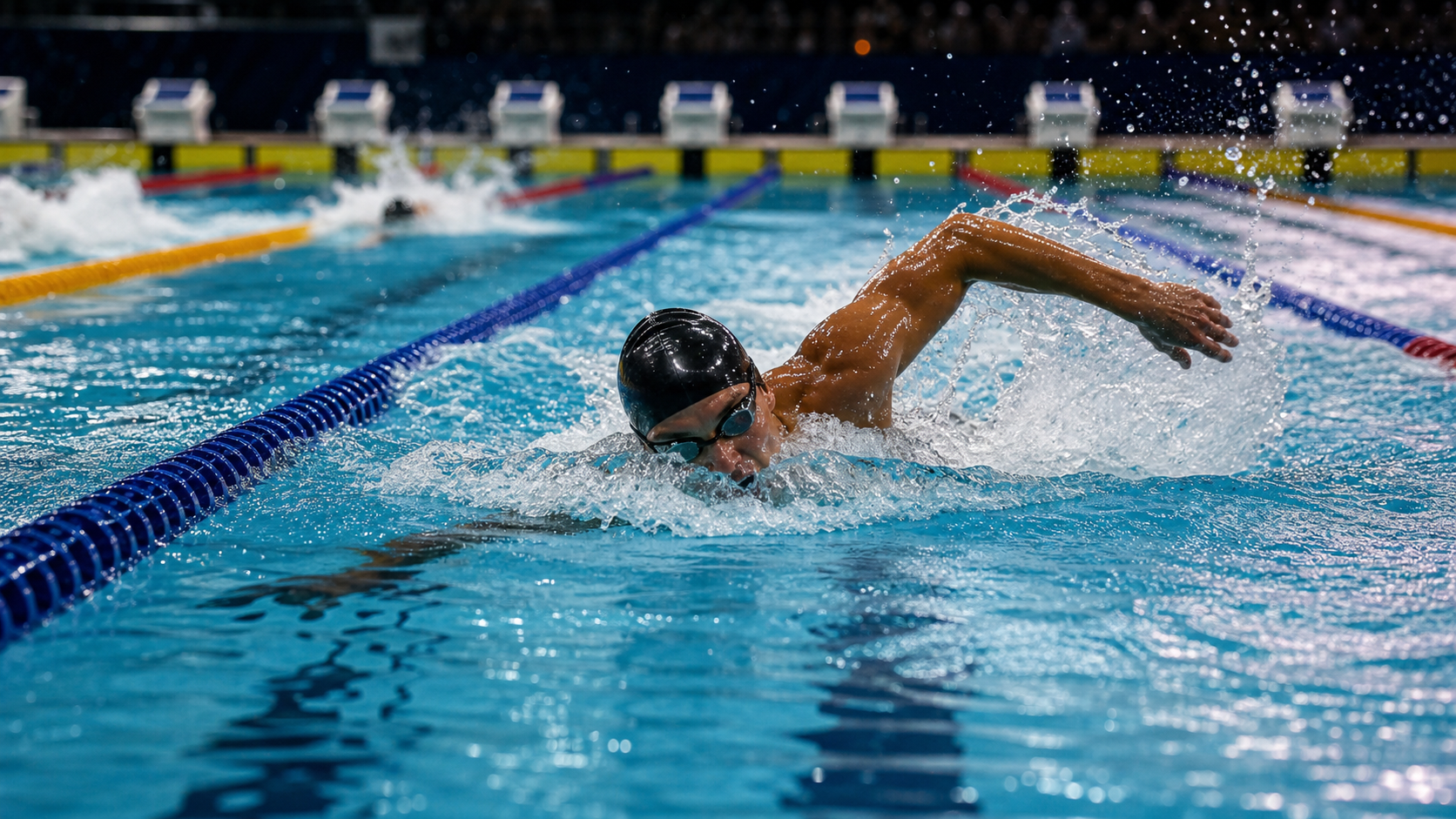
50m Freestyle Splitting Strategy: The Optimal Ratio of the First 15m, Middle Maintenance, and Final Sprint
Introduction
The 50m freestyle is the shortest and most intense event in pool competition. World-class swimmers finish between 20 and 22 seconds, while accomplished amateurs typically range from 24 to 30 seconds. Over this extremely short distance, every 0.1-second difference can change the ranking. Many swimmers assume that “going all-out” is the best strategy, but in reality, the 50m freestyle also follows a precise splitting logic—an incorrect pacing approach will cause you to start slowing down after the 15-meter mark.
1. The Physiological Background of the Three Segments
The 50m freestyle can be divided into three segments based on energy systems:
| Segment | Distance | Primary Energy System | Key Technique |
|---|---|---|---|
| Start and Glide | 0–15m | ATP-PCr (Phosphocreatine) | Dive angle, underwater dolphin kick |
| Middle Swimming | 15–40m | ATP-PCr + Lactic Acid System | Stroke rate maintenance, breathing timing |
| Final Sprint | 40–50m | Lactic Acid System + Willpower | No breathing, reduced drag |
The phosphocreatine system relied upon in the front segment can provide peak power output within 6 to 8 seconds—this is the energy source for the glide after the start. Once you enter the middle swimming segment, the lactic acid system gradually kicks in, and swimmers must control the balance between stroke rate and stroke length to avoid hitting the wall prematurely.
2. The First 15m: Start Technique Sets the Tone for the Race
The first 15 meters include the starting block dive, entry glide, underwater dolphin kick, and breakout strokes, typically accounting for 30 to 35% of the total race time. Elite swimmers can maintain glide momentum for 12 to 15 meters after entry, and this distance is often faster than swimming on the surface.
Key execution points:
- A dive angle of 15 to 20 degrees at entry is ideal; too steep wastes entry speed, while too flat increases body drag
- Maintain 6 to 8 underwater dolphin kicks with a fast tempo (approximately 2.5 to 3 kicks per second), keeping the amplitude moderate to avoid compromising your breakout timing
- Time your breakout based on your hands extended forward; break out immediately when your speed approaches or drops below your surface swimming speed
- The first two to three strokes after breakout should be quick and short to help accelerate into cruise rhythm
If your start and breakout technique in the first 15 meters is rough, no amount of effort in the later stages can fully compensate for the lost speed advantage.
3. Middle Segment (15 to 40m): Maintain Stroke Efficiency, Don’t Panic
Entering the middle segment, many swimmers over-increase their stroke rate due to adrenaline, which shortens stroke length and reduces the efficiency of each pull. This is the most common mistake among amateur swimmers.
Three priorities for middle-segment strategy:
- Prioritize maintaining stroke length: Each hand entry should have the elbow higher than the wrist, ensuring a complete underwater pulling path
- Control breathing frequency: For the 50m, it is recommended to swim the entire race without breathing or with at most one breath (around the 25m mark); breathing causes the head to lift and hips to drop, increasing drag
- Consistency of rhythm: Stroke rate should remain close to the rhythm established after the breakout, without artificially speeding up or deliberately slowing down
A common issue among Taiwanese swimmers is “suddenly exploding the stroke rate after 25 meters,” which usually indicates either being overly conservative in the front half or insufficient physical conditioning causing the body to send a false “push harder” signal—but accelerating at this point often leads to technical breakdown.
4. Final 10m (40 to 50m): Technical Keys for the All-Out Sprint
The final 10 meters mark the peak of lactic acid accumulation; muscles begin to ache and technique easily deteriorates. The key to this distance is not “trying harder” but “maximizing output while maintaining technique.”
Final sprint execution checklist:
- No breathing: Stop breathing from the 40m mark and push water with full effort
- Minimize head movement: Keep the head fixed and facing down, reducing side-to-side sway
- Increase kick rate: In the final 5 meters, kick rate can be 20 to 30% faster than in the middle segment
- Wall touch timing: Do not reach early; keep stroking until the final stroke before touching the wall, avoiding a “glide into the wall” that wastes time
5. Practical Training Recommendations
Training for the splitting strategy can be broken down as follows:
- Start-specific work: Include 5 to 8 sets of 15m start sprints in each session, timing the breakout, with a target of under 7 seconds (amateur standard)
- Stroke efficiency test: Perform 25m “minimal stroke count” drills, recording the number of strokes per length to develop stroke-length awareness
- No-breath tolerance: Practice swimming 25m without breathing to build CO2 tolerance, preparing for the final sprint of the 50m
- Race-pace simulation: At least once a week, swim a full 50m at race pace to let the nervous system memorize the feeling of maximal output
Conclusion
The outcome of a 50m freestyle race is often decided during the preparation phase. Start technique determines your advantage in the first 15 meters, middle-segment stroke efficiency conserves your energy, and technical discipline in the final 10 meters determines whether you hold on to the finish. If Taiwanese swimmers can systematically break down the three segments and train accordingly, even without chasing world records, they can significantly improve their results at the National High School Athletic Games or the University Sports Meet. Treat every practice as a strategic experiment, not just physical exertion—that is the true key to progress.
Related Reading
- 200m Freestyle Splitting Strategy: Pacing Control Across Four 50m Laps
- Swimming 100m Freestyle Front-Back Pacing: World Record Split Analysis
- 100m Freestyle Pacing: The Science of Time Distribution Between First and Second Half
- 100m Freestyle Pacing Analysis: Optimal Front-Back Half Distribution Ratio and Performance Impact
西進武嶺 免費訓練分析服務 Intervals | 練不夠還是練過頭?你哪一種類型選手?AI模型告訴你! | 備戰神器 | 公路車 訓練 | CT Yeh
4 年前
Live) 備戰2019彰化經典百K 賽前攻略 (已完賽請看新影片
7 年前
西進武嶺 自製新版AI配速表產生器 x 賽前攻略 抱佛腳! 沒有功率計也可以產生配速表嗎?有什麼其他眉角賽前要注意的呢? | 西進武嶺 / 東進武嶺 KOM 攻略 | 公路車 | CT Yeh
4 年前
CT 喇低賽) 武嶺牽車 才是王道 西進牽車四小時內秘訣 攝手位置 如何判斷 防抽筋小秘訣
7 年前
教學) 如何做出專業 慢動作 影片 Slow Motion 120fps GoPro 7 ActionCam AX700 A99II
7 年前
live) 超越北高 之一日北高12小時 策略
7 年前
FTL 與 SYB 車隊專訪 西進武嶺 實用攻略分享! 2小時 如何練?!你不知道的眉角!新手準備武嶺必看 EP1 | 實力派女車友 | 精華版 | 公路車 | CTYeh
4 年前
2016 桐花飛舞 單車挑戰 精華片段
10 年前