100m Freestyle Pacing Analysis: Optimal Front/Back Half Split Ratios and Their Impact on Performance
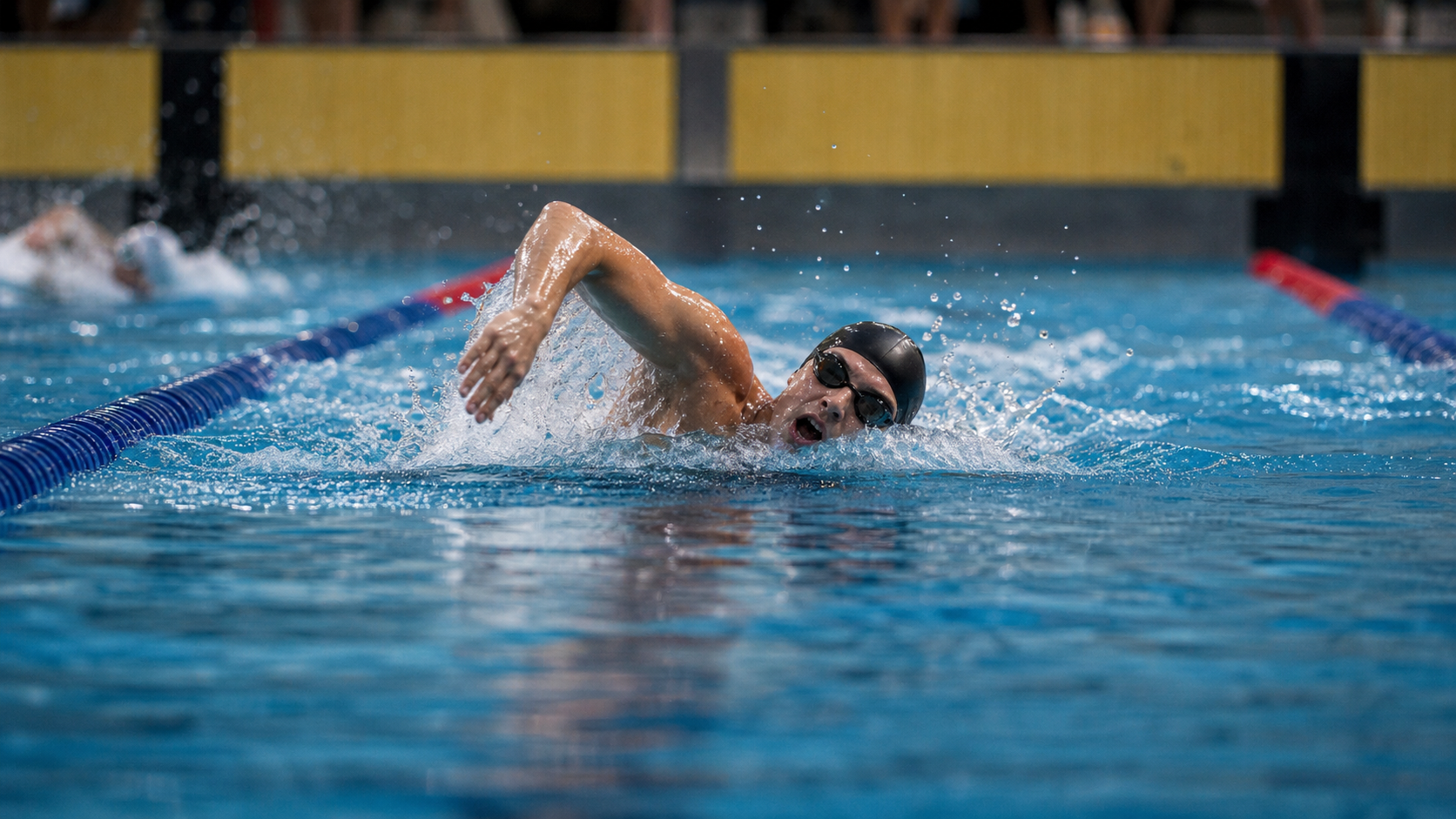
Pacing Analysis of the 100m Freestyle: Optimal Front/Back Half Split Ratios and Performance Impact
Introduction
The 100m freestyle is one of the most spectator-friendly events in Olympic swimming. Sitting between an all-out sprint and aerobic endurance, it requires athletes to precisely manage the balance between explosive power and lactate metabolism within roughly 45 to 55 seconds. Many beginners or amateur swimmers are accustomed to “going all-out in the first half and hanging on for dear life in the second,” which often results in a noticeable drop in speed after the 75-meter mark and a final time that falls short of expectations. This article analyzes the optimal front/back half split ratio from the perspective of segment pacing.
1. Basic Framework of Pacing Analysis
The 100m freestyle can be divided into two halves of 50 meters each. In competitive analysis, the ratio of the second-half time to the first-half time—known as the “Negative Split Ratio”—is a key metric for evaluating pacing strategy.
| Pacing Type | Front 50m Share | Back 50m Share | Back/Front Ratio | Suitable Athlete Level |
|---|---|---|---|---|
| Positive split (fast first, slow second) | 47–48% | 52–53% | 1.08–1.12 | Most amateur swimmers |
| Even pacing | 49–50% | 50–51% | 1.00–1.04 | Intermediate to advanced swimmers |
| Negative split (slow first, fast second) | 50–51% | 49–50% | 0.96–1.00 | Some swimmers transitioning from longer distances |
According to data from past Olympic finals compiled by World Aquatics, the back/front ratio for men’s 100m freestyle champions typically falls between 1.03 and 1.06, indicating that elite swimmers hold back slightly in the first half to ensure they don’t fade dramatically in the second.
2. The First 50 Meters: Building an Advantage Without Overextending
The first 50 meters includes the start, underwater dolphin kick, and the first turn. This segment is primarily powered by the phosphocreatine system, with the lactate system beginning to kick in. A common mistake swimmers make is pushing at maximum stroke rate between the 25- and 30-meter marks, causing lactate to accumulate too early and too heavily.
Execution strategy for the first 50 meters:
- Start to 15 meters: Fully utilize the momentum from the dive, with 6 to 8 underwater dolphin kicks
- 15 to 50 meters: Reach 90 to 95% of your personal maximum cruising speed, without chasing absolute top speed
- Turn technique: Aim for a glide distance of at least 3.5 meters after pushing off the wall from the flip turn
- Breathing frequency: Breathe every 3 to 4 strokes, no more frequently than every 2 strokes
3. The Back 50 Meters: Technical Discipline Decides the Outcome
Entering the second half, lactate levels have risen significantly, and swimmers will feel heavy arms and a shortened stroke length. The key here is not “swim harder” but “maintain maximum output while preserving technical quality.”
Common problems and solutions in the back 50 meters:
- Shortened stroke length: Remind yourself to extend your arm fully after each entry and complete the full pulling arc
- Disrupted kick rhythm: Maintain a 6-beat kick, slightly increasing frequency without overexerting
- Head lifting upward: Deliberately keep your eyes on the pool bottom to avoid neck tension pulling your head up
- No breathing in the final 10 meters: Stop breathing from the 90-meter mark and sprint all-out to the wall
According to analysis, swimmers who lose more than 5% of their speed in the back 50 meters often had a stroke rate in the first half that exceeded their most efficient range, or breathed too frequently (every 2 strokes).
4. Training Methods for Front/Back Half Pacing
Achieving an ideal segment split requires targeted training design:
Pacing awareness training:
- Do 4×100m of your main event, with the first repeat deliberately “conservative in the front half” (front 50m 1 second slower than usual), and observe how the back 50m feels and how fast you go
- Use a stopwatch to record 50m split times for every 100m swim, building a personal pacing database
Lactate tolerance training:
- 8×50m, each repeat at 90% effort, with 60 seconds rest, to build the ability to maintain technique at moderately high intensity
- 4×100m, with 3 minutes rest, completing the back 50m at race pace while maintaining technique
Turn-specific training:
- Arrange 10 to 15 dedicated flip-turn practice repetitions in each session, paying special attention to push-off angle and glide position
5. Common Pacing Issues Among Taiwanese Swimmers
Observing swimming competitions at various levels in Taiwan, the three most common pacing errors among amateur swimmers are:
- Overexcitement after the start: Spurred on by the crowd and the atmosphere, swimmers push the first 25 meters at a pace beyond their training level, causing speed to drop as early as the middle of the race
- Losing momentum on the turn: Failing to execute the flip turn effectively costs roughly 0.5 to 1 second per turn; with only one turn in the 100m, it is extremely valuable
- Abandoning technique in the back half: After the 75-meter mark, feeling like they “can’t swim anymore,” swimmers shorten their stroke or even switch to head-up breathing, causing their time to plummet
Conclusion
The optimal pacing strategy for the 100m freestyle is to “build an advantage in the front half without overextending, and hold speed in the back half through technical discipline.” The golden front/back split ratio is approximately 47 to 49% of the time in the front half and 51 to 53% in the back half, allowing for a slight positive split. For swimming enthusiasts and competitive athletes in Taiwan, incorporating pacing training into the daily practice plan and regularly recording 50m split data is one of the most direct and effective ways to break personal records.
Related Reading
- 100m Freestyle Pacing: The Science of Front/Back Half Time Distribution
- Front/Back Half Pacing in the 100m Freestyle: World Record Split Analysis
- Segment Pacing Strategies in Swimming: Front/Back Half Ratios for 50m, 100m, 200m, and 400m
- 50m Freestyle Segment Strategy: Optimal Ratios for the First 15m, Middle Maintenance, and Final Sprint
崇越盃武嶺冠軍高手 賽前JJSC 群峰會精華!對應大數據分析,會有落差嗎?/ feat. JJSC中部公路車約騎 /公路車 / CT Yeh
2 年前
西進武嶺 免費訓練分析服務 Intervals | 練不夠還是練過頭?你哪一種類型選手?AI模型告訴你! | 備戰神器 | 公路車 訓練 | CT Yeh
4 年前
西進武嶺 自製新版AI配速表產生器 x 賽前攻略 抱佛腳! 沒有功率計也可以產生配速表嗎?有什麼其他眉角賽前要注意的呢? | 西進武嶺 / 東進武嶺 KOM 攻略 | 公路車 | CT Yeh
4 年前
西進武嶺各路段 前8000名 大數據分析 配速攻略/功率/心律/推力比/維持率/踏頻/踏瓦比/牽車率 大公開 | 建大盃 NeverStop 可參考 | 公路車 | CT Yeh
5 年前
Live) 備戰2019彰化經典百K 賽前攻略 (已完賽請看新影片
7 年前
武嶺配速表最佳使用方式 #bike
1 年前
一日北高/長距離團騎 常見問題補充篇 / 組團或跟團的眉角 / 壯車友容易被瘦車友慢性拉爆 / 原來屁股痛可能是這個原因...? / 風場配速法 / 公路車 / CT Yeh
2 年前
戀戀197 競賽組 | 50頁投影片心得報告 | 賽後檢討 攻略 #公路車
6 年前