The Four-Lap Strategy for the 200m Freestyle: Pace Management and Energy Distribution Every 50 Meters
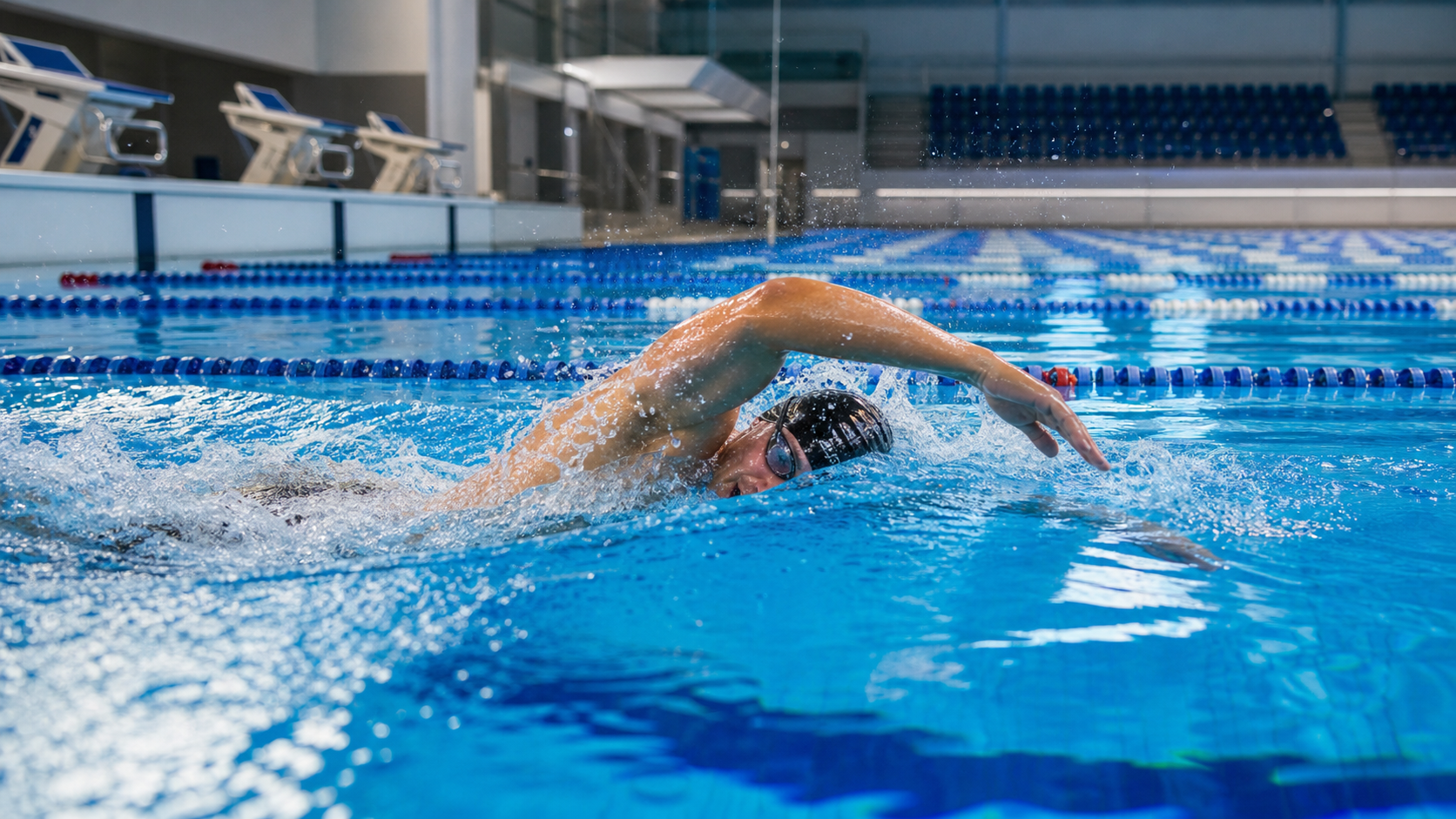
Four-Lap Strategy for the 200m Freestyle: Speed Management and Energy Distribution Every 50m
Introduction
The 200m freestyle is called by many swimming coaches “the distance that tests wisdom the most.” It is too short to be approached conservatively like an endurance event; it is too long to sprint all-out without collapsing in the latter half. This event demands that athletes precisely control the speed curve across four 50m laps during a 1:40 to 2:00 race, while maintaining high-level technical execution. From Michael Phelps to Paul Biedermann, the success of elite swimmers is built on meticulous four-lap strategies.
1. Energy System Analysis of the Four Laps
The 200m freestyle spans three energy systems, which is exactly the source of pacing complexity:
| Lap | Distance | Primary Energy System | Lactate Concentration | Recommended Intensity |
|---|---|---|---|---|
| Lap 1 | 0–50m | ATP-PCr + Lactic Acid | Low→Moderate | 90–95% |
| Lap 2 | 50–100m | Lactic Acid + Aerobic | Moderate→High | 88–92% |
| Lap 3 | 100–150m | Aerobic + Lactate Tolerance | High | 87–91% |
| Lap 4 | 150–200m | Lactate Clearance + Willpower | Highest | 92–98% |
Interestingly, the intensity in Lap 4 is actually the highest, because the “conservation strategy” in the first three laps accumulates enough reserve, allowing the swimmer to launch a true sprint in the final stage.
2. Lap 1 (0 to 50m): A Controlled Start
The core principle of Lap 1 is “establish the rhythm, don’t blow up.” Many swimmers (especially amateurs), driven by the atmosphere and starting adrenaline, swim the first lap 2 to 3 seconds faster than in practice, ultimately causing a severe slowdown in the last two laps.
Key Execution Points for Lap 1:
- Maintain at least 6 underwater dolphin kicks after the start to fully utilize the entry momentum
- Deliberately control stroke rate for the first 10 strokes after surfacing; do not chase maximum speed
- Lap 1 speed should be 2 to 3 seconds slower than your personal best 50m time
- Breathe every 3 strokes to establish a stable breathing rhythm
3. Lap 2 (50 to 100m): The Core of Rhythm Stability
Lap 2 is the “engine room” of the entire race; the rhythm established here will affect all performance in the second half. After the flip turn, the swimmer should settle into a sustainable, steady pace that feels like “somewhat hard but not at the limit.”
Key Execution Points for Lap 2:
- Flip turn quality is crucial; push off the wall with sufficient force and maintain a glide distance of 3 to 4 meters
- Maintain a balance between stroke rate and stroke length; don’t shorten your stroke just because it “feels fast”
- Breathing rhythm can be adjusted to every 2 to 3 strokes to increase oxygen supply
- Maintain body roll to reduce water resistance
4. Lap 3 (100 to 150m): The Toughest Mental Barrier
Lap 3 is usually where 200m swimmers are most prone to a “mental breakdown.” Lactic acid accumulation peaks, arms begin to feel heavy, and the urge to breathe is strong. This 50m is often where the biggest gap between amateur and competitive swimmers appears.
Three Mental Strategies for Lap 3:
- “Technique First” Cue: When feeling fatigued, silently repeat “high elbow, full pull, turn over,” using a technical focus to divert from the feeling of fatigue
- “Rhythm Unchanged” Belief: Tell yourself “I’m just maintaining, not accelerating,” avoiding premature use of sprint reserves
- “The Finish Awaits” Expectation: Visualize the sprint sensation of Lap 4, creating anticipation rather than fear
Common Mistakes in Lap 3:
- Starting to sprint before the 150m mark, causing a severe slowdown in the final 10 meters
- Breathing too frequently (every 2 strokes), with the head lift increasing drag
- Kicking stalls, relying entirely on arm propulsion
5. Lap 4 (150 to 200m): A Strategic All-Out Sprint
After the 150m mark, the swimmer should begin a planned “release” of the energy conserved in the first three laps. This is not “going all-out,” but rather “progressively accelerating.”
Lap 4 Execution Checklist:
- After the 150m turn, increase kick frequency by 20 to 30%
- From the 180m mark, stop breathing and push the water with full effort until touching the wall
- Slightly increase stroke rate, but ensure every pull still finishes fully past the thigh
- Do not shorten the final stroke before touching the wall; keep the body streamlined at the moment the fingers hit the wall
6. Reference Benchmarks for Four-Lap Time Distribution
Using a time of 1:50 (intermediate-advanced amateur male) as an example, the ideal four-lap distribution is approximately:
- Lap 1: 26.5 seconds
- Lap 2: 27.5 seconds
- Lap 3: 27.8 seconds
- Lap 4: 28.2 seconds
The first-half/second-half ratio (last 100m / first 100m) ≈ 1.03, which falls within the golden zone of a slight positive split. If the second half slows by more than 3 seconds (ratio exceeding 1.06), it usually indicates the first half was too fast or a mental breakdown in Lap 3.
7. Training Recommendations
Training design targeting the four-lap strategy:
- Split Timing Training: 4×200m main set, recording the four 50m split times for each repetition, with the goal of keeping the time difference among the first three laps within 1.5 seconds
- Lap 3 Specialty: Practice 50m sprints starting from the 100m mark, maintaining technique under lactic acid accumulation
- Turn Specialization: 3×6 turns, emphasizing push-off angle and glide posture, timing each turn
Conclusion
The four-lap strategy for the 200m freestyle is not a fixed formula, but a dynamic plan adjusted according to individual fitness, technique, and mental state. For Taiwanese swimmers, the most important first step is “start recording split times.” Without data, there is no strategy; only by knowing your time for each lap can you find the true pacing flaws and correct them. Treat every practice as a pacing experiment, and you will find significant room for improvement in your performance without increasing training volume.
Related Reading
- 200m Freestyle Splitting Strategy: Rhythm Control Across Four 50m Segments
- The Art of Pacing in the 400m Freestyle: The Swimming Event That Tests Judgment Most
- 50m Freestyle Splitting Strategy: The Optimal Ratio of the First 15m, Middle Maintenance, and Final Sprint
- Energy Distribution in the 400m Freestyle: Pacing Curve Design Under Aerobic Dominance
西進武嶺 免費訓練分析服務 Intervals | 練不夠還是練過頭?你哪一種類型選手?AI模型告訴你! | 備戰神器 | 公路車 訓練 | CT Yeh
4 年前
西進武嶺 自製新版AI配速表產生器 x 賽前攻略 抱佛腳! 沒有功率計也可以產生配速表嗎?有什麼其他眉角賽前要注意的呢? | 西進武嶺 / 東進武嶺 KOM 攻略 | 公路車 | CT Yeh
4 年前
Live) 備戰2019彰化經典百K 賽前攻略 (已完賽請看新影片
7 年前
CT 喇低賽) 武嶺牽車 才是王道 西進牽車四小時內秘訣 攝手位置 如何判斷 防抽筋小秘訣
7 年前
2026 輪霸西濱200K 挑戰VLOG / 第一集團 / 首次參加..經驗不足、膀胱不足 /死守6H內 / AI戰鬥力顯示系統 / 公路車 / CT Yeh
4 個月前
單車AI教練!全新 ChatGPT4o 幫你分析訓練成果!排武嶺課表,分析騎車姿勢! 太神了! / 公路車 / CT Yeh / feat. 緯緯
2 年前
戰略) Zwift Race 如何咬在第一集團 如何評估自己要開多少推力 (請開1.5倍速看)
7 年前
JE22 百里任務體驗,心跳不能過150,三小時內有可能...? 沒有天時地利難度有多高? / 公路車 / CT Yeh
1 年前