Long-Distance Strategy for the 1500m Freestyle: Pacing by Splits and Mental Milestone Management
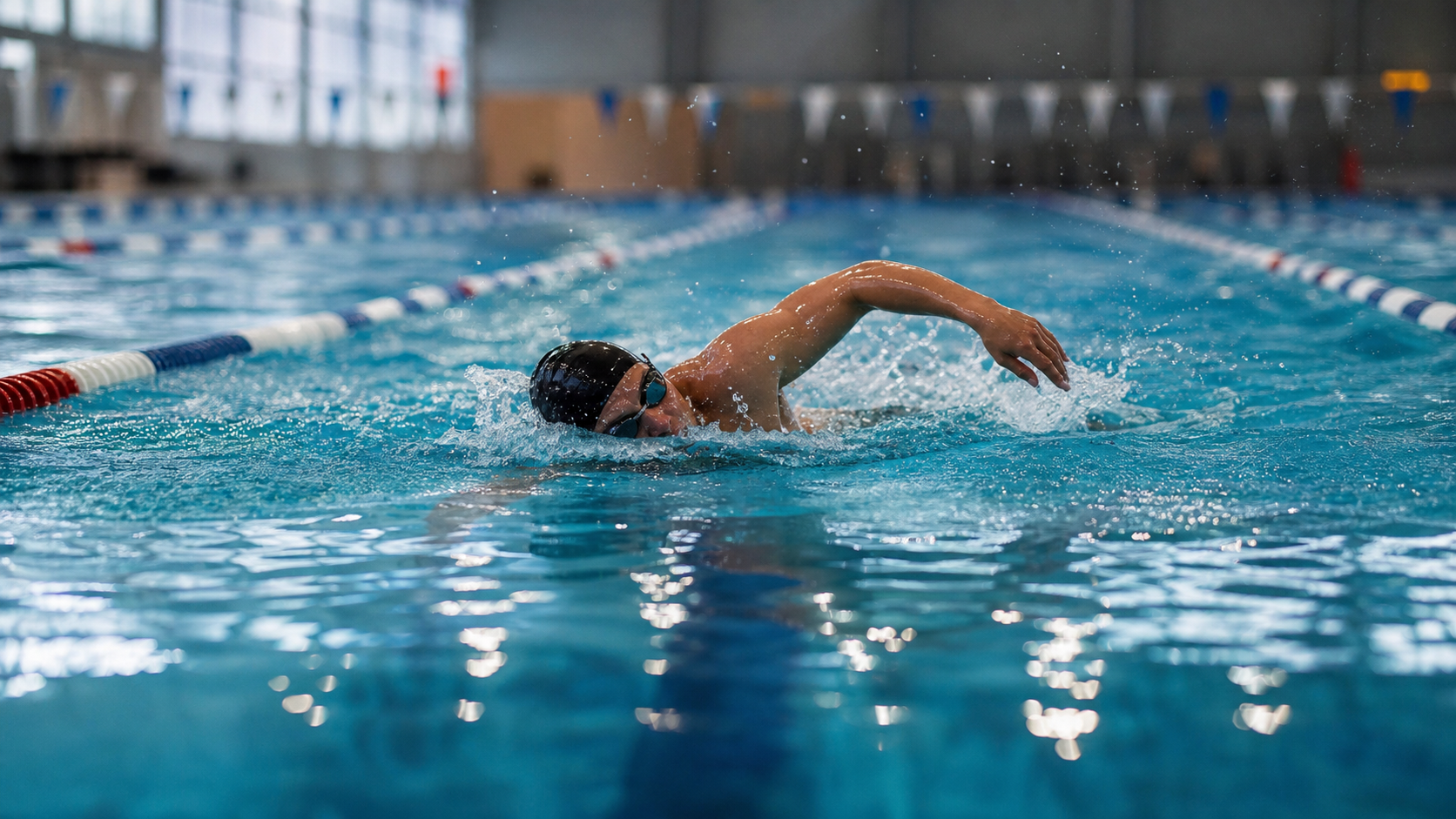
The Long-Distance Strategy for the 1500m Freestyle: Pacing by Splits and Mental Milestone Management
Introduction
The 1500m freestyle, often called the “marathon of swimming,” is the longest individual event in Olympic men’s swimming (with the 800m for women). Top male swimmers finish in roughly 14:30 to 15:00, while accomplished amateurs typically range from 18 to 25 minutes. This distance relies almost entirely on the aerobic energy system, demanding not just physical fitness but also the ability to sustain efficient technique over a long period, along with the mental discipline to manage a grueling race.
1. The Long-Distance Nature of the Energy System
The energy distribution for the 1500m freestyle is fundamentally different from sprint events:
| Energy System | Contribution | Notes |
|---|---|---|
| Aerobic System | 80–85% | Primary source; requires a high VO2max |
| Lactate System | 12–16% | Engages during pace changes |
| Phosphocreatine | 3–5% | Used only for the start and final sprint |
This means an athlete’s maximal oxygen uptake (VO2max) and lactate threshold are the most critical physiological factors determining 1500m performance. The core of pacing strategy is maintaining an intensity at or near the lactate threshold (about 80–85% of maximum heart rate) without exceeding it.
2. The Basic Framework of Split Strategy
Using a 50m pool as an example, the 1500m requires 30 lengths (including one dive-start straightaway plus 29 turns). It can be divided into four tactical phases:
Phase 1 (0 to 300m, first 6 lengths): Establishing the Pace
- Enter the first 50m after the start at your most comfortable long-distance speed
- Avoid being pulled into a faster pace by other swimmers or the crowd atmosphere
- Goal: Stabilize heart rate in the aerobic threshold zone (75–80% of max HR)
Phase 2 (300 to 900m, lengths 7 to 18): Steady Cruising
- This is the longest phase of the race and demands high rhythmic consistency
- Check breathing rhythm and hand entry angle every 3 to 4 lengths
- Goal: Keep lap time variation within 0.5 seconds
Phase 3 (900 to 1300m, lengths 19 to 26): The Mental Test
- Still far from the finish, with noticeable fatigue—this is the segment where pacing is most easily abandoned
- Use “chunking”: focus only on completing the next 100m
- Goal: Maintain pace; absolutely do not “coast” or slack off in this phase
Phase 4 (1300 to 1500m, lengths 27 to 30): Planned Sprint
- Begin gradually increasing speed from the 1300m mark, slightly faster every 100m
- Sprint all-out for the final 50m (length 30)
- Goal: Make the last lap 1–2 seconds faster than the average lap time of lengths 2 through 28
3. Mental Milestone Management: The Core Challenge of Long-Distance Racing
There are five common mental crisis points in a 1500m race:
Crisis Point 1: 300 to 400m
The body is just beginning to feel fatigue, but the finish is still far away. Response: Tell yourself, “The warm-up is over; the real race is just beginning.”
Crisis Point 2: 600 to 700m (around halfway)
At the midpoint of the race, the mind is most prone to the frustration of “there’s still so long to go.” Response: Shift perspective to “Half is already done; everything from here is a bonus.”
Crisis Point 3: 900 to 1000m
Research shows this is the segment where swimmers are most likely to slow down, often subconsciously easing the pace. Response: Use a pace wristband or place marker stickers on the pool wall to force a rhythm check upon reaching this point.
Crisis Point 4: 1200m
The illusion of “almost there” may tempt an early sprint, burning remaining fuel. Response: Stick strictly to the plan; only begin accelerating at 1300m.
Crisis Point 5: 1400m
The temptation of “all-out for the last 100m” is strong, but going full throttle too early can cause a fade in the final 50m. Response: At 1400m, only slightly increase pace, saving the full release for the last 50m.
4. Breathing Strategy and Technique Maintenance
In long-distance swimming, breathing rhythm directly affects oxygen delivery efficiency:
- First half (0 to 750m): Breathe every 3 strokes, alternating sides (bilateral breathing)
- Second half (750 to 1400m): Switch to breathing every 2 strokes to take in more oxygen
- Final 100m: Breathe every 2 strokes or hold your breath (depending on individual fitness)
Three keys to technique maintenance:
- Hand entry angle: When fatigued, the elbow is most prone to “splaying out”; consciously remind yourself of “high-elbow entry”
- Full push phase: Ensure every pull extends past the outer thigh before exiting the water, avoiding a “short pull”
- Body rotation: Insufficient torso rotation increases drag; deliberately maintain a 45-degree rotation
5. Training Recommendations
| Training Type | Content | Goal |
|---|---|---|
| Aerobic Base | 3000–5000m continuous swimming at low-to-moderate intensity | Improve VO2max and lactate threshold |
| Pace Training | 6×250m at target 1500m pace, 60 seconds rest | Develop a sense of pace |
| Lactate Tolerance | 3×500m at slightly faster than 1500m pace, 5 minutes rest | Enhance lactate buffering capacity |
| Mental Simulation | One all-out 1500m test per month | Validate the effectiveness of pacing strategy |
Conclusion
The 1500m freestyle is the event in competitive swimming that demands the most comprehensive combination of mind and body. The core of pacing strategy is “don’t waste energy in the early stages; release it deliberately in the later stages.” For Taiwanese long-distance swimmers, beyond physical training, cultivating the ability to manage mental milestones—knowing where to “hold on” and where to “let go”—is the ultimate key to breaking personal records.
Related Reading
- 1500m Freestyle Race Training: Split Pacing Strategy and Energy Reserve for the Final Sprint
- Pacing Strategies for Long-Distance Swimming (800m/1500m): Even Splits vs. Negative Splits
- Building Rhythm in Long-Distance Swimming: Split Strategies for 1500m Pacing
- 50m Freestyle Split Strategy: The Optimal Ratio of the First 15m, Middle Maintenance, and Final Sprint
西進武嶺 免費訓練分析服務 Intervals | 練不夠還是練過頭?你哪一種類型選手?AI模型告訴你! | 備戰神器 | 公路車 訓練 | CT Yeh
4 年前
Live) 備戰2019彰化經典百K 賽前攻略 (已完賽請看新影片
7 年前
live) 超越北高 之一日北高12小時 策略
7 年前
西進武嶺 自製新版AI配速表產生器 x 賽前攻略 抱佛腳! 沒有功率計也可以產生配速表嗎?有什麼其他眉角賽前要注意的呢? | 西進武嶺 / 東進武嶺 KOM 攻略 | 公路車 | CT Yeh
4 年前
一日北高/長距離團騎 常見問題補充篇 / 組團或跟團的眉角 / 壯車友容易被瘦車友慢性拉爆 / 原來屁股痛可能是這個原因...? / 風場配速法 / 公路車 / CT Yeh
2 年前
靠單車減肥35公斤 心得分享與整理
7 年前
FTL 與 SYB 車隊專訪 西進武嶺 實用攻略分享! 2小時 如何練?!你不知道的眉角!新手準備武嶺必看 EP1 | 實力派女車友 | 精華版 | 公路車 | CTYeh
4 年前
一日北高前的高裝檢 | 北高 360 | 挑戰11小時的裝備 | 一日雙塔 | 補給
6 年前