Explosive Power Management in the 100m Butterfly: Balancing Front-Half Conservation with Back-Half Sprinting
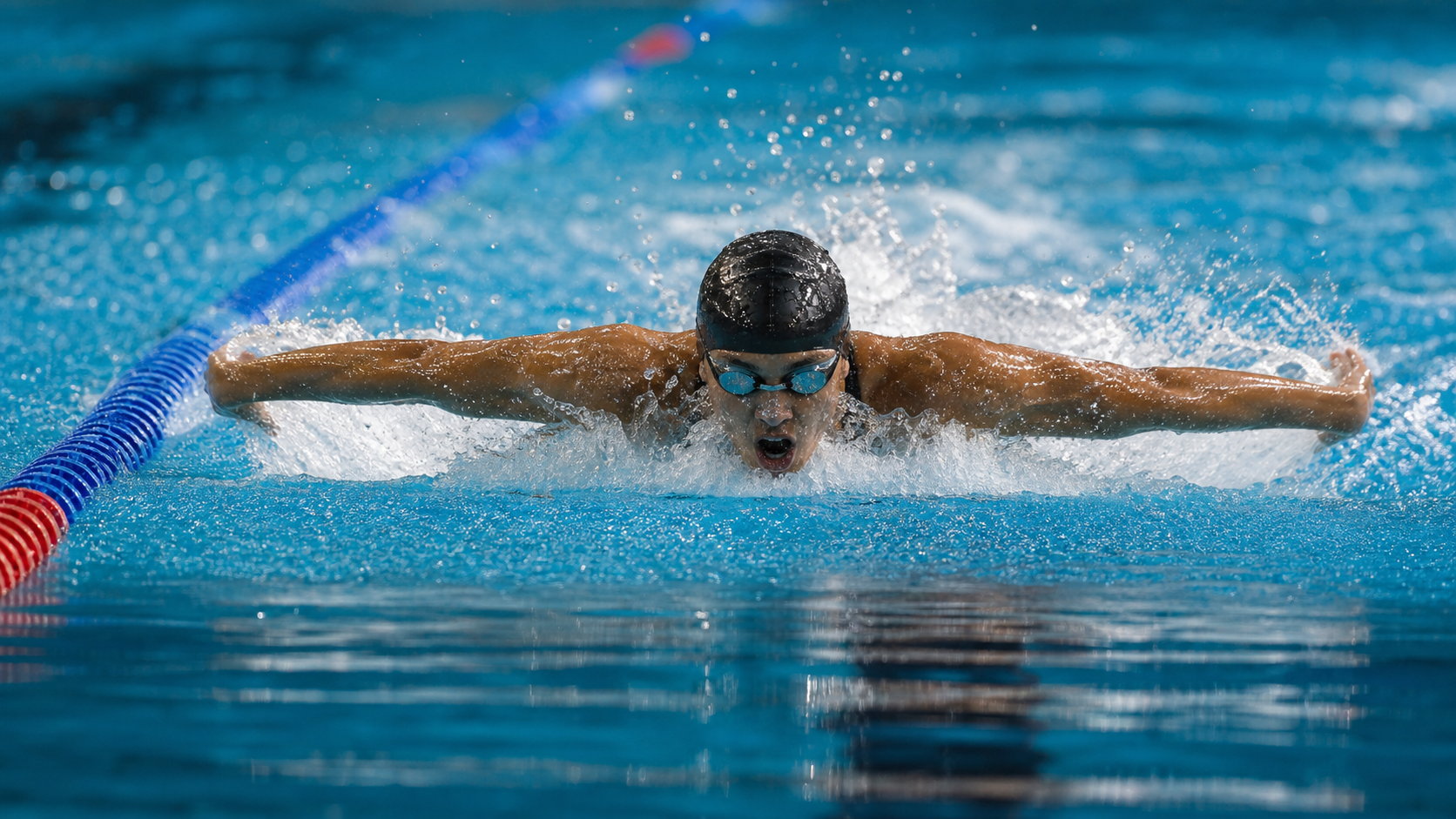
Managing Explosive Power in the 100m Butterfly: Balancing Front-Half Conservation with Back-Half Sprinting
Introduction
The 100m butterfly is one of the most physically demanding events in all of swimming. The butterfly stroke requires the entire body to coordinate wave-like propulsion, with every stroke demanding high synchronization between the torso, arms, and legs, consuming roughly 30 to 40% more energy than freestyle. The world’s top male swimmers finish in 49 to 51 seconds, but even elite athletes almost inevitably slow down in the second 50 meters—the question is only “how much.” Therefore, the strategic core of the butterfly is not “maintaining speed,” but “controlling the rate of deceleration.”
1. The Metabolic Characteristics of the Butterfly
| Segment | Distance | Primary Energy System | Technical Challenge |
|---|---|---|---|
| Start and entry | 0–15m | ATP-PCr | Underwater dolphin kick rhythm |
| Front-half propulsion | 15–50m | ATP-PCr + Lactic acid | Maintaining explosive power and technique |
| Back-half maintenance | 50–85m | Lactic acid system | Preventing technical breakdown |
| Final sprint | 85–100m | Lactic acid + willpower | All-out effort under technical discipline |
What makes the butterfly unique is that technical precision is far harder to maintain under fatigue than in freestyle. Once the body’s wave rhythm falls apart, or the hand entry angle deviates, drag increases dramatically, creating a vicious cycle—the more tired you get, the more you struggle, the slower you become.
2. The First 50 Meters: Smart Explosive Power Conservation
Many butterfly swimmers (including some at the competitive level) push at full effort in the first 50 meters, trying to build a significant lead. But according to research and race data, when swimmers go 5% faster than their personal best pace in the first 50 meters, the second 50 meters often slows by more than 8 to 10%, resulting in a worse overall time.
Key points for the first 50 meters:
- Take 7 to 10 underwater dolphin kicks after the start to fully capitalize on entry momentum (1 to 2 more kicks than in freestyle)
- For the first 5 to 6 strokes after surfacing, prioritize “technique first”: emphasize high-elbow hand entry and a complete pull path
- Control speed at 88 to 92% of your maximum butterfly speed—it should feel “hard but not straining”
- Breathe every 2 strokes, avoiding breathing every stroke (breathing every stroke raises the head and disrupts the wave rhythm)
- Do not breathe in the final 5 meters before the turn; maintain a streamlined body position and push off the wall with full force
3. The Second 50 Meters: Maximum Output Under Technical Discipline
The second 50 meters is the true proving ground for butterfly swimmers. Lactic acid accumulates heavily, the arms feel heavy, and the wave rhythm easily breaks down. The key during this stretch is “let fatigue change the level of effort, but not the technical form.”
Three core elements for maintaining technique in the second 50 meters:
-
Keep the pull path complete: The most common issue under fatigue is “early exit” (the hand leaving the water before pushing past the thigh). Every pull must feel the palm passing by the outside of the hip
-
Keep the wave frequency steady: Even if speed drops, the body’s wave frequency should remain consistent. Do not increase the number of waves with a reduced amplitude just because you want to “speed up”
-
Keep the kick strong and continuous: The dolphin kick in the latter half tends to “go on strike,” but it is a vital source of propulsion and must be maintained consciously
Timing for the back-half sprint:
- From 75 to 80 meters, begin increasing stroke rate (shortening recovery time between strokes)
- From 90 meters, stop breathing and push with everything you have
- On the final stroke before the wall, ensure both hands touch simultaneously (as required by butterfly rules)—do not reach early
4. Breathing Rhythm as a Race Decision
Breathing in the butterfly is a key technical decision that affects performance:
| Breathing Frequency | Advantages | Disadvantages | Best Suited For |
|---|---|---|---|
| Every 2 strokes | Steady oxygen supply | Slightly increased drag | Mainstream 100m strategy |
| Every 3 strokes | Less head lifting | Oxygen deficit pressure | Only for elite swimmers |
| Mixed strategy | Flexible adjustment | Requires high familiarity | 2-stroke front half / every stroke back half |
The most common mistake among Taiwanese amateur butterfly swimmers is “breathing every stroke” (breathing on every hand entry), which severely disrupts body streamlining. It is recommended to build on a “breathe every 2 strokes” foundation and gradually develop tolerance for going without breathing in training.
5. Training Recommendations
- Front-half pacing training: 4×50m butterfly, deliberately controlling pace in the first 25m (2 to 3 seconds slower than all-out), then sprinting the last 25m; record split times
- Technical endurance training: 8×50m butterfly at 80% intensity; note “where fatigue sets in” on each repeat and gradually push that fatigue point later
- No-breath tolerance training: Practice 25m butterfly without breathing weekly to build CO2 tolerance
- Back-half sprint specialization: 50m all-out butterfly starting from the 50m mark to get accustomed to all-out output under lactic acid buildup
Conclusion
Managing explosive power in the 100m butterfly is not about “how fast you swim,” but “how smart you swim.” The conservation strategy in the front half leaves enough energy to maintain technique in the back half, and the technical discipline in the back half converts limited energy into maximum speed. If Taiwanese swimmers can cultivate this “hold back first, unleash later” pacing instinct in training, they will find a new path to breakthrough performances in the butterfly.
Related Reading
- Butterfly Race Preparation: 50m Butterfly Sprint and 100m Splitting Strategy
- 50m Freestyle Splitting Strategy: The Optimal Ratio of the First 15m, Middle Maintenance, and Final Sprint
- 50m Freestyle Race Strategy: Reaction Time, Mid-Race Swimming, and Sprinting
- 100m Freestyle Pacing: The Science of Front-Half and Back-Half Time Distribution
教學) 如何做出專業 慢動作 影片 Slow Motion 120fps GoPro 7 ActionCam AX700 A99II
7 年前
CT 喇低賽) 武嶺牽車 才是王道 西進牽車四小時內秘訣 攝手位置 如何判斷 防抽筋小秘訣
7 年前
西進武嶺 自製新版AI配速表產生器 x 賽前攻略 抱佛腳! 沒有功率計也可以產生配速表嗎?有什麼其他眉角賽前要注意的呢? | 西進武嶺 / 東進武嶺 KOM 攻略 | 公路車 | CT Yeh
4 年前
西進武嶺 免費訓練分析服務 Intervals | 練不夠還是練過頭?你哪一種類型選手?AI模型告訴你! | 備戰神器 | 公路車 訓練 | CT Yeh
4 年前
戰略) Zwift Race 如何咬在第一集團 如何評估自己要開多少推力 (請開1.5倍速看)
7 年前
Live) 備戰2019彰化經典百K 賽前攻略 (已完賽請看新影片
7 年前
風櫃嘴 衝刺慢動作回放!
8 年前
多機位拍片神器 DJI Action 2 拍出速度張力感 | 類空拍機視角 4陣列麥克風超強降風噪 實測! | 公路車 | CT Yeh
3 年前