Swimming Dive Reaction Time Analysis: The Critical Impact of Starting Block Technique on Performance
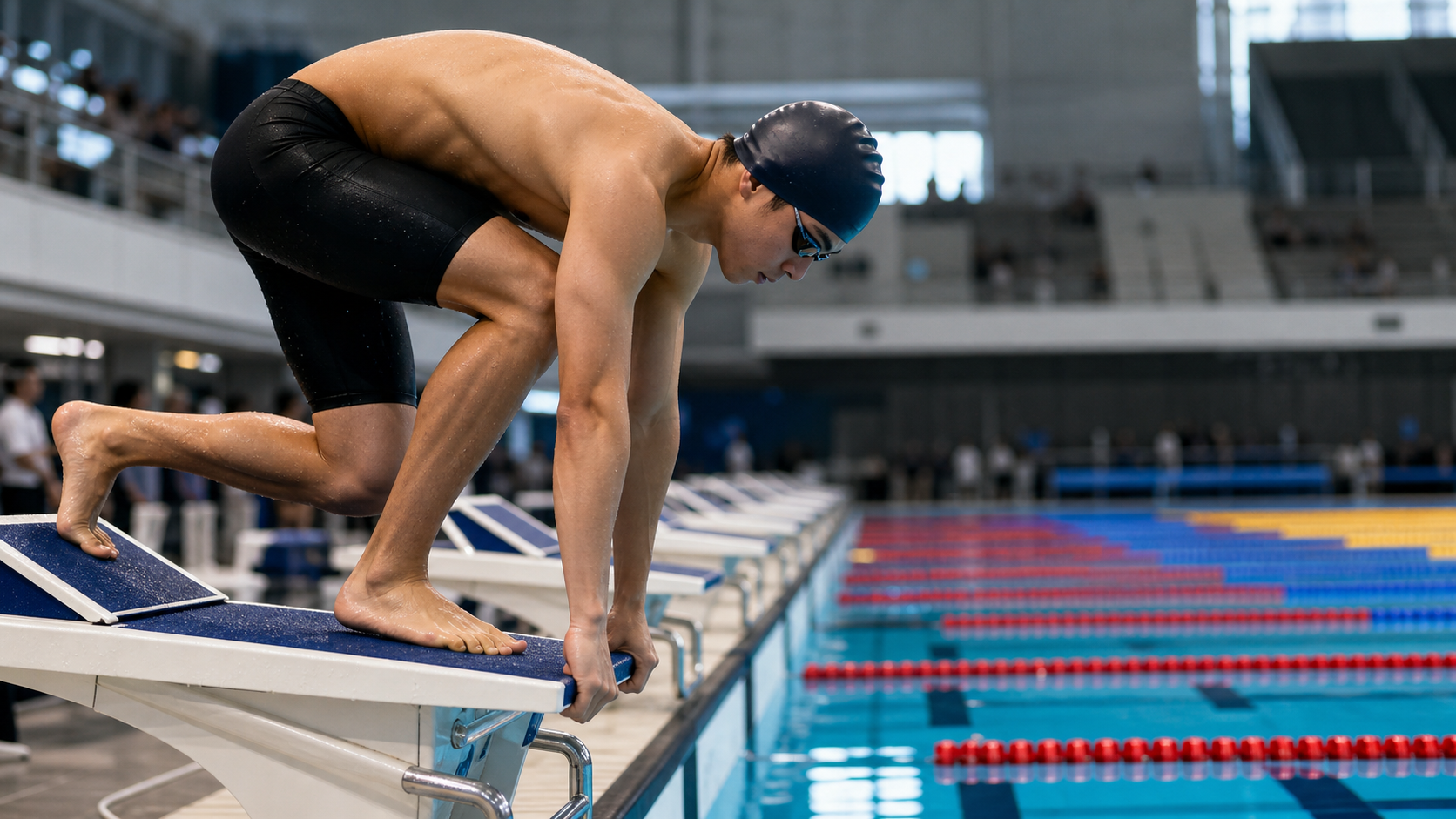
Swimming Dive Reaction Time Analysis: The Critical Impact of Starting Block Technique on Performance
Introduction
In swimming competitions, the time from when a swimmer hears the starting signal to when they leave the starting block is called the “Reaction Time” (RT). This figure may seem small, but it has a significant impact on final results. According to statistics from World Aquatics, the average reaction time of Olympic finalists ranges from 0.63 to 0.72 seconds, while amateur swimmers’ reaction times can be as high as 0.85 to 1.2 seconds.
In a 50-meter freestyle race, a 0.2-second difference in reaction time is equivalent to one-third of the performance gap between elite swimmers. Understanding and optimizing reaction time is one of the highest cost-benefit training investments for improving competitive performance.
1. Breakdown of Reaction Time Components
The reaction time in a swimming dive can be divided into three consecutive phases:
| Phase | Time (estimated) | Description | Trainability |
|---|---|---|---|
| Perception phase | 0.10–0.15 sec | Ear receives sound → brain processes | Low (limited by nerve conduction speed) |
| Decision phase | 0.05–0.15 sec | Brain decides → sends motor commands | Medium (can be shortened through training) |
| Action phase | 0.30–0.60 sec | Muscle contraction → feet leave the block | High (greatest training potential) |
Most training can improve the “action phase”—that is, the time from when muscles begin to contract until both feet leave the block. This depends on the preparatory stance on the starting block, muscle pre-tension, and the coordination of the dive movement.
2. Modern Starting Block Techniques (Grab Start vs. Track Start)
Two mainstream starting techniques are currently used in competitive swimming:
Grab Start:
- Both feet stand parallel at the edge of the starting block
- Hands grip the front edge of the starting block
- Advantages: Simple movement, high stability
- Disadvantages: Slightly longer reaction time (average 0.68 to 0.75 seconds)
Track Start:
- Staggered stance (similar to a track and field starting position)
- Rear foot placed in the back wedge of the starting block (available on modern starting blocks)
- Advantages: Shorter reaction time (average 0.62 to 0.70 seconds), greater thrust
- Disadvantages: Requires more practice to master consistently
According to research, the track start has become the mainstream at elite competitive levels, with an adoption rate of over 85% among Olympic swimmers. If Taiwanese swimmers have not yet mastered the track start, it is worth gradually introducing it into training.
3. Entry Angle and Glide Efficiency
Reaction time is only the first step in starting efficiency; the entry angle determines subsequent underwater speed:
Optimal Entry Angle Analysis:
- Entry angle too steep (over 25 degrees): Greater body drag, more kinetic energy loss
- Entry angle too flat (below 10 degrees): Greater surface impact, sudden speed reduction
- Optimal range: 15 to 20 degrees entry, combined with a streamlined position (arms extended forward, hands overlapping)
The Critical Role of Underwater Dolphin Kick:
- Begin dolphin kicking immediately after entry to maintain forward momentum
- Dolphin kick frequency: 2.5 to 3 kicks per second, with knee flexion ideally not exceeding 80 degrees
- Surface timing: Surface when speed approaches surface swimming speed (typically at 12 to 15 meters)
- Research shows that each additional effective underwater dolphin kick improves overall starting efficiency by approximately 0.3 to 0.5%
4. External Factors Affecting Reaction Time
In addition to technical training, the following factors also affect reaction time during competition:
- Starting signal type: Auditory signals (beep) trigger faster reactions than visual signals (lights), but modern competitions primarily use auditory signals
- Water temperature and muscle temperature: Inadequate warm-up before the race leads to lower muscle temperature, prolonging the action phase reaction time
- Attention focus: The psychological preparation state before the race directly affects the perception phase speed
- False start anxiety: Excessive worry about “false starting” (which results in disqualification) paradoxically causes swimmers to have longer reaction times
5. Training Methods to Improve Reaction Time
Starting Block Specific Training:
- Complete 5 to 10 start practice repetitions before each training session, simulating race conditions (whistle → dive)
- Use a stopwatch or electronic timer to record the time from each start to the 10-meter mark to track progress
Explosive Power Training:
- Land-based explosive power exercises such as squat jumps and box jumps can enhance the rapid contraction ability of leg muscles
- Recommended 2 to 3 times per week, with 3 sets of 8 to 10 jumps per session
Mental Preparation Training:
- Simulate race conditions in training: full entry procedure, stepping onto the starting block, adjusting stance, waiting for the signal
- Train a “relaxed waiting” mindset to avoid muscle pre-tension caused by false start anxiety
Conclusion
Swimming dive reaction time is a “low-profile but high-yield” pathway to improving performance. While many Taiwanese swimmers invest substantial time in improving stroke technique, starting block technique is often overlooked. Through systematic starting block practice, land-based explosive power training, and mental preparation strategies, swimmers can consistently shave 0.1 to 0.2 seconds off their start time without altering their main training plan—which in competitive swimming is often the difference between rankings.
Related Reading
- The Science of Swimming Start Technique: Optimizing Block Reaction Time and Entry Angle
- Explosive Swimming Starts: How Jump Platform Strength Training Improves Start Performance
- Starting Block Takeoff Technique: Reaction Time Comparison Between Track Start and Grab Start
- Swimming Race Start Technique: Details and Improvement Methods for the Grab Start
Live) 備戰2019彰化經典百K 賽前攻略 (已完賽請看新影片
7 年前
西進武嶺 免費訓練分析服務 Intervals | 練不夠還是練過頭?你哪一種類型選手?AI模型告訴你! | 備戰神器 | 公路車 訓練 | CT Yeh
4 年前
崇越盃武嶺冠軍高手 賽前JJSC 群峰會精華!對應大數據分析,會有落差嗎?/ feat. JJSC中部公路車約騎 /公路車 / CT Yeh
2 年前
2016 桐花飛舞 單車挑戰 精華片段
10 年前
戰略) Zwift Race 如何咬在第一集團 如何評估自己要開多少推力 (請開1.5倍速看)
7 年前
滑雪新手們慘摔學習全紀錄(請開字幕),滑雪好好玩 | Snowboard + Ski | 岩原 スキー場 | 滑雪APP使用 | GoPro Max
6 年前
實景訓練台) 彰化經典百K 高強度喵團 90分鐘 跟著一起練功 2019 Indoor workout Changhua Classic 100 Taiwan
7 年前
live) 超越北高 之一日北高12小時 策略
7 年前