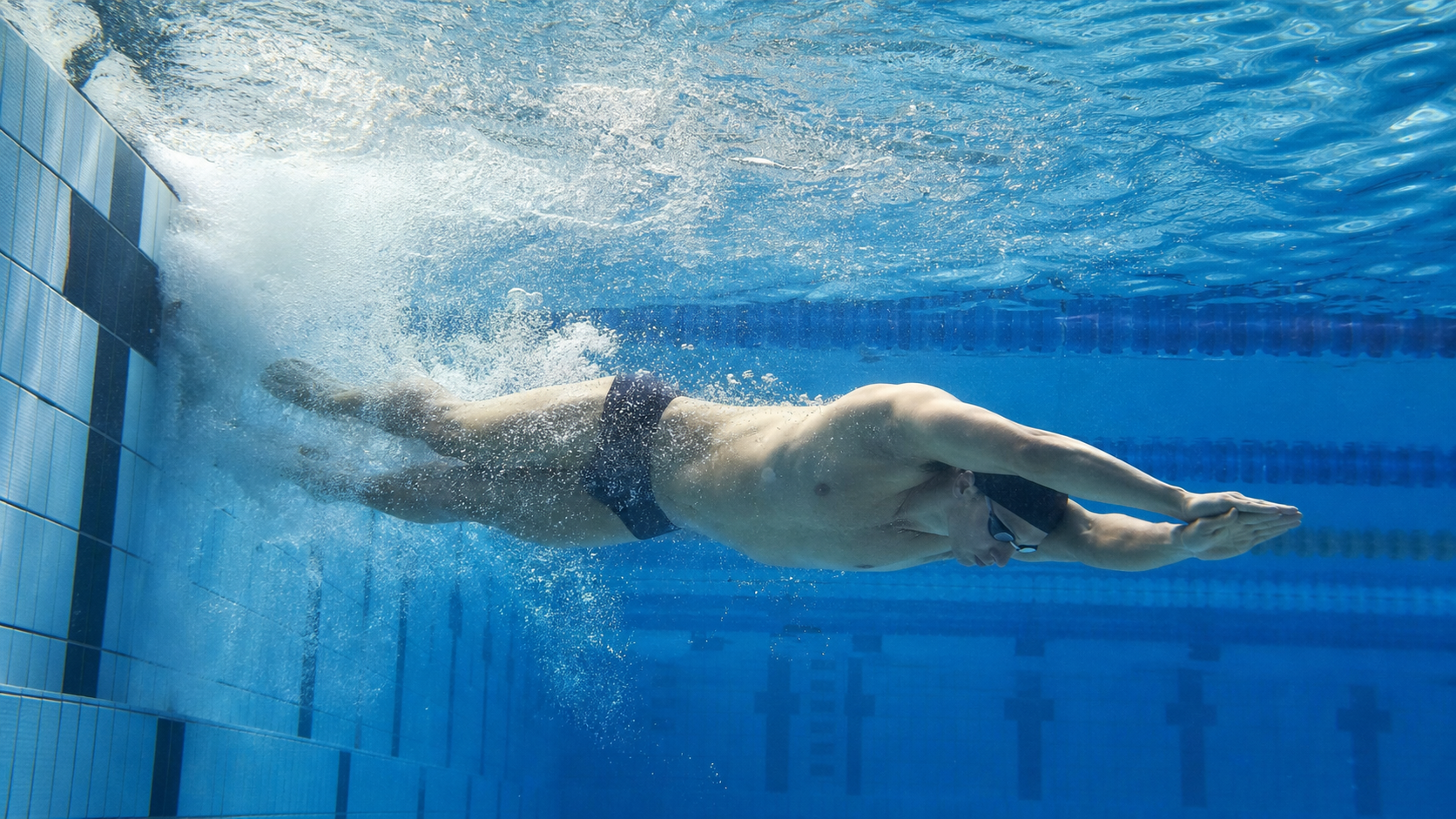
Swimming Turn Efficiency Analysis: Maximizing Wall Push Force and Glide Distance in Flip Turns
Introduction
In a 100-meter freestyle race, the flip turn occurs only once, but differences in its efficiency can create a time gap of more than 1 second. In a 400-meter freestyle, there are seven turn opportunities—if each turn saves 0.5 seconds, that totals 3.5 seconds saved—nearly equivalent to the time difference between competitive levels. Despite this, many athletes focus their training time on surface swimming technique, with significantly insufficient attention given to turns.
The flip turn (Flip Turn / Tumble Turn) is the primary turning method for freestyle and backstroke, and its efficiency is determined by three key factors: approach speed, flip maneuver efficiency, and post-push glide posture.
1. The Three Core Phases of the Flip Turn
| Phase | Key Action | Common Mistakes | Ideal Time |
|---|---|---|---|
| Wall Approach Judgment | Determine the turn initiation point (approximately 1 to 1.5m from the wall) | Slowing down too early, or rushing the flip too late | — |
| Flip Maneuver | Tuck the head, bend the knees, complete a 180-degree rotation | Flip arc too wide, feet landing too high | 0.4–0.6 seconds |
| Push and Glide | Push forcefully off the wall with both feet, streamline glide | Push angle too high, short glide distance | Glide 3–5 meters |
2. Strategies for Maintaining Approach Speed
Many swimmers unconsciously begin to slow down approximately 3 to 5 meters before the turning wall. This typically stems from the psychological behavior of “distance assessment”—the swimmer shifts attention from swimming movements to calculating the turn timing, disrupting stroke rhythm.
Techniques for maintaining approach speed:
- Establish “T-mark recognition” in training: every pool has a T-mark on the bottom, usually about 2 meters from the wall, serving as the trigger point for the flip
- Do not breathe on the final stroke before the flip; keep the head down to enter the flip in optimal streamline
- Avoid shortening the stroke length when approaching the wall—complete the final stroke fully and carry momentum into the flip
Research shows that when swimmers decelerate more than 5% within 3 meters of the wall, post-flip glide speed drops by approximately 8%, a loss that is difficult to fully compensate for during the subsequent swimming.
3. Biomechanical Analysis of the Flip Maneuver
The flip maneuver must complete a 180-degree rotation in an extremely short time, and its efficiency depends on the management of “moment of inertia”:
Technical points for accelerating the flip:
- Tuck the head and engage the core: Quickly lower the head (chin to chest) at the start of the flip, combined with abdominal contraction, bringing the body’s center of mass closer to the axis to reduce moment of inertia
- Knee bend range: Bend the knees approximately 90 to 110 degrees—avoid excessive knee bend (increases moment of inertia) or insufficient knee bend (feet cannot reach the correct position)
- Arm position: Keep the arms close to the body during the flip, avoiding “stroke-assisted flips” (using arm strokes to aid rotation) which increases drag
The importance of foot placement:
- The ideal foot placement is when both feet contact the wall at hip height (level with or slightly below the hips)
- Placement too high (head height): pushes downward, wasting momentum in the vertical direction
- Placement too low (knee height): the legs cannot fully extend to generate force, resulting in insufficient push power
4. Maximizing Push Force and Direction
The wall push is the primary source of speed in the flip turn, and the magnitude and direction of the push force directly determine glide speed:
Ideal push angle:
- The push direction should be completely horizontal (parallel to the water surface), converting all force into forward speed
- Avoid pushing upward off the wall (body drifts upward), which wastes momentum during surfacing
- Immediately transition into a streamline position after pushing (arms extended forward, hands overlapped, toes pointed)
Push power training:
- Land-based squat exercises help improve wall push force
- In-water wall push-off practice: stand at the pool wall and practice the streamline glide distance after a single push-off
- Goal: recreational swimmers should achieve at least 3.5 meters of glide distance per push-off; competitive swimmers should target 4.5 meters or more
5. Maximizing Glide Distance
The glide distance after the wall push is the ultimate indicator of turn efficiency. The following factors affect glide distance:
- Quality of streamline position: Arms extended, head tucked between the arms, legs extended—the closer the body is to a “pencil shape,” the less drag
- Timing of underwater dolphin kicks: Begin dolphin kicks when glide speed drops close to swimming speed—not too early (wastes momentum) or too late (excessive speed loss)
- Surfacing angle: Control body angle when surfacing, avoiding the head rising first which causes the hips to sink and increases drag
| Glide Distance | Swimmer Level | Improvement Suggestions |
|---|---|---|
| Under 2 meters | Beginner | Start with streamline position training |
| 2.5–3.5 meters | Recreational | Strengthen push force and streamline |
| 3.5–4.5 meters | Intermediate to Advanced | Optimize underwater dolphin kick timing |
| 4.5 meters and above | Competitive | Refine push angle |
6. Training Plan Recommendations
- Turn quota per session: Arrange 10 to 15 dedicated flip turn practice repetitions, separate from the main training set
- Glide distance testing: Once per week, perform a “maximum glide” test, recording the surfacing distance to track progress
- Timing: 5-meter approach to wall → flip → 5-meter exit from wall, measure the complete time, targeting under 3.5 seconds (recreational) and under 3 seconds (competitive)
Conclusion
The flip turn is one of the “highest return on investment” technical elements in swimming training. Compared to the hundreds of hours required to improve stroke technique, systematic turn training can yield 0.3 to 0.8 seconds of improvement within 4 to 8 weeks. If Taiwanese swimmers incorporate turn training into their daily routines and track glide distance improvements with data, they can find significant speed gains without increasing physical training volume.
Related Reading
- Refining Swimming Turn Technique: Push Timing and Streamline Maintenance in Flip Turns
- Applying Swimming Turn Technique in Competition: How to Save Time with Flip Turns
- The Mechanics of Wall Push in Swimming Turns: Technical Details for Maximum Propulsion
- Turn Technique Refinement: Wall Contact Angle and Push Timing in Flip Turns
CT 喇低賽) 武嶺牽車 才是王道 西進牽車四小時內秘訣 攝手位置 如何判斷 防抽筋小秘訣
7 年前
西進武嶺 免費訓練分析服務 Intervals | 練不夠還是練過頭?你哪一種類型選手?AI模型告訴你! | 備戰神器 | 公路車 訓練 | CT Yeh
4 年前
戰略) Zwift Race 如何咬在第一集團 如何評估自己要開多少推力 (請開1.5倍速看)
7 年前
2023桃園團體繞圈賽 / 海鷗繞圈賽 | 全程空拍數據版 | 公路車 | CT Yeh
2 年前
公路車 爬坡 破PR 紀錄 小技巧 分享
6 年前
Live) 備戰2019彰化經典百K 賽前攻略 (已完賽請看新影片
7 年前
2016 桐花飛舞 單車挑戰 精華片段
10 年前
大禹嶺 到 武嶺牌樓 全程前後實況錄影 | 北進武嶺 | 東進武嶺 | KOM | 訓練台 | 坡度分析 | Taiwan KOM Last 10 km HARD | 公路車
6 年前