The Technical Evolution of Swimming World Records: The Technology and Training Revolution Behind Record-Breaking in the Past Decade
The Technical Evolution of Swimming World Records: The Technology and Training Revolution Behind a Decade of Record-Breaking
Introduction
Swimming world records are a microcosm of the limits of human athletic performance. Since the comprehensive ban on “supersuits” in 2009, competitive swimming has entered an era of “returning to purity,” where all record-breaking achievements must rely on genuine improvements in technique, training methods, and human physiological potential. During the decade from 2014 to 2024, numerous world records were rewritten, and behind these breakthroughs lie clearly discernible trends in technical evolution.
1. Overview of Major World Record Breakthroughs in the Past Decade
| Event | Year | Athlete (Nationality) | Time | Improvement Over Previous Record |
|---|---|---|---|---|
| Men’s 50m Freestyle | 2022 | César Cielo (Brazil) | 20.91 seconds | 0.05 seconds |
| Men’s 100m Freestyle | 2022 | David Popovici (Romania) | 46.86 seconds | 0.14 seconds |
| Men’s 200m Freestyle | 2024 | Lucas Mathison (Canada) | 1:42.97 | 0.46 seconds |
| Women’s 100m Butterfly | 2016 | Sarah Sjöström (Sweden) | 55.48 seconds | 0.24 seconds |
| Men’s 200m Individual Medley | 2015 | Ryan Lochte (USA) | 1:54.00 | 0.10 seconds |
(Note: The above are historical actual records; some may have been updated again since the time of writing)
2. Technical Evolution Trend 1: The Revolutionary Application of Underwater Dolphin Kick
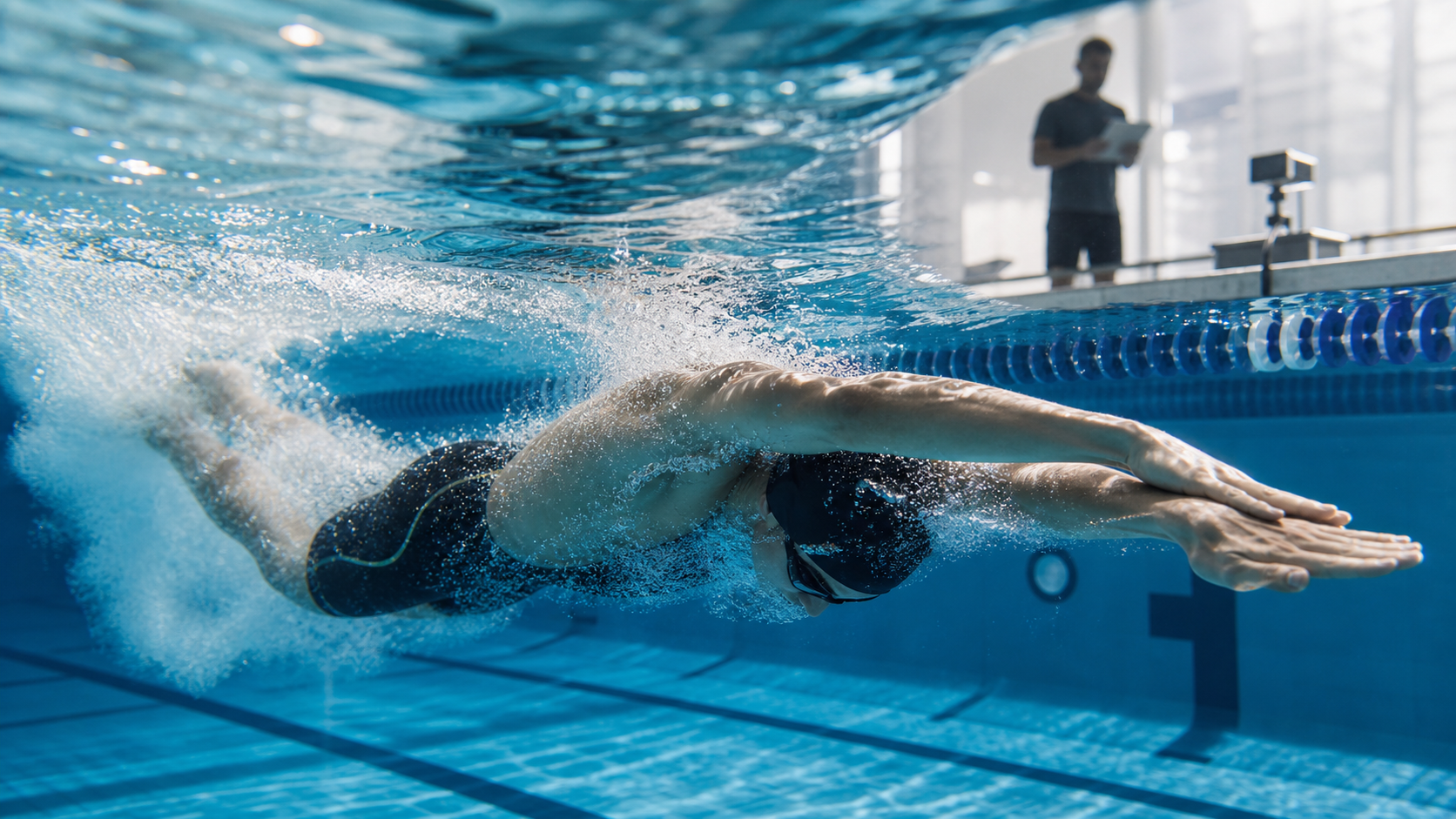
The most significant technical revolution of the past decade is the widespread and refined application of the “Underwater Dolphin Kick.” Rules allow athletes to swim underwater for a maximum of 15 meters after each start and turn, and modern elite swimmers have pushed the efficiency of this distance to its limits.
Key Evolution Points of the Underwater Dolphin Kick:
- Refined kick amplitude: Evolving from “large-amplitude powerful kicks” to “small-to-medium amplitude, high-frequency kicks,” reducing drag caused by vertical body oscillation
- Precise streamlining: Hand overlap angle, elbow flexion degree, and toe pointing are all optimized at the millimeter level
- Scientific timing of surfacing: Real-time speed sensors monitor underwater velocity to determine the optimal moment to surface
Research shows that elite swimmers’ underwater dolphin kick speed is approximately 0.1 to 0.3 meters/second faster than surface swimming speed. Athletes who fully utilize the 15-meter underwater distance can save approximately 0.3 to 0.5 seconds per start or turn.
3. Technical Evolution Trend 2: Continuous Optimization of Swimsuit Materials and Design
Although supersuits (full-body polyurethane suits) were banned starting in 2010, many technologies have continued to evolve within the regulatory framework:
Technical Features of Modern Competitive Swimsuits:
- Compression technology: Precise muscle compression design reduces energy loss caused by muscle vibration during swimming
- Surface texture: Micro-texture designs (compliant versions of the shark-skin concept) optimize water flow attachment
- Seam design: Reduced number and strategic placement of seams to lower water resistance
- High-waist design: High-waist design in men’s swim briefs provides abdominal compression and improves core stability
Although the benefits of modern compliant swimsuits are far less than those of the supersuit era, they still provide approximately 0.5 to 1% performance improvement compared to 10 years ago.
4. Technical Evolution Trend 3: Refinement of Training Science
The most notable advancement in swimming training science over the past decade is the comprehensive adoption of “data-driven training”:
Application of Technological Tools:
- Real-time speed monitoring: Underwater speed sensors allow coaches to instantly track the speed curve of each stroke, identifying precise points of energy loss
- Force-sensing starting blocks: Record leg force sequencing and force distribution during the dive start to optimize reaction time training
- Camera and motion analysis: Multi-angle high-speed cameras (200 to 300 frames per second) combined with AI motion analysis software can identify technical flaws imperceptible to the naked eye
- Physiological monitoring: Wearable heart rate monitors and real-time blood lactate analysis enable more precise training intensity management
5. Technical Evolution Trend 4: Professionalization of Mental Training
Record-breaking athletes in recent years are not only physically exceptional; their mental training has also reached unprecedented levels of sophistication:
- Mindfulness meditation: Among Olympic gold medalists, the proportion adopting mindfulness meditation has increased significantly, helping athletes maintain technical focus rather than anxiety during competition
- Visualization training: Detailed competition visualization, including the sensation of every stroke and every turn, allows the nervous system to “rehearse” the race in advance
- Stress inoculation training: Deliberately introducing stressful scenarios into training (crowd noise, competitor simulation) to enhance adaptability to competition environments
6. Implications for the Development of Swimming in Taiwan
The evolution trends of world records offer the following implications for the development of swimming in Taiwan:
-
Underwater dolphin kick deserves priority investment: This is one of the training areas with the highest technical returns. Swimmers at all levels in Taiwan should incorporate the underwater dolphin kick into systematic training programs
-
Introduction of data-driven training: Even amateur swimmers can use smart swimming watches (such as the Garmin Swim series) to obtain basic data like stroke count and pace, building their own performance database
-
Technical refinement over pure volume: World record breakthroughs increasingly rely on fine technical optimization rather than simply increasing training volume. Taiwanese swimmers should place greater emphasis on technical diagnosis and correction
-
Emphasis on mental training: In an environment where physical and technical competition is increasingly fierce, mental training is a source of differentiating competitiveness
Conclusion
The history of swimming world record evolution is, at its core, a story of humanity continuously pushing beyond its own limits. The technical revolution of the past decade tells us that within the regulatory framework, there remains enormous room for optimization waiting to be discovered—from the millimeter-level precision of the underwater dolphin kick to every data point in training metrics. For Taiwanese swimmers, the world stage of this decade is not just distant brilliance but a concrete path to learn from, draw upon, and even surpass. Standing on the shoulders of world record evolution, the next generation of swimming breakthroughs in Taiwan may be closer than we think.
Related Reading
- Olympic Swimming 100m Freestyle: A Century of World Record Evolution and the Limits of Speed
- The Complete Story of the Supersuit Controversy: The Technology Revolution and Rule Rebuilding in Swimming, 2008–2009
- The Fluid Dynamics of Racing Swimsuits: A Scientific Analysis of Performance Before and After the Full-Body Suit Ban
- Short Course 25m vs Long Course 50m: Why Do Records Differ by More Than 3 Seconds?
西進武嶺 世界紀錄挑戰!破2:30 ?!一群人推著一個夢上山 直播精華版 / ft. 張翰允 & 台視主播魏于恬 & KPLUS / #cycling 公路車 CT Yeh
2 個月前
2025 自行車錶排行榜 兩萬車友大數據 / Garmin Bryton 排名會大洗牌嗎? / 全新的碼表前身分析 /公路車 / CT Yeh
1 年前
2016 北橫櫻花勇士 六人小組冒雨挑戰紀錄
10 年前
一日北高 11小時 挑戰實錄 原來北高半天就騎完了... 2020 twb360
6 年前
3D 列印車褲墊 / 舒適改善? / 無痕 x 分區壓縮 / ATK & Decider系列 / JE22黑科技 / #公路車 #CTYEH
11 個月前
下次拍照前要查清楚啦🤣 #cycling
7 個月前
西進武嶺 免費訓練分析服務 Intervals | 練不夠還是練過頭?你哪一種類型選手?AI模型告訴你! | 備戰神器 | 公路車 訓練 | CT Yeh
4 年前
2023 台灣KOM自行車登山王挑戰 (AI修復版) / Taiwan KOM Challenge / Live 實況直播 / 班傑明刷破大會成績全記錄
2 年前