Introduction
Traditional strength training theory holds that muscle hypertrophy requires a load of at least 65–75% 1RM (one-repetition maximum) to effectively stimulate growth. However, the emergence of Blood Flow Restriction Training (BFR) has upended this assumption—research shows that at a low intensity of 20–30% 1RM, combined with partial blood flow restriction, significant muscle hypertrophy and strength gains can still be induced.
For cyclists, this finding is particularly meaningful. Traditional high-intensity strength training (e.g., squats at 80% 1RM) requires substantial recovery time after sessions, affecting the quality of the next day’s riding. The low-intensity nature of BFR theoretically allows for concurrent strength stimulation without compromising cycling recovery. But does the scientific research actually support this application?
The Physiological Mechanisms of BFR
How Blood Flow Restriction Stimulates Muscle
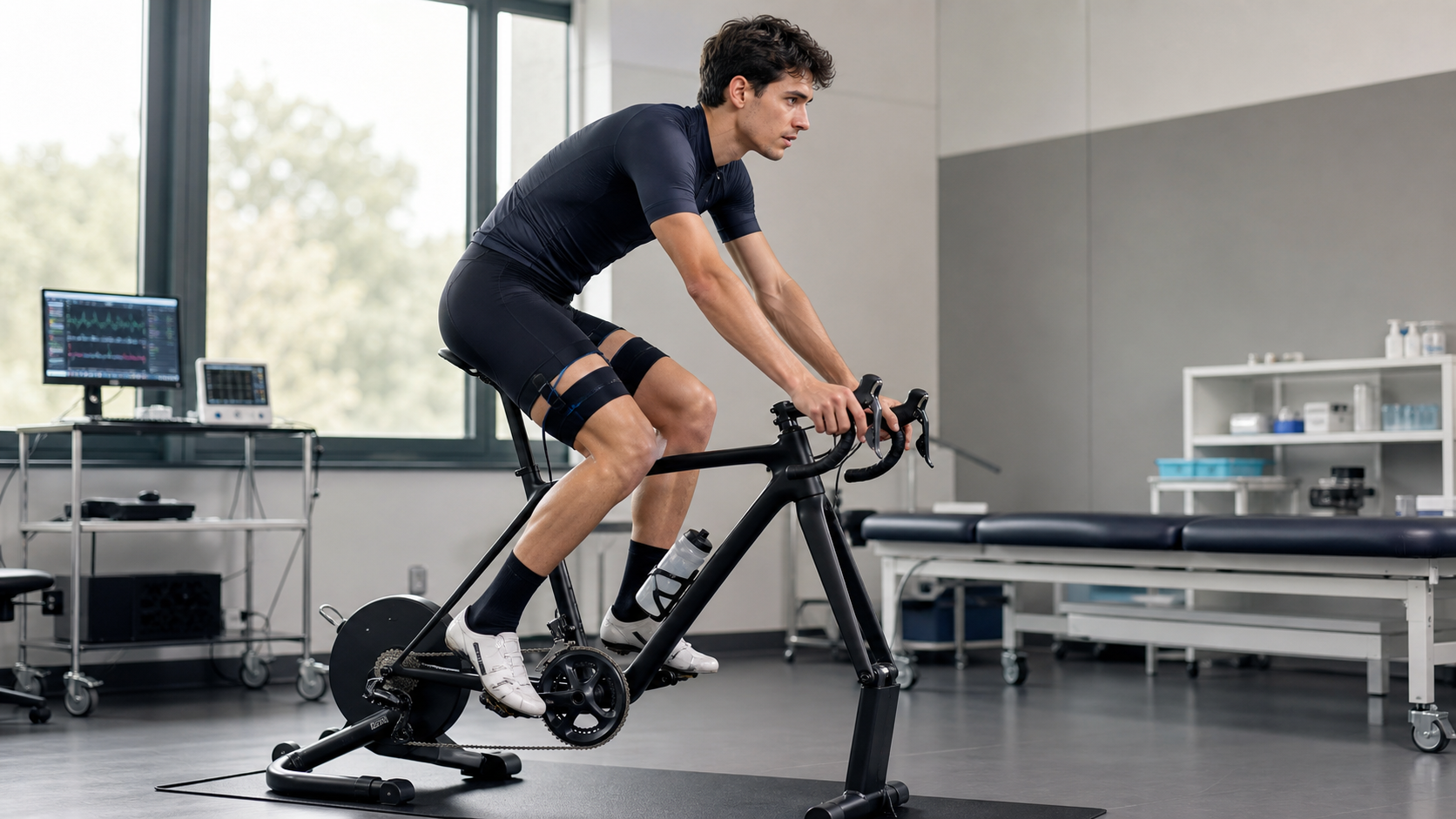
BFR applies band pressure (typically 40–80% of arterial occlusion pressure) to the proximal portion of the limbs (upper thigh or upper arm root), partially blocking venous return while preserving arterial inflow. This creates a unique metabolic environment:
- Metabolic waste accumulation: Metabolic byproducts such as lactate and hydrogen ions cannot be cleared by venous blood, accumulating within the muscle
- Muscle hypoxia: Local oxygen supply is reduced, forcing the muscle to shift toward anaerobic metabolism
- Forced recruitment of fast-twitch muscle fibers: Low-intensity exercise typically recruits only slow-twitch fibers; the local fatigue caused by BFR forces the nervous system to recruit fast-twitch fibers earlier
- Hormonal response: Metabolic stress triggers the release of local growth factors (such as IGF-1) and systemic anabolic hormones (growth hormone)
Cell Signaling Pathways
BFR-induced muscle hypertrophy primarily operates through the following pathways:
| Pathway | Stimulus | Downstream Effect |
|---|---|---|
| mTORC1 | Mechanical tension, anabolic hormones | Protein synthesis |
| MAPK/ERK | Metabolic stress | Myocyte proliferation |
| Satellite cell activation | Muscle damage, hypoxia | Muscle fiber repair and growth |
Research Evidence for Cycling Applications
BFR Combined with Cycling
Multiple studies have examined the effects of BFR applied directly to cycling:
| Study | Subjects | Training Protocol | Key Findings |
|---|---|---|---|
| Abe et al. (2010) | Untrained adults | BFR walking + leg extensions | Quadriceps cross-sectional area +7.8% |
| Conceição et al. (2019) | Cyclists | BFR low-intensity cycling for 8 weeks | VO₂max +5.1% |
| Karabulut et al. (2014) | Older riders | BFR cycling | Strength +15%, no high-intensity side effects |
Aerobic Adaptation Effects
Surprisingly to researchers, BFR affects not only strength but also induces adaptations in aerobic metabolism:
- Local muscle hypoxia stimulates hypoxia-inducible factor (HIF-1α), promoting angiogenesis
- Increased VEGF (vascular endothelial growth factor) secretion improves muscle oxygen utilization
- Some studies report VO₂max improvements of 3–6%, though less pronounced than high-intensity training
Practical Application Protocols
Standardized Parameters for BFR Training
Research-recommended standards for BFR cycling training:
- Band placement: Proximal thigh (3–5 cm below the groin)
- Pressure setting: 40–60% of limb occlusion pressure (LOP) (requires a pressure gauge), or a subjective setting that is tight but not painful
- Intensity: 20–30% of maximal power (easy pedaling feel)
- Sets/duration: 4 sets × 5 minutes (1-minute rest between sets, release pressure during rest)
- Cadence: 80–90 rpm (maintaining a normal riding feel)
Positioning BFR Within the Training Plan
BFR training is best positioned as a supplementary training tool, not a primary training method:
- Post-injury rehabilitation: When high-intensity training is not possible, BFR can maintain muscle mass and vascular function
- High-volume periods: During high-cycling-volume phases, replace some traditional strength training with BFR to reduce systemic fatigue
- Overtraining recovery: During mild overtraining, BFR can provide low-fatigue muscle stimulation
- Transition period maintenance: During the post-season transition period, maintain baseline muscle mass
Safety Considerations
BFR training has the following contraindications or situations requiring special attention:
- History of deep vein thrombosis (DVT): Absolute contraindication
- Cardiovascular disease: Requires physician evaluation
- Hypertensive patients: BFR causes a transient rise in blood pressure; caution is required
- Numbness or tingling: A warning sign of excessive band pressure; release immediately
- Skin damage: Should not be used on areas with wounds or skin conditions
Practical Recommendations
- Start with low pressure: For first-time BFR use, start at 40% LOP, and only adjust gradually after confirming no discomfort
- No need to purchase professional equipment: Research shows that appropriate elastic bands (such as yoga bands) are also effective under subjective “tightness” control, though consistency is poorer
- Combine with strength assessment: Perform a quadriceps strength test (e.g., single-leg squat repetitions) every 4 weeks to confirm BFR effectiveness
- Suitable for recovery weeks: Adding BFR cycling during low-volume recovery weeks can serve as an “active recovery” strategy
Conclusion
Research on the application of blood flow restriction training in cycling science continues to deepen. As a training tool that allows near-high-intensity benefits at low intensity, BFR is particularly suited to athletes who need to maintain cycling training quality while also strengthening lower-limb musculature. Future research will more clearly define the optimal application strategies for BFR across different competitive levels and training phases.
Related Reading
- A Complete Guide to Blood Flow Restriction Training (BFR) for Cyclists’ Post-Injury Rehabilitation
- Systemic Effects of Blood Flow Restriction Training: Multi-Organ Impacts of Hypoxic Signaling
- Application of Blood Flow Restriction Training (BFR) to the Lower Limbs of Cyclists: Low-Load, High-Benefit Research
- The Science of Blood Flow Restriction Training (BFR): Why 30% of the Load Can Achieve 70% of the Results
本週北高前練習,連同天比的226們也來⋯鐵車真的太猛了 #cycling #北高
2 年前
一日北高常見問題大集合 | 攻略 | 路線 | 訓練 | 補給 | 自行車 單車 | 一日雙城 | 雙塔 | TWB北高360 | 屁股痛
6 年前
靠單車減肥35公斤 心得分享與整理
7 年前
#公路車 #Vo2Max #最大攝氧量 測驗 體驗 | 心肺測試
6 年前
一日北高前的西濱集訓 | 跟著11小時軍團 | 300W踩不動的大逆風 | 輪車破風差幾瓦?
6 年前
公路車 爬坡 破PR 紀錄 小技巧 分享
6 年前
#公路車 #Fitting 靠人工智慧APP 幫你調整單車
6 年前
西進武嶺 免費訓練分析服務 Intervals | 練不夠還是練過頭?你哪一種類型選手?AI模型告訴你! | 備戰神器 | 公路車 訓練 | CT Yeh
4 年前