Introduction
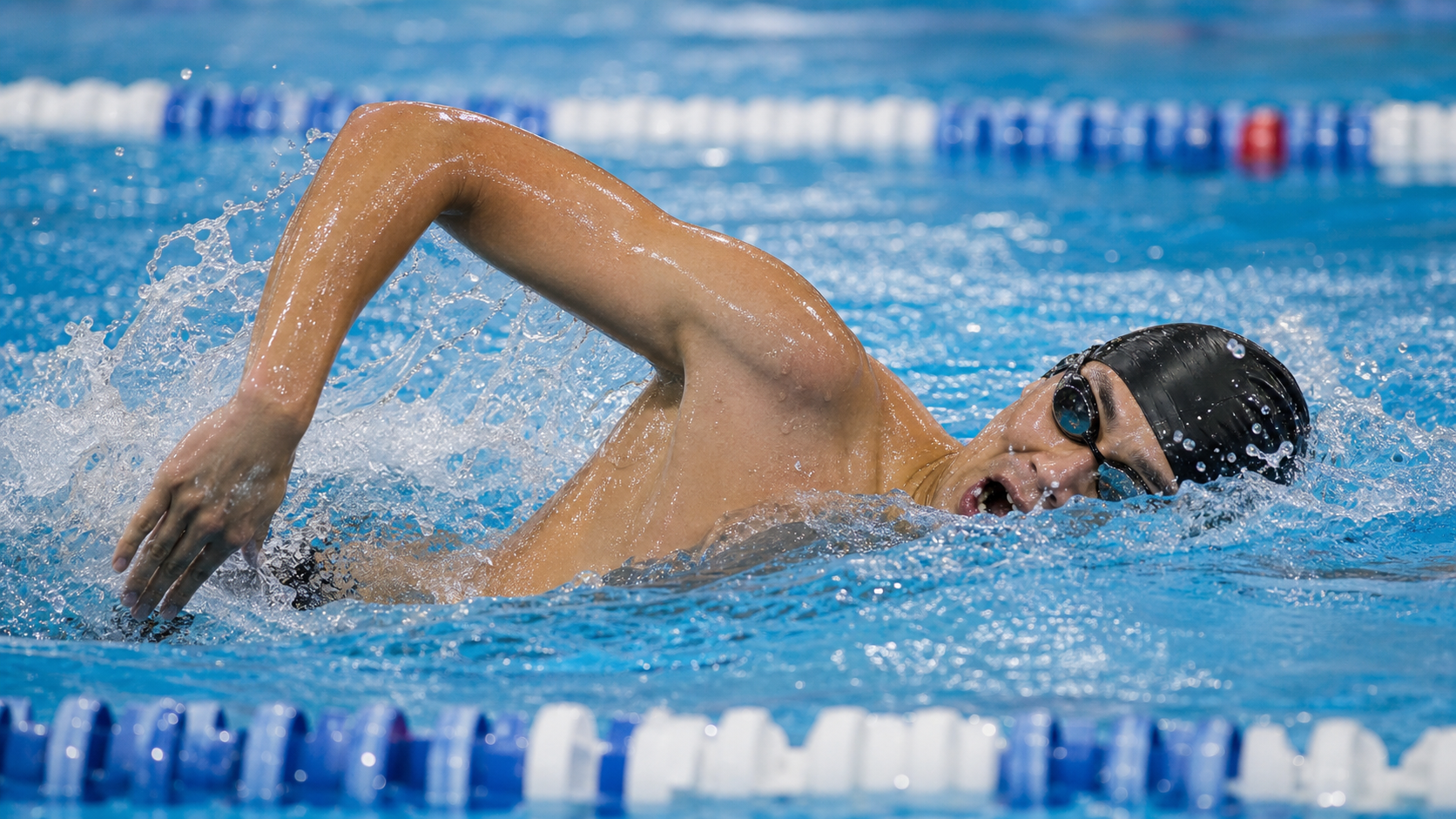
Many beginner swimmers believe that freestyle relies primarily on arm strokes, but coaches who truly understand swimming biomechanics know that body roll is the core of freestyle efficiency. Proper body rotation allows the stroke to engage larger muscle groups (especially the latissimus dorsi), increases the effective stroke length, and reduces the risk of shoulder injury. This article will delve into the angle, timing, and training methods of rotation.
The Biomechanical Principles of Body Rotation
The propulsion in freestyle comes from two main sources: the arm’s pulling motion and the body’s rotational movement. These two are not independent but rather mutually reinforcing.
When the body rotates to the right, the right latissimus dorsi is pre-stretched, much like a bow drawn to full tension, enabling greater contractile force during the subsequent pull. This principle is known as the “Pre-stretch Effect,” a natural characteristic of human muscles.
In simple terms: The closer the body rotation angle is to the optimal value, the greater the muscle force that can be recruited per stroke, and the higher the stroke efficiency.
Research on Optimal Rotation Angles
| Rotation Angle | Latissimus Dorsi Recruitment | Water Resistance Impact | Assessment |
|---|---|---|---|
| 0–20 degrees (almost no rotation) | Low | Low | Insufficient power, poor efficiency |
| 20–40 degrees | Moderate | Low to moderate | Suitable for beginner swimmers |
| 40–50 degrees | High | Moderate | Ideal range for most swimmers |
| 50–60 degrees | Very high | Moderate to high | Advanced swimmers, requires technical coordination |
| Over 60 degrees | Very high but stability decreases | High | Prone to over-rotation, poor balance |
Most swimming coaches recommend a rotation range of 40–50 degrees, which strikes the best balance between power output and body stability.
Rotation Timing: More Important Than Angle
While the rotation angle is important, the “timing” of the rotation has a more direct impact on whether the technique is effective. Incorrect rotation timing, even with the correct angle, cannot effectively transfer power.
Correct rotation sequence:
- Hand entry into the water (using the right hand as an example)
- As the hand glides forward, the right side of the body begins to rotate downward (right shoulder dips into the water)
- The right latissimus dorsi is pre-stretched during the rotation
- The left arm begins its pull, and the body rotates from right to left
- The kinetic energy of the left-side rotation is added to the pulling force of the left arm
Common timing errors:
- Rotating only after the pull is completed (too late, missing the pre-stretch effect)
- Starting rotation and pull simultaneously (no pre-stretch, insufficient power boost)
- Over-relying on rotation while shortening the stroke length (rotation and pull need coordination; one cannot be sacrificed for the other)
The Problem of Over-Rotation
Many swimmers, after learning that rotation aids efficiency, deliberately increase their rotation angle, but rotation beyond 60 degrees often leads to the following issues:
- Kick imbalance: Excessive body tilt causes the feet to drift out of the midline during kicking, increasing drag
- Breathing difficulty: Excessive rotation complicates the breathing motion
- Snake-like swimming: Over-rotation tends to cause lateral body sway (Snake Effect), significantly increasing forward resistance
- Rhythm breakdown: Large rotations require more time, leading to an unstable stroke rhythm
The Role of the Core Musculature in Rotation
Body rotation is not “forced” by the shoulders or arms; it is driven by the core musculature. The following muscle groups play key roles in rotation:
- Oblique Abdominals: Primary rotators, controlling the speed and angle of rotation
- Hip rotator muscles: The initiation point of body rotation is actually at the hips, not the shoulders
- Erector Spinae: Maintains a neutral spine position, preventing excessive curvature that compromises rotation quality
Training recommendation: Performing rotational core exercises on land (such as side plank rotations and Russian twists) can directly improve rotational control in the water.
Training Methods
Side Kick Drill:
Assume a side-lying position (e.g., right ear near the water surface), extend the bottom arm forward, and kick with the bottom leg to move forward, experiencing the sense of balance while in a rotated body position.
Hand-Led Rotation Drill:
Make a fist with one hand (no pulling), while the other hand pulls normally, feeling how the body rotation on the fist side actively drives power output on the pulling side.
Counting Rotation Drill:
With each stroke, mentally gauge your rotation angle (feeling the angle between your shoulder and the water surface) to ensure symmetrical rotation on both sides.
The Problem of Asymmetrical Rotation and Its Correction
Many swimmers have asymmetrical rotation between left and right sides (usually less rotation on the dominant-hand side), leading to differences in pulling power between the two sides. Long-term asymmetrical rotation may cause scoliosis and uneven shoulder heights.
Correction method: For the side with less rotation, deliberately practice single-arm pulls with increased rotation, combined with asymmetrical oblique training on land.
Conclusion
Body rotation is the “hidden” source of propulsion in freestyle and an important indicator of technical maturity. Mastering the correct rotation angle and timing allows the same energy output to produce greater forward speed. It is recommended that every serious swimmer include body rotation training as a core component of technical refinement, rather than focusing solely on arm stroke movements.
Related Reading
- Freestyle Body Rotation: The Hidden Key to Efficiency
- Freestyle Rotation Technique: The Relationship Between Hip Rotation Angle and Pulling Efficiency
- Backstroke Technique Essentials: A Guide to Rotation Axis and Stroke Efficiency
- Muscle Recruitment in Swimming: Analysis of Primary and Secondary Muscle Groups in the Freestyle Pull
CT 喇低賽) 武嶺牽車 才是王道 西進牽車四小時內秘訣 攝手位置 如何判斷 防抽筋小秘訣
7 年前
戰略) Zwift Race 如何咬在第一集團 如何評估自己要開多少推力 (請開1.5倍速看)
7 年前
抖肩舞 APOLLO RIDE 生日趴 搖滾混音無尺度版 Coincidance 甩肩舞
8 年前
西進武嶺 免費訓練分析服務 Intervals | 練不夠還是練過頭?你哪一種類型選手?AI模型告訴你! | 備戰神器 | 公路車 訓練 | CT Yeh
4 年前
一起升級!海鷗盃LSD團練...JJSC Zone2招待 騎到手抖 / 公路車 / CT Yeh
2 天前
抖肩舞 台灣x日本交流版 (台灣 vs 前橋) 赤城山登山賽 coincidance
8 年前
西進武嶺 自製新版AI配速表產生器 x 賽前攻略 抱佛腳! 沒有功率計也可以產生配速表嗎?有什麼其他眉角賽前要注意的呢? | 西進武嶺 / 東進武嶺 KOM 攻略 | 公路車 | CT Yeh
4 年前
2023桃園團體繞圈賽 / 海鷗繞圈賽 | 全程空拍數據版 | 公路車 | CT Yeh
2 年前