Introduction
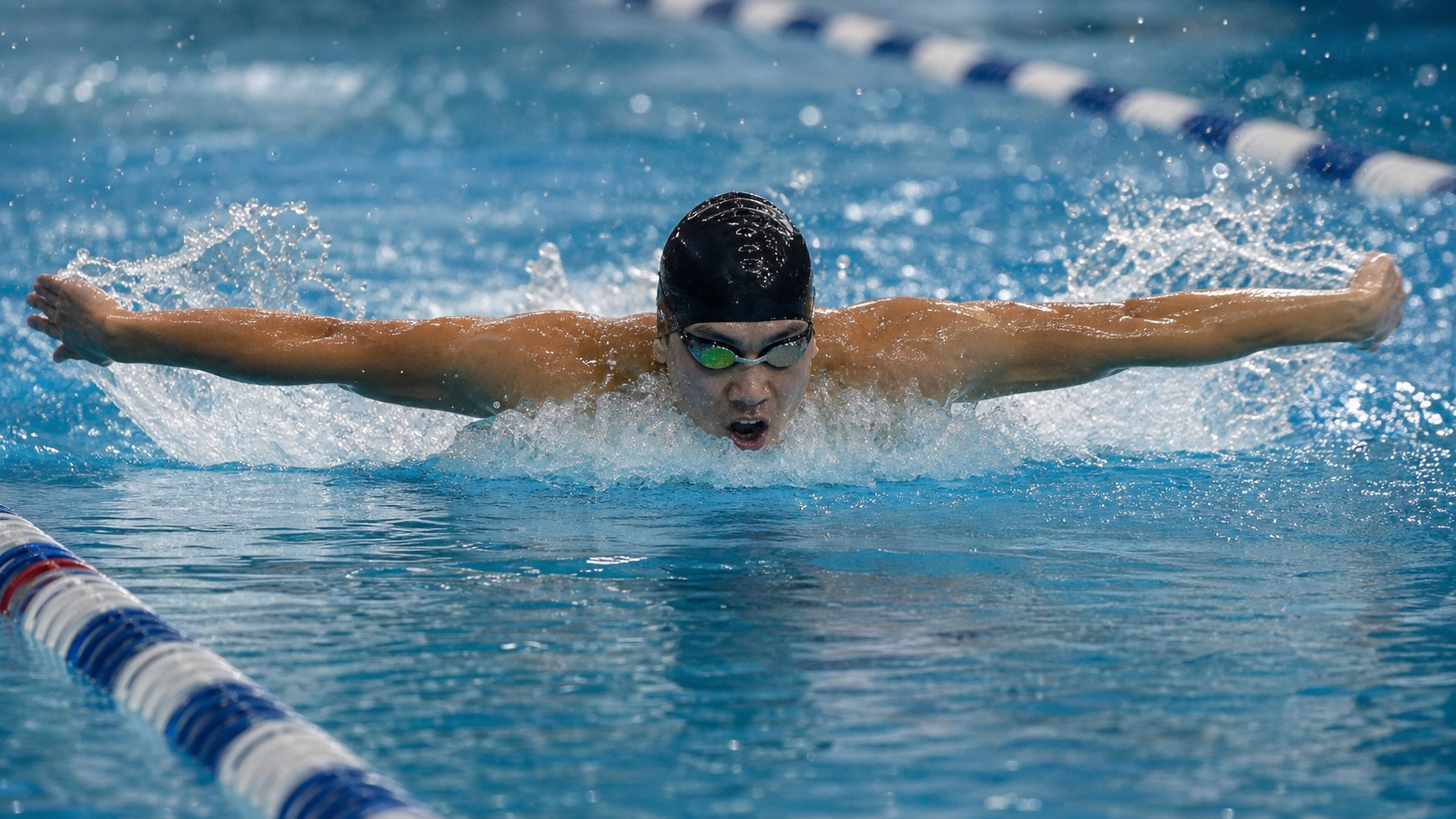
The butterfly stroke, with its powerful body undulation and symmetrical arm movements, is the most visually striking of the four competitive swimming strokes, as well as the most technically demanding and physically exhausting. Many recreational swimmers find butterfly exceptionally tiring due to incorrect technique, and the root cause often lies not in a lack of stamina, but in a failure to coordinate the two-kick rhythm with breathing timing.
The Core of Butterfly: Body Undulation
Butterfly is not a stiff up-and-down kicking motion, but a fluid body undulation. This wave-like motion travels from the head through the hips and down to the legs, much like how a dolphin swims (which is why the butterfly kick is also called the “Dolphin Kick”).
Characteristics of Proper Undulation:
- The motion originates from the upper body pressing down (chest entering the water), not from lifting the hips
- During each undulation cycle, the hips alternate between high and low points
- The leg kick is a continuation of the undulation, not an independent movement
Timing and Function of the Two Kicks
Each full arm stroke cycle in butterfly includes two kicks, each with completely different timing and function:
| Kick Order | Timing | Function | Leg Amplitude |
|---|---|---|---|
| First Kick (Entry Kick) | When the arms enter the water and begin gliding forward | Presses the body down, assists the catch | Smaller (20–30 cm) |
| Second Kick (Exit Kick) | When the arms finish the pull and begin the recovery | Primary propulsion, lifts the body up for breathing | Larger (30–40 cm) |
The First Kick (Entry Kick) is timed at the moment the arms complete their entry into the water. At this point, the hips sink and the chest presses down; the kicking motion helps keep the body near the surface while also assisting the initiation of the catch. The amplitude does not need to be large—the purpose is rhythm coordination rather than propulsion.
The Second Kick (Exit Kick) is the primary propulsive kick, occurring as the arm pull nears completion (when the hands are approximately near the thighs). This kick is more powerful and simultaneously drives the hips and head upward, creating the conditions for the breathing motion.
Mastering Breathing Timing
Breathing timing in butterfly is a critical point where many swimmers make mistakes. Proper breathing should occur as the second kick lifts the head, rather than by actively straining the neck muscles to raise the head.
Proper Breathing Sequence:
- Second kick: hips press down, head rises with the motion
- Arms begin the recovery out of the water
- Head clears the water (the chin just needs to pass the surface—no need to lift too high)
- Quick inhale (very brief, approximately 0.3–0.5 seconds)
- Before the arms enter the water, the head has already begun pressing back down
- Arms enter the water, first kick, entering the next cycle
Common Breathing Errors:
- Lifting the head too early (raising the head before the pull is complete, disrupting stroke efficiency)
- Raising the chin too high (causing the upper body to exit the water excessively, resulting in a large impact upon re-entry)
- Slow head return after breathing (keeping the head above water too long, increasing drag)
Non-Breathing Rhythm Techniques in Butterfly
In longer-distance butterfly or specific training sets, a strategy of “breathing every two cycles” is sometimes used to reduce the disruption breathing causes to the rhythm. During non-breathing cycles, the head remains facing down, and the amplitude of movements can be smaller, helping to maintain a high stroke rate.
Common Issues in Arm Recovery
Incorrect Wide Recovery:
Many swimmers rotate their arms into the water from the sides after exiting (Wide Recovery). This can easily cause shoulder injuries when shoulder mobility is insufficient, and the longer movement path prevents an increase in stroke rate.
Ideal Recovery Path:
After the arms exit the water, they swing forward in a low, flat arc (close to the water surface), with the elbows slightly bent (not fully extended). The hands enter the water at the shoulder line with a minimal entry angle.
Energy Management in Butterfly
The high energy expenditure of butterfly makes pacing strategy crucial. For a 100-meter butterfly, a common strategy is:
- First 50 meters: Maintain technical quality, avoid over-sprinting
- Last 50 meters: Increase kick rate, use the propulsion of the second kick to sprint
For recreational swimmers practicing butterfly, it is recommended to train in short segments (in 25-meter units) rather than forcing longer distances, to ensure technical quality is maintained during every session.
Training Recommendations
Dolphin Kick Specialty Training:
With hands on the hips (without a kickboard), perform only dolphin kicks to feel the undulation traveling from the waist to the toes. Sets of 25–50 meters.
Single-Arm Butterfly Drill:
Keep one arm at the side while the other performs the full butterfly motion. This helps develop coordination between the arm entry and the kicking rhythm.
Rhythm Counting Drill:
Mentally count “one, kick, kick, two, kick, kick” (one represents the entry, kick represents each of the two kicks) to establish a clear sense of rhythm.
Underwater Dolphin Kick Start Practice:
Underwater dolphin kicks after turns are a major component of butterfly speed. After each turn, try to maintain underwater dolphin kicks for 5–7 meters before surfacing.
Conclusion
The beauty of butterfly lies in the combination of fluid body undulation and power, but this beauty can only be achieved through systematic technical training. Mastering the timing difference between the two kicks and the correct breathing rhythm is the key turning point from “struggling with effort” to “gliding with elegance.” Maintaining targeted butterfly technique training each week will, in time, yield noticeable improvement.
Related Reading
- The Wave Rhythm of Butterfly: Synchronizing Body Undulation and Breathing Timing
- Butterfly No Longer a Nightmare: A Scientific Breakdown of Dolphin Waves, Two-Kick Timing, and Energy-Saving Rhythm
- Coordination Training for Dolphin Kick and Body Wave in Butterfly
- Butterfly Wave Motion: Chest and Hip Undulation Coordination Drills
CT 喇低賽) 武嶺牽車 才是王道 西進牽車四小時內秘訣 攝手位置 如何判斷 防抽筋小秘訣
7 年前
FTL 與 SYB 車隊專訪 西進武嶺 實用攻略分享! 2小時 如何練?!你不知道的眉角!新手準備武嶺必看 EP1 | 實力派女車友 | 精華版 | 公路車 | CTYeh
4 年前
西進武嶺 免費訓練分析服務 Intervals | 練不夠還是練過頭?你哪一種類型選手?AI模型告訴你! | 備戰神器 | 公路車 訓練 | CT Yeh
4 年前
類空拍神器 Feiyu Pocket 2s (有優惠連結)三軸穩定 運動攝影機 開箱!比GoPro 還強的滑順視角!三小時長時間錄影 行車記錄器 | 環花東365實測 | 公路車 CT Yeh
4 年前
風櫃嘴 衝刺慢動作回放!
8 年前
西進武嶺 自製新版AI配速表產生器 x 賽前攻略 抱佛腳! 沒有功率計也可以產生配速表嗎?有什麼其他眉角賽前要注意的呢? | 西進武嶺 / 東進武嶺 KOM 攻略 | 公路車 | CT Yeh
4 年前
多機位拍片神器 DJI Action 2 拍出速度張力感 | 類空拍機視角 4陣列麥克風超強降風噪 實測! | 公路車 | CT Yeh
3 年前
一起升級!海鷗盃LSD團練...JJSC Zone2招待 騎到手抖 / 公路車 / CT Yeh
1 天前