Introduction
In a 100-meter freestyle race, a flip turn (Flip Turn / Tumble Turn) occurs once; in a 200-meter race, it occurs three times; and in a 1500-meter race, it happens as many as 29 times. Research shows that the turn phase (including the 5 meters before the wall, the turn itself, the push-off, and the underwater glide until surfacing) accounts for 20%–40% of total race time. This shows how much impact turn technique has on performance, yet most amateur swimmers almost never practice it systematically.
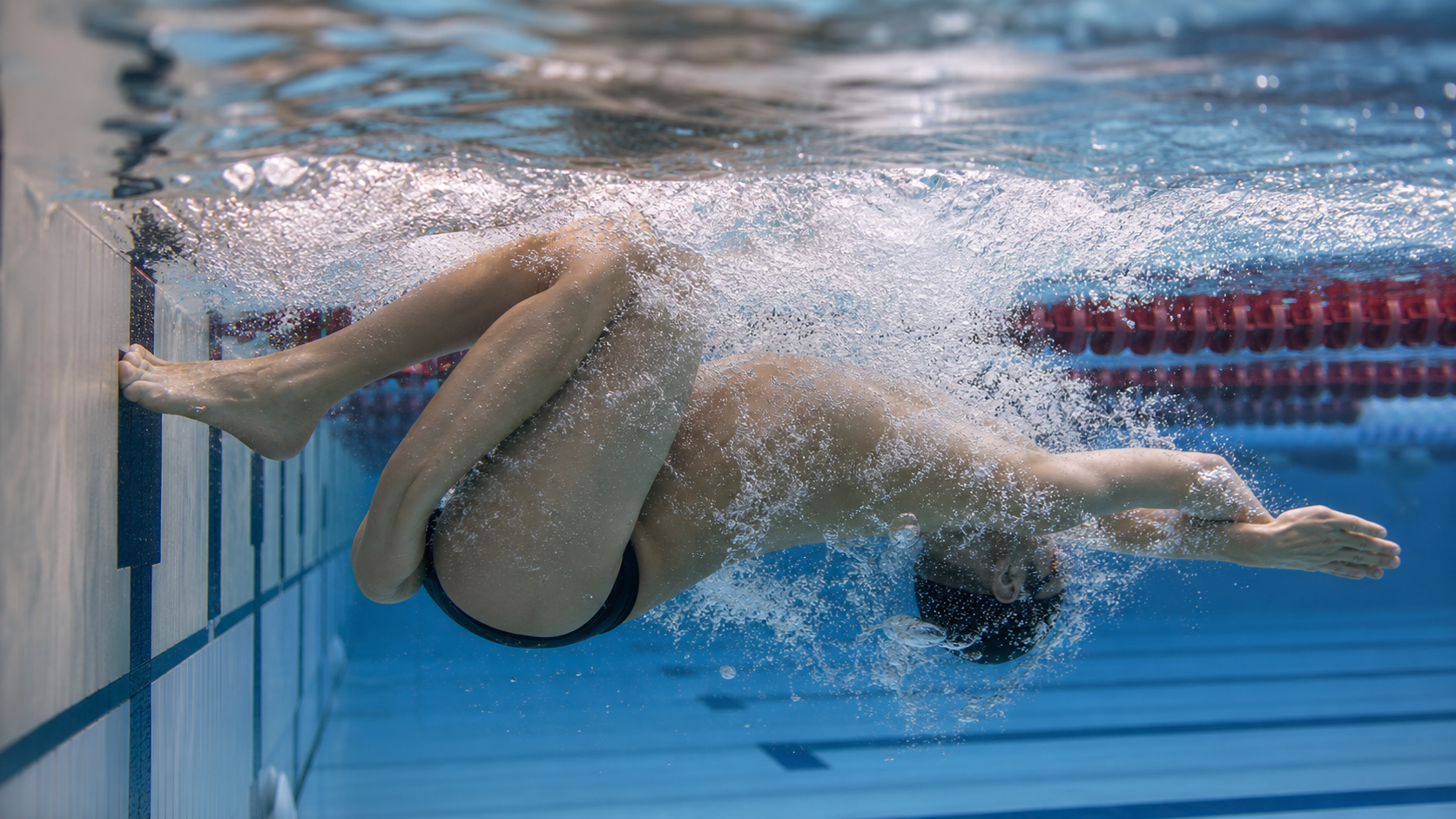
Technical Breakdown of the Freestyle Flip Turn
The freestyle flip turn can be divided into the following five key phases:
Phase 1: Maintaining Speed in the 5 Meters Before the Wall
Many swimmers actively slow down when approaching the wall (afraid of hitting it), which is a major mistake. The correct approach is to approach the wall at full speed, using the 5-meter flags at the top of the pool to gauge the distance to the wall, and developing your own proprioceptive sense of “strokes to the wall.”
Phase 2: The Flip
Initiate the flip approximately 1–1.5 meters from the wall:
- Quickly press the head downward (driving the body into the roll)
- Perform a “pull → press” motion with the arms to assist the flip
- Tuck the chin tightly to shorten the rotation radius (the smaller the radius, the faster the rotation)
- The entire flip takes about 0.3–0.5 seconds
Phase 3: Foot Placement on the Wall
Foot placement on the wall is the foundation of push-off power, and correct placement is critical:
| Foot Placement | Push-Off Effect | Issue |
|---|---|---|
| Approximately 30–45 cm below the surface | Optimal (natural surfacing angle after push-off) | Requires precise distance calculation |
| Near the surface | Push-off angle too shallow, surfaces too quickly | Short underwater glide distance |
| 60 cm+ below the surface | Too deep after push-off, requires extra effort to surface | Wastes energy |
The sole of the foot (not the toes) should be flat against the wall, with the knees bent at approximately 90 degrees, ready to explode off the wall.
Phase 4: Push Off
The push-off is the phase requiring the most explosive power in the turn:
- Both legs push off the wall simultaneously with maximum force
- The body has already rotated back to a prone position during the push-off (rotating 90–180 degrees from the supine position of the flip)
- The arms extend forward in a streamlined position during the push-off (arms stacked, one palm pressing on the back of the other hand)
- The head is tucked between the arms, maintaining a streamlined position
Phase 5: Underwater Glide and Surfacing
The underwater glide distance after the push-off depends on push-off power, streamline quality, and underwater kick efficiency:
- Recommended distance: approximately 4–6 meters (or until speed drops below 80% of swimming speed)
- Underwater dolphin kicks (freestyle) or frog kicks (breaststroke) can extend the effective glide distance
- The first 1–2 strokes after surfacing should be slightly faster than normal swimming to maintain momentum
Common Flip Turn Errors
Error 1: Flipping Too Far from the Wall
After completing the flip, the feet fail to reach the wall, requiring extra strokes in the water to close the distance, wasting significant time and energy. Start by practicing “strokes to the wall” to develop precise distance awareness.
Error 2: Flipping Too Close to the Wall
The head touches the wall during the flip, or the knees are overly bent (beyond 90 degrees) when the feet contact the wall, making an effective push-off impossible. Practice initiating the flip earlier.
Error 3: Pushing Off Before Rotating to a Prone Position
The body is still on its side or in a supine position when pushing off, resulting in an incorrect push-off direction and a skewed underwater glide path.
Error 4: Hands Separating During the Underwater Glide
The arms separate during the underwater glide, significantly increasing water resistance. Maintain a tight streamline with hands stacked together.
Error 5: Surfacing Too Early
Rushing to surface and start stroking while speed is still higher than swimming speed wastes valuable “free speed.”
Training Recommendations
Personalized “Strokes to the Wall” Training:
Swim toward the wall at a fixed pace, count how many strokes it takes from the 5-meter flags to the wall, and repeat and record multiple times to establish a stable personal turn pattern.
Turn Time Timing Training:
Have a coach or partner time from passing under the flags to surfacing—this is the most direct indicator of turn efficiency.
Land-Based Push-Off Power Training:
Jump squats and single-leg push-off drills can directly improve push-off power. Recommended twice per week.
Underwater Glide Time Training:
After pushing off, count the number of underwater dolphin kicks, gradually increasing the effective underwater distance (from 3 meters to 6 meters) to feel the improvement in streamlining.
Conclusion
Refining turn technique is the most “cost-effective” training investment for competitive swimming progress. Compared to improving stroke technique, which requires hundreds of hours of water feel training, turn technique can be improved with targeted drills and show significant performance gains in a short period. Spending 10 minutes on dedicated turn practice at the end of every training session is a required course for all serious competitive swimmers.
Related Reading
- Refining Swimming Turn Technique: Push-Off Timing and Streamline Maintenance in Flip Turns
- Refining Turn Technique: Foot Placement Angle and Push-Off Timing in Flip Turns
- Complete Turn Technique Analysis: Foot Placement Timing and Push-Off Angle in Freestyle Flip Turns
- The Mechanics of Push-Off in Swimming Turns: Technical Details for Maximum Propulsion
CT 喇低賽) 武嶺牽車 才是王道 西進牽車四小時內秘訣 攝手位置 如何判斷 防抽筋小秘訣
7 年前
抖肩舞 台灣x日本交流版 (台灣 vs 前橋) 赤城山登山賽 coincidance
8 年前
西進武嶺 自製新版AI配速表產生器 x 賽前攻略 抱佛腳! 沒有功率計也可以產生配速表嗎?有什麼其他眉角賽前要注意的呢? | 西進武嶺 / 東進武嶺 KOM 攻略 | 公路車 | CT Yeh
4 年前
FTL 與 SYB 車隊專訪 西進武嶺 實用攻略分享! 2小時 如何練?!你不知道的眉角!新手準備武嶺必看 EP1 | 實力派女車友 | 精華版 | 公路車 | CTYeh
4 年前
Insta 360 One 超級防手震技術實測
7 年前
大禹嶺 到 武嶺牌樓 全程前後實況錄影 | 北進武嶺 | 東進武嶺 | KOM | 訓練台 | 坡度分析 | Taiwan KOM Last 10 km HARD | 公路車
6 年前
西進武嶺 免費訓練分析服務 Intervals | 練不夠還是練過頭?你哪一種類型選手?AI模型告訴你! | 備戰神器 | 公路車 訓練 | CT Yeh
4 年前
昇陽SYB車隊 & Fuji 菁英選手們的趣味經驗分享,長知識了!市民車友必看~ 一路被拉爆後才給問 | 戀戀197 武嶺 凸台經驗分享 | 公路車 | CT Yeh
4 年前