Core Training for Swimming: The Direct Impact of Land-Based Core Strengthening on Water Streamlining
Introduction
When coaches say “engage your core while swimming,” most swimmers’ first reaction is, “Does that just mean sucking in my stomach?” But the core stability required for swimming is far more complex than simply pulling in your abdomen. Core training for swimming must encompass the abdominals, back, hips, and the lumbopelvic complex to truly deliver results in the water. This article will detail which core exercises are most beneficial for swimming and how they directly improve streamlining and propulsion efficiency in the water.
The Role of the Core in Swimming
The core musculature must perform four primary functions while swimming:
- Maintaining Streamlining: Preventing the hips and legs from sinking to reduce water resistance
- Transferring Rotational Force: Acting as a bridge for force transfer during body rotation (arm power → core → legs)
- Stabilizing Breathing Movements: When the head turns to breathe, the core must keep the rest of the body stable
- Coordinating Arm and Leg Rhythm: Particularly in butterfly and breaststroke, the core’s undulation rhythm directly affects kicking efficiency
Core Muscle Groups and Their Relevance to Swimming
| Muscle Group | Primary Swimming Function | Representative Exercises |
|---|---|---|
| Rectus Abdominis | Maintains neutral body position, prevents excessive lower back arching | Plank, Dead Bug |
| Obliques | Control the amplitude and rhythm of body rotation | Side Plank, Russian Twists |
| Multifidus | Fine spinal stabilization, prevents lateral sway of the lower back during arm pulls | Quadruped Opposite Arm/Leg Raises |
| Gluteus Maximus | Power source for butterfly and breaststroke kicking | Bridge, Glute Bridge |
| Iliopsoas | Up-kick motion in freestyle kicking | Mountain Climbers, Standing Knee Raises |
Core Exercises Specifically Designed for Swimming
Exercise 1: Dead Bug
Targeted Function: Symmetrical abdominal stability, preventing lower back sway (corresponds to rotational stability in freestyle)
Execution:
- Lie on your back with arms extended vertically and knees bent at 90 degrees
- Slowly extend your right arm overhead while simultaneously extending your left leg forward (foot about 10 cm off the ground)
- Keep your lower back pressed into the floor; do not let it arch
- Perform 10–12 reps per side
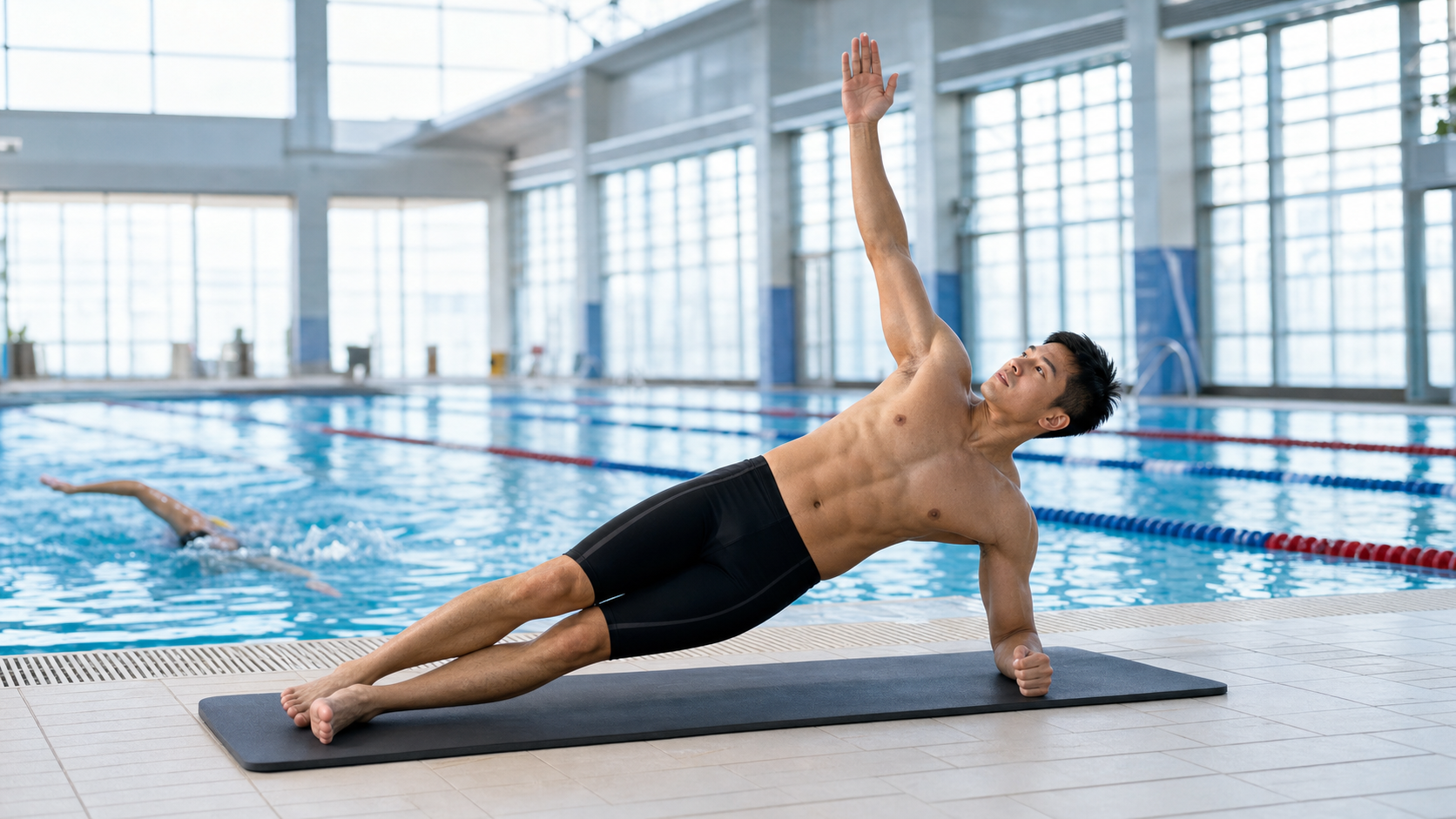
Exercise 2: Side Plank Rotation
Targeted Function: Strengthens the obliques, corresponding to axial rotation control in freestyle and backstroke
Execution:
- Start in a side plank position
- Reach the top arm forward, leading the upper body into a downward rotation (threading it beneath your body)
- Return to the starting position, reaching the arm toward the ceiling
- Perform 8–10 reps per side
Exercise 3: Swimmer’s Plank
Targeted Function: Simulates the core load during the high-elbow catch in freestyle, strengthening scapular stability
Execution:
- Assume a standard plank position
- “Slide” one arm forward from the shoulder line (extending it past your head), hold for 3 seconds, then switch sides
- Keep the core engaged throughout; do not let the lower back sag
Exercise 4: Bridge with Alternating Leg Extension
Targeted Function: Glute strength + unilateral stability, corresponding to the explosive power of the butterfly kick
Execution:
- Lie on your back in a bridge position, lifting your hips off the ground
- Extend one leg straight forward, hold for 2 seconds, without letting the hips drop
- Perform 10 reps per side
Exercise 5: Lizard Crawl (Bear Crawl Variation)
Targeted Function: Cross-body limb coordination, corresponding to the alternating coordination of the freestyle arm pull and kick
Execution:
- Start on all fours, with knees slightly lifted off the ground (about 5 cm)
- Move your right hand and left foot forward simultaneously; then follow with your left hand and right foot
- 5 steps forward and 5 steps backward count as one set; perform 4 sets
Training Program Recommendations
Here is a weekly core training schedule suitable for swimmers:
3 times per week (approximately 20–25 minutes each session):
- Dead Bug: 3 sets × 12 reps
- Side Plank Rotation: 3 sets × 10 reps (per side)
- Swimmer’s Plank: 3 sets × 8 reps (per side)
- Bridge with Alternating Leg Extension: 3 sets × 10 reps (per side)
- Lizard Crawl: 4 sets × 5 steps out and back
Key Principles:
- Prioritize quality; do not sacrifice proper form for more repetitions
- Perform a 5-minute dynamic warm-up before training (rotations, leg lifts, shoulder circles)
- Core training should be scheduled after swim practice to avoid fatigue compromising in-water technique
How to Verify the Effectiveness of Core Training
After following the core training program for 4–6 weeks, you can evaluate its effectiveness using the following indicators:
- Whether the frequency of hip sinking while swimming has decreased (ask a coach or partner to observe)
- Whether your SWOLF score has improved
- Whether technical stability in the latter half of long-distance swims has increased
- Whether body sway during breathing has been reduced
Conclusion
Core training is the “foundation” for swimming technique improvement, yet many swimmers overlook the importance of land-based training and only practice in the water. In fact, swimming-specific land-based core training can deliver significant improvements in in-water technique at a lower time cost (3 sessions × 20 minutes per week). Starting today, incorporate core training into your swim program, and over the coming months, you will experience a comprehensive improvement in technical stability.
Related Reading
- Core Muscle Training for Swimming: The Scientific Basis of Propulsion in Water
- Core Training for Swimming: The Dialectic of Rotational Power and Spinal Stability
- Swimming and Core Shaping: The Benefits of Consistent Swimming on Waist and Abdominal Definition
- Swimming Core: Why Anti-Rotation Matters More Than Flexion
[教學] Premiere 影片 手震 修正 教學 防抖 單眼 影像 GoPro 穩定 Video Stabilization
8 年前
一日北高/長距離團騎 常見問題補充篇 / 組團或跟團的眉角 / 壯車友容易被瘦車友慢性拉爆 / 原來屁股痛可能是這個原因...? / 風場配速法 / 公路車 / CT Yeh
2 年前
一起升級!海鷗盃LSD團練...JJSC Zone2招待 騎到手抖 / 公路車 / CT Yeh
1 天前
西進武嶺 免費訓練分析服務 Intervals | 練不夠還是練過頭?你哪一種類型選手?AI模型告訴你! | 備戰神器 | 公路車 訓練 | CT Yeh
4 年前
CT 喇低賽) 武嶺牽車 才是王道 西進牽車四小時內秘訣 攝手位置 如何判斷 防抽筋小秘訣
7 年前
實景訓練台) 彰化經典百K 高強度喵團 90分鐘 跟著一起練功 2019 Indoor workout Changhua Classic 100 Taiwan
7 年前
福隆鐵人團練隨拍
8 年前
教學) 如何做出專業 慢動作 影片 Slow Motion 120fps GoPro 7 ActionCam AX700 A99II
7 年前