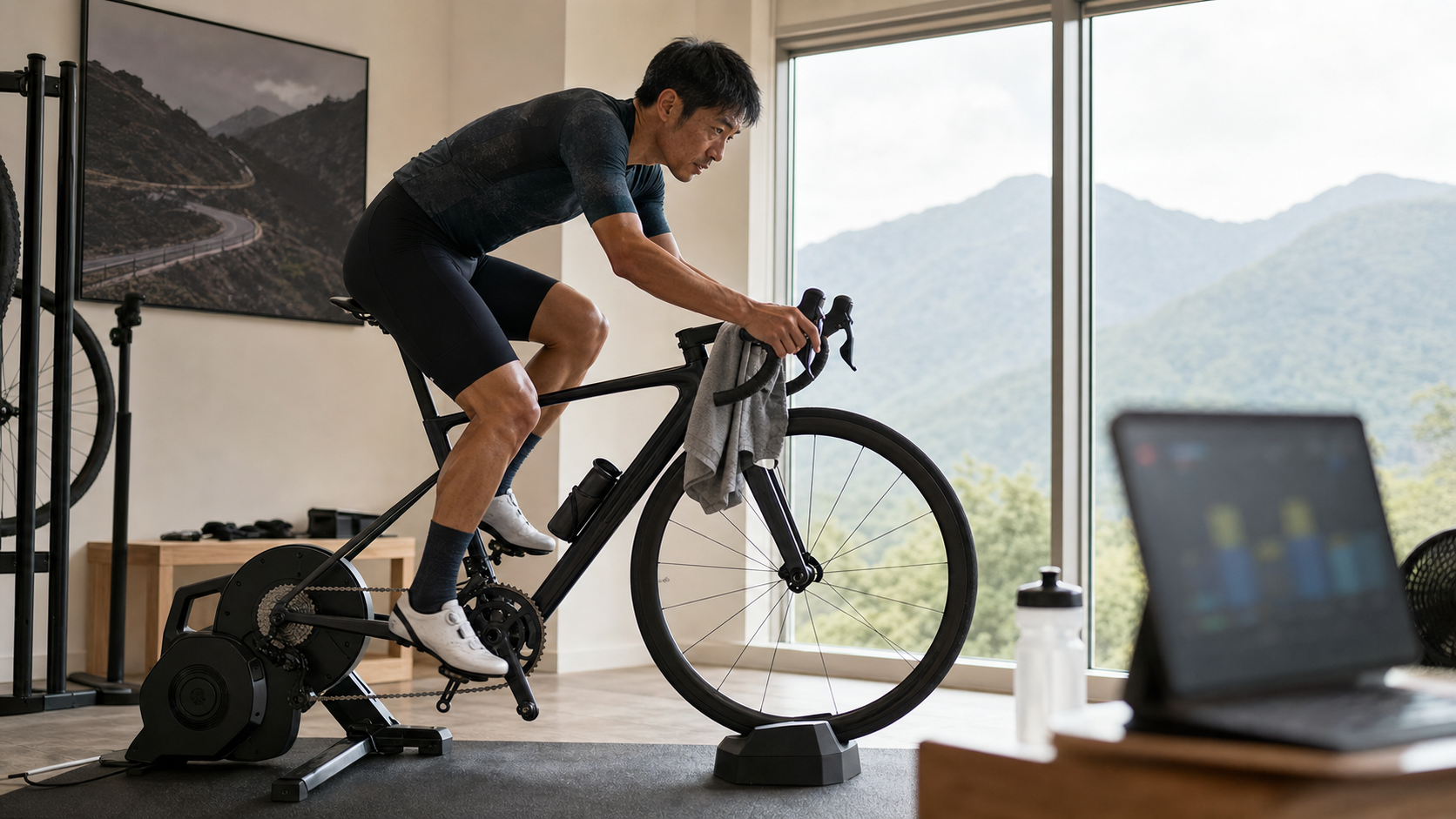
Indoor Trainer Climbing Simulation: Applications of ERG Mode and Slope Mode for Climbing Training
Introduction
Taiwan’s weather is unpredictable, making it difficult to get outdoor climbing training during the week. Indoor trainers have become a daily training companion for many cyclists. However, the two main modes of a trainer—ERG mode and Slope mode—have vastly different training characteristics. Choosing the wrong mode not only diminishes training effectiveness but may also cultivate poor pedaling habits.
How ERG Mode Works
ERG (Ergometer) mode allows the trainer to automatically adjust resistance to maintain a set target power. Whether you pedal fast or slow, the trainer adjusts resistance to keep your power output at the target value.
Characteristics of ERG Mode:
- Power locking: resistance automatically compensates when cadence changes
- Suitable for precisely executing power-based workouts (e.g., Sweet Spot, Threshold intervals)
- Eliminates the cognitive load of “finding the right gear”
The ERG Trap (ERG Spiral of Death):
In ERG mode, if your cadence suddenly drops (e.g., due to excessive fatigue at the start of an interval), the trainer increases resistance to maintain power. This in turn causes the cadence to drop further, creating a vicious cycle of “cadence drops → resistance increases → cadence drops again,” eventually leading to a complete stop. Solution: when struggling, actively increase cadence rather than pushing harder.
How Slope Mode Works
Slope mode (Slope/Simulation Mode) simulates the resistance of a specific gradient, allowing the rider to control power output by choosing their own gear and cadence. It is the closest to real outdoor riding.
Characteristics of Slope Mode:
- The rider controls power themselves (via gear + cadence)
- Resistance follows speed (fast → higher resistance, slow → lower resistance)
- Power output is more dynamic and closer to the real climbing feel
Comparison of the Two Modes
| Feature | ERG Mode | Slope Mode |
|---|---|---|
| Power control | Automatically maintains target power | Manual control (gear + cadence) |
| Cadence freedom | Low (changing cadence affects execution) | High (simulates real climbing) |
| Suitable workouts | Structured intervals, Sweet Spot | Climbing simulation, self-paced riding |
| Climbing realism | Low (fixed resistance, not slope-feel) | High (gravity feel closer to reality) |
| Psychological difficulty | High (controlled by the numbers) | Medium (closer to outdoor experience) |
| Technical training benefit | Low (does not train pacing judgment) | High (practices gear selection and pacing) |
Mode Selection Recommendations for Climbing Training
Situations to Use ERG Mode
- Sweet Spot Intervals (2×20 minutes @ 88–92% FTP): Precise maintenance of the power zone is required; ERG mode lets you focus on breathing and cadence without the distraction of shifting gears.
- Lactate Threshold Testing: Precise heart rate response testing at specific power outputs is needed.
- Ramp Test (FTP Assessment): Automated progressive power increase eliminates human error.
- Short Intervals (VO2max, 3–5 minutes high intensity): Precise target power is required; ERG mode is the most efficient.
Situations to Use Slope Mode
- Climbing Pace Training: Set a 6–10% gradient and practice managing power output with gear + cadence, simulating real climbing decisions.
- Standing Pedaling Practice: Standing up to pedal in Slope mode feels closer to outdoor riding, making it ideal for practicing the rhythm of standing and seated transitions.
- Long Climb Tempo (> 30 minutes continuous climbing): Allows natural power fluctuations within the target zone, which better matches actual climbing characteristics than ERG’s “rigid fixed” output.
- Mental Training: Learn to maintain pace under the increasingly heavy feel of slope resistance, building mental resilience for climbing.
Practical Workouts for Indoor Climbing Simulation
Workout 1: ERG Mode Sweet Spot Climbing (75 minutes)
- Warm-up: 15 minutes progressive (Zone 1→3)
- Main set: 3 × 15 minutes @ 88–92% FTP, with 5 minutes Zone 1 recovery between
- Cool-down: 10 minutes
Workout 2: Slope Mode Climbing Simulation (90 minutes)
- Set gradient to 7%
- Warm-up: 15 minutes (using an easy gear)
- Main set: 60 minutes steady climbing (target Zone 3–4), self-select gear to maintain 70–80 rpm
- Every 10 minutes, stand and pedal for 60–90 seconds to practice standing/seated transitions
- Cool-down: 15 minutes (switch to a low 3% gradient with easy pedaling)
Workout 3: Mixed-Mode Climbing Intervals (80 minutes)
- Slope mode warm-up for 15 minutes
- Switch to ERG mode: 6 × 4 minutes @ 105–110% FTP, with 4 minutes Zone 1 recovery between each
- Switch back to Slope mode for a 15-minute cool-down
Additional Tips for Indoor Climbing Training
- A fan is essential: Indoors there is no wind, and sweat output far exceeds that of outdoor riding at the same intensity. Adequate cooling is key to maintaining training quality.
- Double the hydration: Indoor training requires 750–1000 mL of fluid per hour, 50% more than outdoors.
- High-altitude simulation is optional: Some advanced athletes use altitude tents combined with indoor climbing simulation, but the average cyclist does not need to pursue this equipment.
- Platforms like Zwift / RGT as aids: Using virtual riding platforms can add fun to training, especially virtual routes in Slope mode, effectively boosting training motivation.
Conclusion
ERG mode and Slope mode each have irreplaceable training value. The ideal approach is to choose the appropriate mode based on the day’s workout goals rather than sticking to the same one. For comprehensive climbing ability improvement, it is recommended to split usage roughly evenly between the two modes, allowing precise power training and realistic climbing simulation to complement each other in building your climbing strength.
Related Reading
- Interval Training on Indoor Trainers: Differences Between ERG Mode and Resistance Mode
- Indoor Trainer Climbing Simulation: Differences Between Gradient Settings and Real Climbing
- Indoor Trainer Power Training: Proper Use of ERG Mode and Common Pitfalls
- ERG Mode vs SIM Mode: A Decision Tree for the Two Modes of Smart Trainers
ThinkRider 智騎 XXPRO 訓練台,高階機種功能 只要 1/3價格!? 實測功率對比、噪音實測 / 公路車 / CT Yeh
1 年前
RAMP FTP Test 直播 究竟能撐到幾瓦 訓練台 Gravat Zwift
6 年前
白沙屯媽祖進香在家走!UREVO 坡度自調走步機 / 可連接訓練遊戲APP MyWhoosh / 邊看直播邊走起來 / CT Yeh
11 個月前
Stages功率計 和 智騎 X7 Pro 訓練檯同時騎兩個 Rouvy 角色會一起進終點嗎?最後來點數據分析 | 公路車
5 年前
訓練台體驗) 2019台北自行車展 三大家 訓練台體驗 Tacx Neo Flux 2 Xepdo Apx Wahoo Kickr
7 年前
邁金 T500 訓練台開箱!有下坡輔助、路感模擬、不用插電、直驅電機 !兩萬級距頂規享受新選擇!/ 公路車 / 室內訓練 / CT Yeh
1 年前
Fitting訓練兩用功率車 ! Thinkrider ST900 完整實測!/ 坡度升降 / 鄰居測試/ smart bike/公路車/ CT Yeh
2 年前
安裝) 超酷! RGT Cycling 最新 訓練台 騎乘軟體 模擬一級賽經典路線 選手 Road Grand Tours 安裝教學 Zwift 替代方案
7 年前