Warm-Up Design for Speed Training: The Correct Sequence of Dynamic Stretching and Progressive Acceleration
Why Is Warming Up So Important?
Speed training (intervals, tempo, sprints) places high demands on the body. Entering high-intensity work while the muscles are not fully prepared can lead to:
- Significantly higher risk of muscle strain: Cold muscles have poor extensibility, and sudden rapid contractions can easily cause muscle fiber tears
- Unactivated neuromuscular system: High-speed running requires rapid recruitment from the neuromuscular system; without prior activation, movement efficiency is low
- Cardiorespiratory system not ready: The heart and lungs need time to increase output; running at high intensity without warming up can cause an uncomfortable “hitting the wall” feeling in the cardiorespiratory system
- Reduced training quality: Pacing in the first 2–3 intervals is usually unstable, wasting the training stimulus
A well-designed warm-up routine (15–20 minutes) can effectively solve all of the above issues.
The Four Phases of a Speed Training Warm-Up
Phase 1: Easy Jogging (8–12 minutes)
- Pace: 30–40 seconds/km slower than your normal easy run
- Purpose: Raise core temperature, increase muscle blood flow, lubricate the joints
- Feel: Should feel very easy, almost like walking with a slightly faster pace
Common mistake: Running too fast, turning the warm-up jog into an easy-run effort. The purpose of the warm-up jog is to “wake the body up,” not to train. The slower, the better.
Phase 2: Dynamic Stretching (5–7 minutes)
Dynamic stretching refers to a method of stretching that gradually increases the range of motion of the joints while moving, which is fundamentally different from static stretching (holding still for 30 seconds).
Why shouldn’t you do static stretching during a warm-up?
Research shows that doing static stretching before running (especially stretches held for more than 30 seconds) temporarily reduces muscle power output and explosiveness (by 5–8%), which is detrimental to subsequent speed training. Static stretching should be reserved for the cool-down phase after training.
Recommended dynamic stretching exercises:
| Exercise | Reps | Target Muscles | Notes |
|---|---|---|---|
| Big leg swings | 10 each direction | Around the hip joint | Stand on one leg for support, maintain balance |
| Lateral walking lunges | 8–10 each side | Adductors/abductors, glutes | Take a large enough step |
| Front kicks (leg swings) | 10 each leg | Hamstrings, hip flexors | Control the force; don’t fling the leg |
| Butt kicks walking | 20m × 1 | Hamstrings | Actively kick heels toward the glutes |
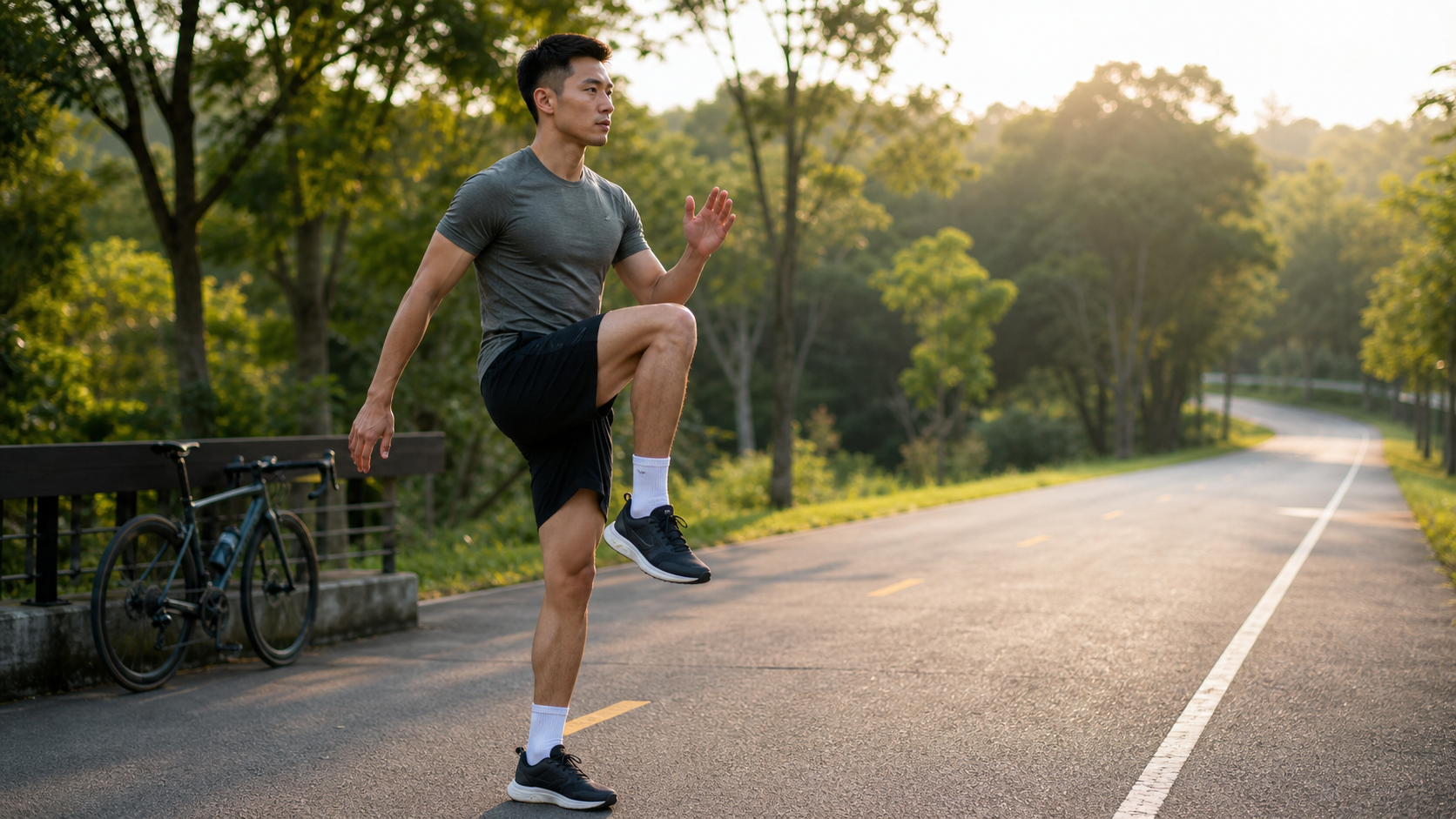
| High knees walking | 20m × 1 | Hip flexors, core | Drive knees up above hip height |
| Walking lunge with rotation | 8 each side | Hip flexors, torso rotation | Front leg in lunge position, rotate both hands toward the front leg |
| Ankle circles | 10 each ankle | Ankle joint | Slowly make large circles |
Phase 3: Progressive Acceleration (Strides, 3–5 minutes)
Strides are the “bridge” connecting the warm-up to the main workout, pre-heating the neuromuscular system to near training intensity.
Standard strides protocol:
- Distance: 80–120m (about 15–20 seconds of acceleration)
- Number: 3–6 reps (the higher the training intensity, the more strides)
- Acceleration method: First 30% easy, middle 40% gradually accelerate, final 30% hold near target pace
- Recovery between reps: Easy walking for 45–60 seconds
Recommended number of strides by workout type:
| Workout Type | Number of Strides | Target Intensity |
|---|---|---|
| Tempo run | 3–4 reps | Gradually up to T pace |
| 1000m intervals | 3–4 reps | Gradually up to I pace |
| 400m intervals | 4–5 reps | Gradually up to R pace |
| 200m sprints | 5–6 reps (including at least 2 near-maximal) | Close to maximum speed |
Phase 4: Final Check and Start (1 minute)
In the 1 minute before starting the main workout:
- Do quick high-knee steps in place for 10 seconds to confirm the legs are fully activated
- Take 3 deep breaths to settle into your breathing rhythm
- Confirm the GPS watch has locked on and the timer is ready
- Mentally confirm the target pace (repeat the target time for the first interval in your head)
Complete Warm-Up Routine Timeline
| Phase | Duration | Summary |
|---|---|---|
| Easy jogging | 8–12 minutes | Very slow jogging to wake the body up |
| Dynamic stretching | 5–7 minutes | 7–8 exercises, 8–10 reps each |
| Strides (progressive acceleration) | 5–7 minutes | 3–6 × 100m, from easy to training intensity |
| Start check | 1 minute | Confirm heart rate, pace, breathing |
| Total | 19–27 minutes | Complete speed training warm-up |
Weather Adjustment Recommendations
- Cold weather (below 15°C): Extend the jogging segment to 15 minutes and add 2–3 more dynamic stretching exercises to ensure muscle temperature is fully raised
- Hot weather (above 30°C): The jogging segment can be shortened to 8 minutes, but dynamic stretching and strides must not be skipped; it is recommended to do them in the shade
- Rainy weather: Dynamic stretching can be done indoors or under cover; make sure the ground is slip-resistant before starting strides
Conclusion
Warming up is never a “waste of time”—it is part of speed training. Investing 20 minutes to get 1 hour of high-quality training is an extremely high return. Before every interval session, give your body adequate preparation time, and you will find that the first interval feels smoother, pacing is more consistent throughout, and the training results are more satisfying.
Related Reading
- Warm-Up and Cool-Down for Road Running: A 5-Minute Dynamic Warm-Up and Static Stretching Combo
- 8 Dynamic Warm-Up Moves Before Running: Truly Wake Your Body Up in 10 Minutes
- The Correct Way to Warm Up Before Running: Replace Static Stretching with Dynamic Warm-Up
- Prevention Over Treatment: A 10-Minute Pre-Run Warm-Up Routine Every Week
西進武嶺 免費訓練分析服務 Intervals | 練不夠還是練過頭?你哪一種類型選手?AI模型告訴你! | 備戰神器 | 公路車 訓練 | CT Yeh
4 年前
FTL 與 SYB 車隊專訪 西進武嶺 實用攻略分享! 2小時 如何練?!你不知道的眉角!新手準備武嶺必看 EP1 | 實力派女車友 | 精華版 | 公路車 | CTYeh
4 年前
教學) 如何做出專業 慢動作 影片 Slow Motion 120fps GoPro 7 ActionCam AX700 A99II
7 年前
實景訓練台) 彰化經典百K 高強度喵團 90分鐘 跟著一起練功 2019 Indoor workout Changhua Classic 100 Taiwan
7 年前
西進武嶺 自製新版AI配速表產生器 x 賽前攻略 抱佛腳! 沒有功率計也可以產生配速表嗎?有什麼其他眉角賽前要注意的呢? | 西進武嶺 / 東進武嶺 KOM 攻略 | 公路車 | CT Yeh
4 年前
一日北高/長距離團騎 常見問題補充篇 / 組團或跟團的眉角 / 壯車友容易被瘦車友慢性拉爆 / 原來屁股痛可能是這個原因...? / 風場配速法 / 公路車 / CT Yeh
2 年前
Live) 備戰2019彰化經典百K 賽前攻略 (已完賽請看新影片
7 年前
[教學] Premiere 影片 手震 修正 教學 防抖 單眼 影像 GoPro 穩定 Video Stabilization
8 年前