Cooling Down After Speed Training: A 10-Minute Recovery Protocol of Static Stretching and Jogging
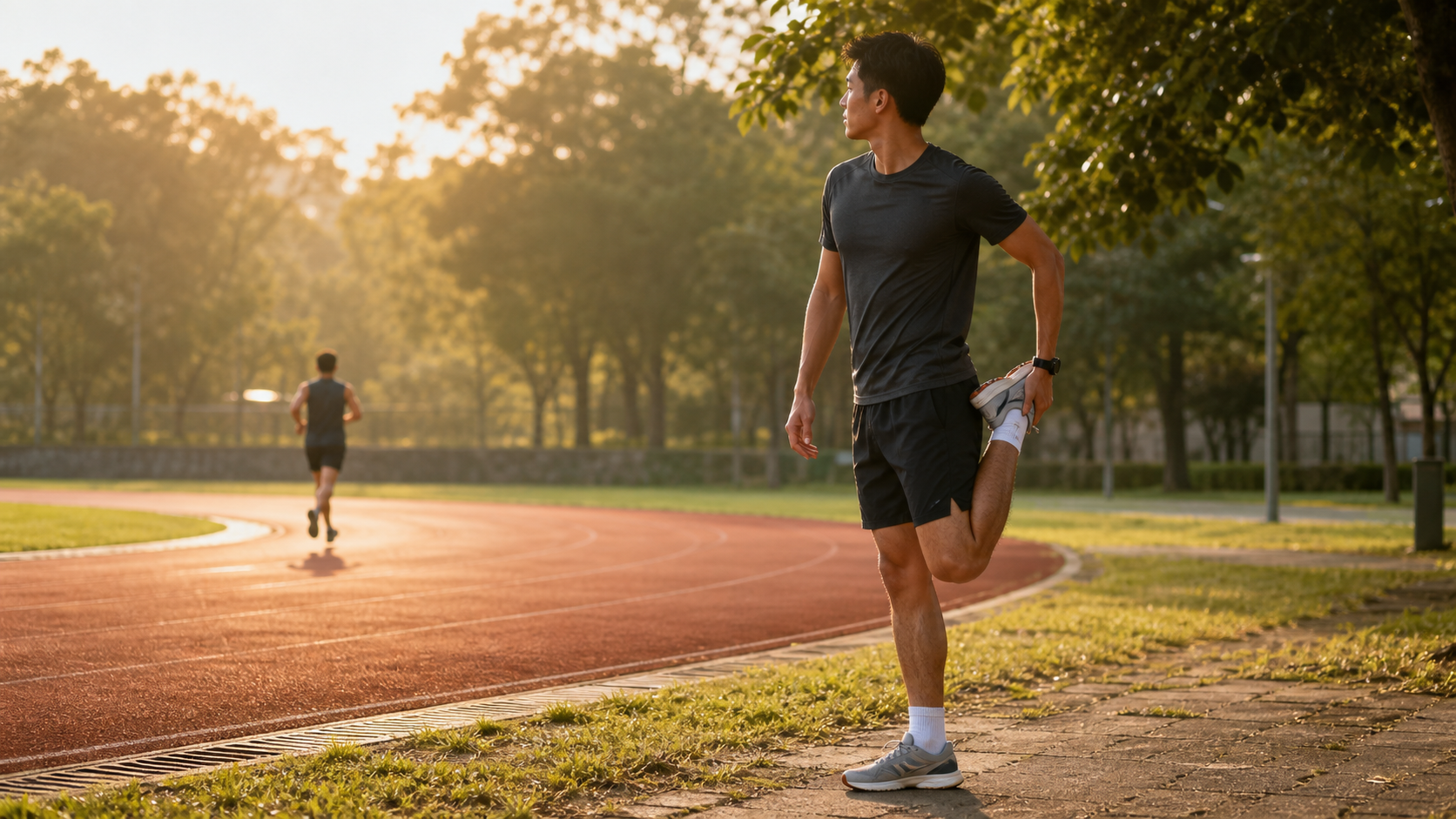
The Necessity of Cooling Down: Why Can’t You Just Stop After Running?
Stopping immediately after high-intensity speed training may seem like a “time-saver,” but it can have the following negative effects on your body:
- Blood pooling in the lower limbs: During high-intensity running, a large amount of blood flows to the leg muscles. If you stop suddenly, the muscles’ “pumping effect” disappears, blood pools in the lower limbs, and cardiac output drops sharply, potentially causing dizziness or even fainting
- Slower lactate clearance: Continuing to move at an easy pace maintains muscle blood flow and accelerates lactate metabolism
- Increased muscle stiffness and soreness: Stopping suddenly causes muscle temperature to drop rapidly, and muscle fibers solidify under high tension, worsening delayed-onset muscle soreness
- Overactivation of the nervous system: After high-intensity training, the sympathetic nervous system is highly active and needs a gradual transition to a parasympathetic state
A 20-minute investment in cooling down yields noticeably faster recovery—a habit every runner should adopt.
The Two Core Phases of Cooling Down
Phase 1: Jogging Cool-Down (10 Minutes)
Pace setting: 30–50 seconds/km slower than an easy run, feeling like “you’re almost walking, just with your feet running.” Heart rate target: 55–65% of maximum heart rate.
Why 10 minutes?
- First 3 minutes: Heart rate drops from 80–85% MHR to 70–75%
- Minutes 3–7: Primary window for blood lactate clearance; muscles continue metabolizing lactate
- Minutes 7–10: Heart rate drops below 65% MHR; the sympathetic nervous system begins to settle
Technical reminders for the jogging cool-down:
- Don’t look down at your phone or watch; maintain an upright, relaxed posture
- Breathe deeply (4-second inhale, 6-second exhale) to actively activate the parasympathetic nervous system
- Keep your stride relaxed; there’s no need to maintain any “running form” at all
Phase 2: Static Stretching (10 Minutes)
Muscle temperature is high after intense training, making this the best time for static stretching—muscle flexibility is at its peak, stretching effectiveness is greatest, and unlike stretching before a workout, it won’t reduce power output (since the main session is already over).
Complete static stretching routine:
| Stretch | Duration | Target Muscles | Technical Reminders |
|---|---|---|---|
| Standing quadriceps stretch | 40 seconds each side | Front of thighs | Stand on one leg, hold the wall for balance |
| Standing hamstring stretch | 40 seconds each side | Back of thighs | Heel on the ground, lean torso forward, don’t bend the back |
| Lunge hip flexor stretch | 40 seconds each side | Hip flexors (most commonly neglected by runners) | Front knee doesn’t pass the toes; back knee touches the ground |
| Glute stretch (pigeon variation) | 40 seconds each side | Glutes | Sit on the ground, front leg crossed with knee bent |
| Standing calf stretch | 40 seconds each side | Gastrocnemius | Ball of foot against the wall, heel on the ground, lean body forward |
| Soleus stretch | 30 seconds each side | Deep calf muscles | Same as above, but with knee slightly bent |
| Thoracic spine rotation | 20 seconds each side | Spine, lateral torso | Lie on the ground, cross one leg over, allowing the spine to rotate |
Timing for Hydration and Nutrition
The cool-down phase is also a golden window for replenishing fluids and nutrients:
- Hydration: Start taking small sips of water during the jogging cool-down (100–150ml every 5 minutes), avoiding large, rapid gulps
- Within 30 minutes after training: Consume food or drinks containing carbohydrates and protein
- Convenient options: Banana (carbs) + low-sugar soy milk (protein)
- Ideal ratio: Carbohydrate-to-protein = 3:1 to 4:1
- Taiwan convenience store option: Rice ball + tea egg (a simple and effective post-workout refuel)
Cool-Down Adjustments for Special Situations
| Situation | Adjustment |
|---|---|
| After training in Taiwan’s summer heat | Shorten the cool-down jog to 5–7 minutes, move to a shaded area for static stretching as soon as possible, and double your fluid intake |
| After a race | Replace jogging with walking (your body is already at its limit), stretch more gently, and increase electrolyte replenishment |
| Stretching injured muscles | Avoid forcing a stretch on the injured area; have a physical therapist assess it first |
| Extreme fatigue (e.g., after a long run) | Change the cool-down jog to walking; static stretching time can be extended to 15 minutes |
Advanced Recovery Tools (Optional)
After completing the basic cool-down routine, the following tools can further accelerate recovery:
- Foam rolling: Target the front and back of the thighs, the IT band (outer thigh), and the calves, 60–90 seconds per area
- Cold water foot soak: Soak from the ankles to the calves in 15–18°C cold water for 10–15 minutes to speed up swelling reduction and lactate clearance
- Compression tights/calf sleeves: Wear for 1–2 hours after training to promote venous return
- Pre-sleep static stretching: Do another 10-minute static stretching session on training days in the evening to fully relax the muscles before sleep
Post-Cool-Down Assessment: How Do You Know You’ve Recovered Enough?
You can use the following simple indicators to determine whether you’ve recovered sufficiently and are ready for your next training session:
- Resting heart rate: Morning resting heart rate is within +3 bpm of your normal value
- Muscle sensation: Mild soreness is acceptable, but no sharp pain or one-sided pain
- Sleep quality: Falling asleep easily, with no nighttime leg cramps or discomfort
- Appetite: Normal, with no unusual appetite suppression (loss of appetite is a common sign of overtraining)
Conclusion
The cool-down is the final important component of speed training—and the one most often skipped. Treat the 10-minute jog plus 10-minute static stretch as the “period” at the end of your training session, not an “optional extra.” This 20-minute investment allows your body to recover more fully before your next workout, ensuring every speed session delivers maximum benefit at its best. Speed isn’t just built through training—it’s also built through recovery.
Related Reading
- Post-Run Cool-Down and Stretching: A Complete 15-Minute Routine
- Warm-Up Design for Speed Training: The Correct Sequence of Dynamic Stretching and Progressive Acceleration
- Road Running Warm-Up and Cool-Down: A 5-Minute Dynamic Warm-Up and Static Stretch Combo
- Post-Run Cool-Down: Why You Can’t Stop Suddenly
教學) 如何做出專業 慢動作 影片 Slow Motion 120fps GoPro 7 ActionCam AX700 A99II
7 年前
西進武嶺 免費訓練分析服務 Intervals | 練不夠還是練過頭?你哪一種類型選手?AI模型告訴你! | 備戰神器 | 公路車 訓練 | CT Yeh
4 年前
[教學] Premiere 影片 手震 修正 教學 防抖 單眼 影像 GoPro 穩定 Video Stabilization
8 年前
FTL 與 SYB 車隊專訪 西進武嶺 實用攻略分享! 2小時 如何練?!你不知道的眉角!新手準備武嶺必看 EP1 | 實力派女車友 | 精華版 | 公路車 | CTYeh
4 年前
實景訓練台) 彰化經典百K 高強度喵團 90分鐘 跟著一起練功 2019 Indoor workout Changhua Classic 100 Taiwan
7 年前
Live) 備戰2019彰化經典百K 賽前攻略 (已完賽請看新影片
7 年前
Garmin Edge 1040 重大韌體更新!! / 1050功能全下放!? / 坡度反應變快了嗎?/ 快速對比實測 / 公路車 / CT Yeh
1 年前
CT暗黑廚房) 車友必備 宇宙無敵鮮蚵湯 幫助訓練恢復 天然食補 好市多 超肥鮮蚵 破PR
7 年前