Runner's Knee (Iliotibial Band Syndrome): A Complete Guide to Causes, Prevention Training, and Taping Techniques
What is Iliotibial Band Syndrome?
Whenever a runner experiences sharp pain on the outside of the knee after training, especially worsening after downhill runs or long distances, it is most likely Iliotibial Band Syndrome (ITBS) at play. This thick ligament, extending from the ilium to the lateral tibia, repeatedly rubs against the lateral femoral epicondyle at around 30 degrees of knee flexion, eventually leading to inflammation and pain. According to clinical statistics from Taiwanese sports medicine, ITBS accounts for approximately 10–12% of all running injuries, with peak occurrence during half-marathon and full-marathon training periods.
Anatomical Cause Analysis
The iliotibial band itself is not a muscle and cannot be actively stretched. The real problem often stems from imbalances in the surrounding muscles:
- Weak gluteus medius and gluteus minimus: Causes pelvic drop during running (Trendelenburg Sign), forcing the iliotibial band to compensate and bear extra tension
- Tight lateral quadriceps: Contracture of the TFL (tensor fasciae latae) directly tightens the iliotibial band
- Sudden spike in running mileage: Weekly mileage increases exceeding 10–15% leave the body unable to adapt in time
- Improper footwear or running surfaces: Long-term running in one direction on cambered surfaces accumulates asymmetrical stress
Common Risk Factors
| Risk Factor | Description | Relative Risk |
|---|---|---|
| Weak gluteus medius | Pelvic drop > 1 cm during single-leg stance | High |
| Rapid training volume increase | Weekly increase > 10% | High |
| Bow legs (genu varum) | Increases iliotibial band tension | Medium |
| High proportion of downhill running | Repeatedly increases knee flexion in the 30-degree range | Medium |
| Excessive foot pronation | Alters knee joint alignment as a result | Medium |
Pain Diagnosis: Ober’s Test and Noble Compression Test
Ober’s Test: Lying on your side, the therapist abducts the upper leg and then lowers it. If the leg cannot drop below horizontal, it indicates a tight iliotibial band.
Noble Compression Test: With the knee flexed at 30 degrees, pressure is applied 3 cm above the lateral femoral epicondyle. Significant pain upon pressure indicates a positive result.
Preventive Strengthening Training Program
The following exercises are recommended 3 times per week, scheduled on non-long-run days:
Phase 1: Foundational Strength (Weeks 1–3)
- Side-lying Clamshell: 3 sets × 15 reps, using a resistance band
- Standing hip abduction: 3 sets × 12 reps, with slow, controlled movements
- Single-leg bridge: 3 sets × 10 reps, keeping the pelvis level
Phase 2: Functional Strength (Weeks 4–6)
- Lateral band walk (Monster Walk): 4 sets × 20 steps
- Single-leg squat (assisted Pistol Squat): 3 sets × 8 reps
- Single-leg Romanian deadlift: 3 sets × 10 reps
Phase 3: Running Integration (From Week 7)
- Forward lunge combined with hip abduction: 3 sets × 10 reps per leg
- Treadmill incline adjustment training
KT Taping Technique
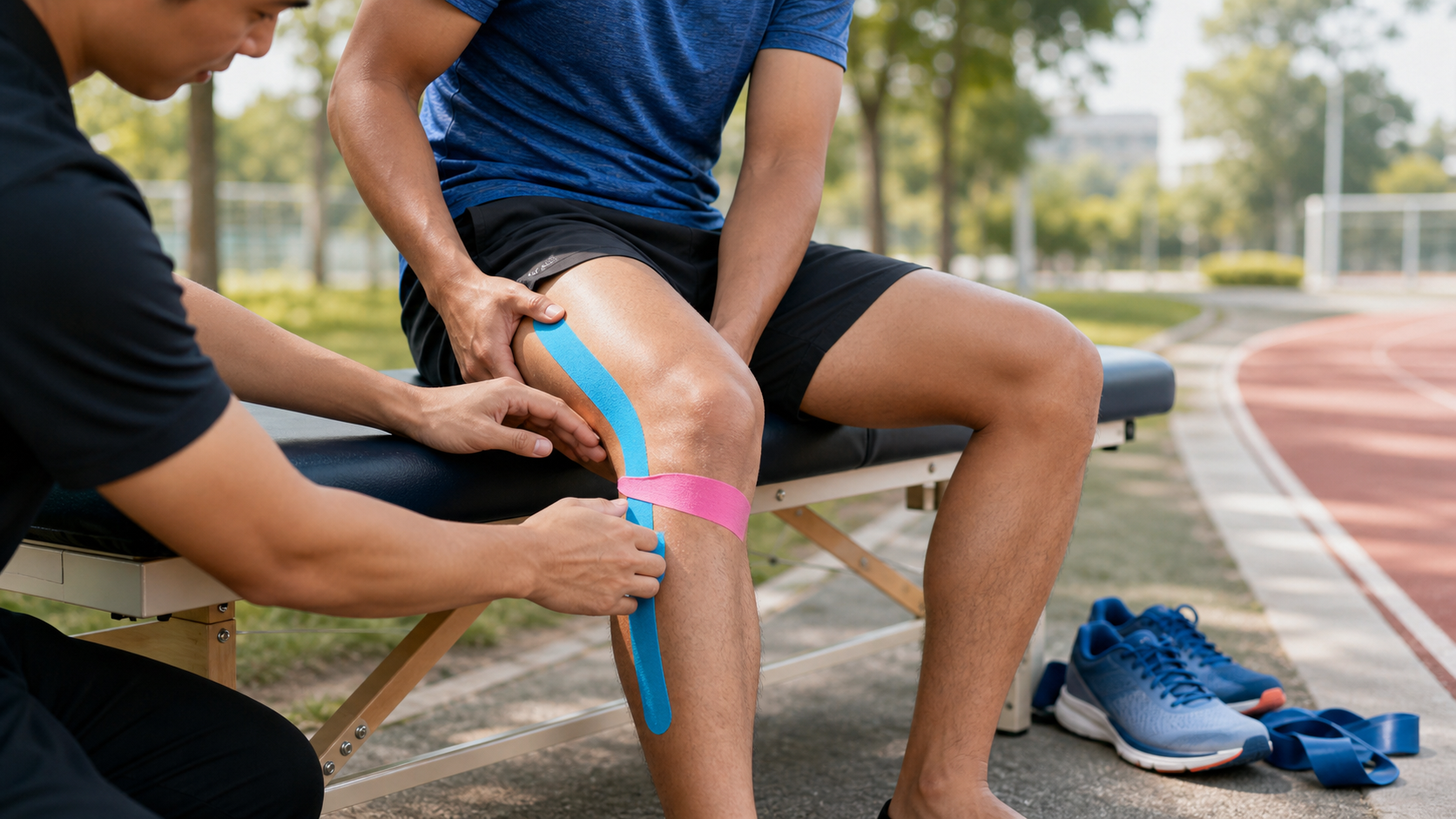
Use 5 cm wide sports tape, cut in a Y-shape:
- Base anchor: Start 2 cm below the lateral knee, applied with no tension
- Anterior strip: Run along the anterior edge of the iliotibial band upward, extending to the lateral thigh with approximately 20% tension
- Posterior strip: Run along the posterior edge of the iliotibial band, parallel to the anterior strip with the same tension
- End anchor: Finish at the lateral hip, also with no tension
Taping is not a treatment but a supportive tool; its effects are lasting only when combined with strength training.
Acute Phase Management
When pain flares up, prioritize the POLICE principle (Protection, Optimal Loading, Ice, Compression, Elevation). Recommendations for the acute phase:
- Pause running for 2–5 days, switching to swimming or cycling to maintain aerobic fitness
- Ice 3–4 times daily for 15 minutes each session during the acute phase
- Avoid deep massage directly on the lateral femoral epicondyle (it can worsen inflammation during the acute phase)
Determining When to Return to Running
Gradual return to running is allowed only after meeting the following criteria:
- Pain-free walking for 30 minutes
- 15 single-leg squats without pain
- Negative Noble compression test
- Bilateral gluteus medius strength difference < 15%
Running Form Adjustment Recommendations
Research indicates that increasing cadence can reduce ITBS symptoms. Adjusting target cadence to 170–180 steps per minute, with each stride shortened by 5–10%, can significantly reduce peak tension on the iliotibial band. Additionally, the “focus on a point ahead” running style helps naturally reduce pelvic drop.
Conclusion
The core solution to iliotibial band syndrome lies not in stretching or massaging the iliotibial band itself, but in strengthening the gluteal muscles, correcting running form, and properly managing training volume. When the gluteus medius is strong enough and the pelvis is stable enough, the iliotibial band no longer needs to compensate, and the pain naturally subsides. Investing in proper strength training is the fundamental way to keep you running long distances injury-free.
Related Reading
- Runner’s Knee (Iliotibial Band Syndrome) Complete Guide: Causes, Diagnosis, Treatment, and Prevention
- Iliotibial Band Syndrome (ITBS): A Complete Management Handbook for Runners’ Lateral Knee Pain
- Iliotibial Band Syndrome Complete Guide: A Full Home Rehabilitation Record for Runners’ Lateral Knee Pain
- Iliotibial Band Syndrome (IT Band): A Complete Prevention and Rehabilitation Guide
一日北高/長距離團騎 常見問題補充篇 / 組團或跟團的眉角 / 壯車友容易被瘦車友慢性拉爆 / 原來屁股痛可能是這個原因...? / 風場配速法 / 公路車 / CT Yeh
2 年前
一日北高常見問題大集合 | 攻略 | 路線 | 訓練 | 補給 | 自行車 單車 | 一日雙城 | 雙塔 | TWB北高360 | 屁股痛
6 年前
iPhone內建一秒變長腿🤣 車友必備#cycling
2 年前
Never Stop 西進武嶺 前後雙機 完整全程錄影 訓練台 實境
8 年前
西進武嶺 免費訓練分析服務 Intervals | 練不夠還是練過頭?你哪一種類型選手?AI模型告訴你! | 備戰神器 | 公路車 訓練 | CT Yeh
4 年前
摔車後補裝備: 好市多新款單車安全帽& Specialized Romin 北高整路屁股都不痛的坐墊 | 一千元居然有MIPS | CT Yeh | 公路車
4 年前
CT 喇低賽) 武嶺牽車 才是王道 西進牽車四小時內秘訣 攝手位置 如何判斷 防抽筋小秘訣
7 年前
CT 喇低賽) 單車 比賽總是沒照片? 攝影師的觀點大公開 姿勢就是力量! 請加速1.25倍收看
7 年前