The Gold-Standard Treatment for Achilles Tendinopathy: The Scientific Basis and Complete Execution Guide for Eccentric Training
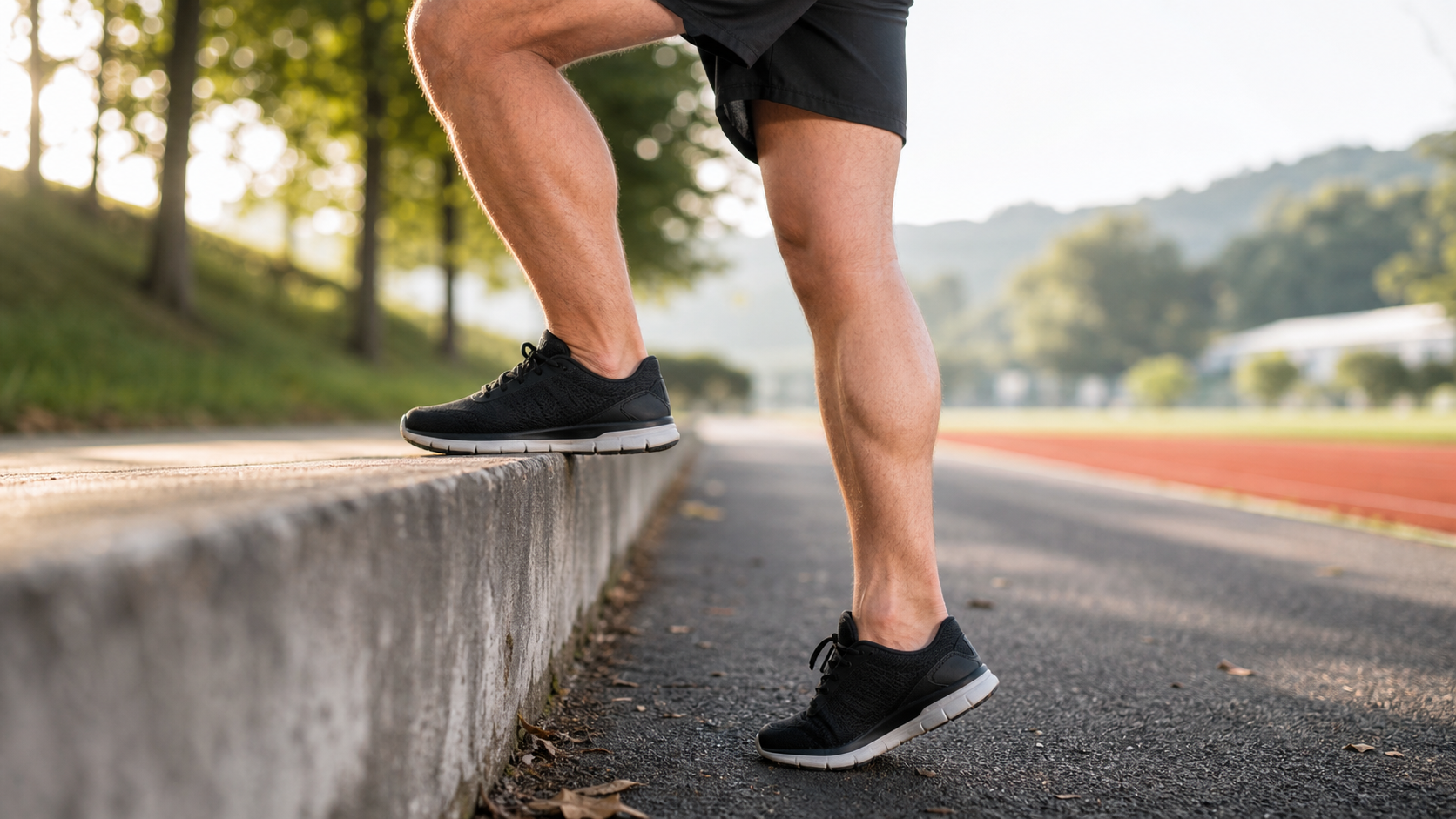
The Runner’s Achilles’ Heel
The Achilles tendon is the strongest tendon in the human body, yet it is also one of the most commonly injured areas for runners. This tendon, connecting the triceps surae muscles to the heel bone, bears approximately 3–5 times body weight with every running stride. When cumulative mechanical load exceeds the tissue’s repair capacity, tendinopathy quietly develops.
Notably, similar to plantar fasciitis, modern imaging studies show that chronic Achilles tendon pain is mostly “degenerative” rather than “inflammatory”—which is precisely why traditional anti-inflammatory medications and rest therapy have limited long-term effectiveness.
Anatomical Classification: Midportion vs. Insertional
Correct classification is key to determining treatment strategy:
| Feature | Midportion | Insertional |
|---|---|---|
| Pain location | 2–6 cm above the heel bone | At the attachment point on the posterior heel |
| Commonly affected population | Runners aged 35–45 | Older runners, high-arched feet |
| Morning stiffness | Pronounced | Pronounced |
| Tenderness characteristics | Localized to the tendon body | Posterior-superior angle of the heel bone |
| Eccentric training | Strongly recommended (Alfredson) | Adjust with caution; heel lowering not advised |
Clinical assessment tools:
- Arc Sign: During active ankle dorsiflexion, the tendon swelling moves with the motion (positive result indicates tendinopathy)
- Royal London Hospital Test (RLHPT): Tenderness decreases with ankle dorsiflexion, helping confirm midportion involvement
The Alfredson Eccentric Training Protocol
In 1998, Swedish surgeon Hakan Alfredson published a groundbreaking study on eccentric training: a 12-week eccentric training protocol achieved a success rate of up to 89% for chronic Achilles tendinopathy. To this day, this protocol remains the highest level of clinical evidence.
Execution Details
Exercise 1: Eccentric heel drops with straight knee (primarily targets the gastrocnemius)
- Stand on a step with both feet, heels hanging off the edge
- Rise up on the toes using the healthy leg, then lower slowly and independently on the affected leg (3–4 seconds)
- After the heel drops below the step, use the healthy leg to return to the top
- 3 sets × 15 reps, performed twice daily (morning and evening)
Exercise 2: Eccentric heel drops with slightly bent knee (primarily targets the soleus)
- Same as above, but maintain approximately 30 degrees of knee flexion throughout the movement
- 3 sets × 15 reps, performed twice daily
Training Progression
| Week | Load | Expected Sensation |
|---|---|---|
| Weeks 1–2 | Body weight | Mild soreness (3–4/10), which is normal |
| Weeks 3–4 | Body weight | Pain should begin to improve |
| Weeks 5–8 | Add backpack weight (5–10 kg) | Continued progress |
| Weeks 9–12 | Continue increasing load | Function approaching normal |
Important principles: Pain during training is normal and does not require stopping, unless the NRS score exceeds 5/10. Soreness 24 hours after training should not be worse than before training; otherwise, reduce the volume.
Modified Protocol for Insertional Achilles Tendinopathy
Insertional tendinopathy is not suitable for full eccentric movements with the heel dropping below the step, as this creates compression at the posterior-superior angle of the heel bone. Alternative options:
- Perform eccentric heel drops on a flat surface (not beyond the neutral position)
- Add isometric training: hold a calf raise for 30–45 seconds, 5 repetitions, 3 sets daily
- Use a heel lift to reduce compression at the insertion point
- Avoid shoes with a lower heel (such as trail shoes)
Adjusting Running Training
Complete rest from running is not required during Achilles tendinopathy treatment, but adjustments are needed:
- Reduce running volume by 30–50%, and avoid uphill and downhill running
- Prioritize cushioned surfaces (rubber track > grass > asphalt > concrete)
- Increase cadence to above 170 steps/minute to reduce Achilles tendon loading
- Forefoot striking actually increases Achilles tendon load and should be avoided during the acute phase
Adjunctive Treatment Options
Extracorporeal Shock Wave Therapy (ESWT): Suitable for chronic cases that have not responded to 12 weeks of eccentric training; 3–5 sessions are recommended.
Platelet-Rich Plasma (PRP) injection: May promote regeneration of tendinopathic tissue, but must be precisely injected under ultrasound guidance to avoid direct injection into the tendon body.
Corticosteroid injections: Although they provide short-term pain relief, they carry a risk of increased tendon rupture and are currently not recommended for the Achilles tendon.
Prevention Strategies
- Do not increase weekly training volume by more than 10%
- Wear running shoes with a heel drop of 8 mm or more
- Perform gastrocnemius eccentric training twice weekly as maintenance
- Replace running shoes promptly after more than 800 km
Conclusion
Treating Achilles tendinopathy requires patience—the 12-week eccentric training program must be followed consistently. The “training-induced pain” that occurs during the process is not a sign of deterioration but rather part of tissue remodeling. Rather than seeking quick pain-relief injections, treat the twice-daily heel-drop routine as a runner’s required homework. Build a resilient Achilles tendon, and you will be able to run strong for the long haul.
Related Reading
- Conservative Treatment and Return-to-Running Criteria for Achilles Tendinopathy
- Achilles Tendinitis in Running: Etiology, Diagnosis, and Progressive Rehabilitation
- Achilles (Tendo Achillis) Tendinopathy: Why Eccentric Training Is the Gold Standard for Rehabilitation
- Achilles Tendinitis: The Heel Problem Runners Fear Most
西進武嶺 免費訓練分析服務 Intervals | 練不夠還是練過頭?你哪一種類型選手?AI模型告訴你! | 備戰神器 | 公路車 訓練 | CT Yeh
4 年前
Never Stop 西進武嶺 前後雙機 完整全程錄影 訓練台 實境
8 年前
CT 喇低賽) 武嶺牽車 才是王道 西進牽車四小時內秘訣 攝手位置 如何判斷 防抽筋小秘訣
7 年前
一日北高/長距離團騎 常見問題補充篇 / 組團或跟團的眉角 / 壯車友容易被瘦車友慢性拉爆 / 原來屁股痛可能是這個原因...? / 風場配速法 / 公路車 / CT Yeh
2 年前
單車AI教練!全新 ChatGPT4o 幫你分析訓練成果!排武嶺課表,分析騎車姿勢! 太神了! / 公路車 / CT Yeh / feat. 緯緯
2 年前
一日北高常見問題大集合 | 攻略 | 路線 | 訓練 | 補給 | 自行車 單車 | 一日雙城 | 雙塔 | TWB北高360 | 屁股痛
6 年前
水金九不厭五分 10度寒流冷到不願停!feat. 卡卡 / 公路車 / CT Yeh
6 個月前
2016 桐花飛舞 單車挑戰 精華片段
10 年前