Hip Flexor Strain and Iliopsoas Syndrome in Runners: Anatomical Principles, Diagnosis, and a Complete Stretching and Strengthening Protocol
The “Engine” of Running: The Iliopsoas
With every stride forward, the primary driver swinging your leg forward is the iliopsoas—composed of the iliacus and the psoas major. This deep muscle group originates from the transverse processes of the lumbar spine, passes through the pelvis, and attaches to the lesser trochanter of the femur. It is the body’s most powerful hip flexor and a crucial structure for maintaining lumbar lordosis.
During running, the iliopsoas is responsible for accelerating the forward swing of the thigh during the swing phase and eccentrically contracting to control hip extension speed during the terminal stance phase. For high-mileage runners, the iliopsoas performs thousands of contractions per run, and accumulated fatigue and shortening are primary sources of anterior hip pain.
Classification of Iliopsoas-Related Injuries
I. Iliopsoas Strain
Acute overstretching or explosive acceleration (e.g., sprinting in track and field) causes muscle fiber tears, classified into three grades by severity:
| Grade | Tissue Damage | Symptoms | Expected Recovery |
|---|---|---|---|
| Grade 1 | Micro-tears (< 5%) | Mild tightness, function preserved | 1–2 weeks |
| Grade 2 | Partial tear (5–50%) | Significant pain, altered gait | 3–6 weeks |
| Grade 3 | Complete rupture | Inability to actively flex the hip | Surgical evaluation needed |
II. Iliopsoas Syndrome
A chronic overuse condition leading to tendinopathy or bursitis, characterized by a “Snapping Hip” accompanied by pain. The iliopsoas tendon snaps over the iliopubic eminence, producing a “click” sound; if accompanied by pain, active management is required.
Assessment and Diagnosis
Thomas Test: In a supine position, bring one knee to your chest. If the opposite leg naturally lifts off the table, it indicates tightness in the hip flexors (especially the iliopsoas). Normally, the leg should rest flat on the table.
Ely Test: In a prone position, the therapist passively flexes the knee. If the buttock automatically lifts, it indicates tightness in the rectus femoris (one of the hip flexors).
Resisted Hip Flexion Strength Test: Seated with the hip flexed at 90 degrees, resist the therapist’s downward pressure. Pain or weakness warrants further evaluation.
Ultrasound/MRI: To rule out the extent of tearing or bursal effusion.
Acute Phase Management (Weeks 1–2)
- Rest: Avoid high-intensity hip flexion activities such as sprinting, large strides, and hill running
- Ice: Apply to the painful area (deep in the groin) 2–3 times daily for 15 minutes each
- Gait Modification: Temporarily shorten stride length to avoid excessive posterior lean
- NSAIDs: May be used short-term (as directed by a physician) to reduce acute swelling
Stretching Program (Subacute Phase, Weeks 2–4)
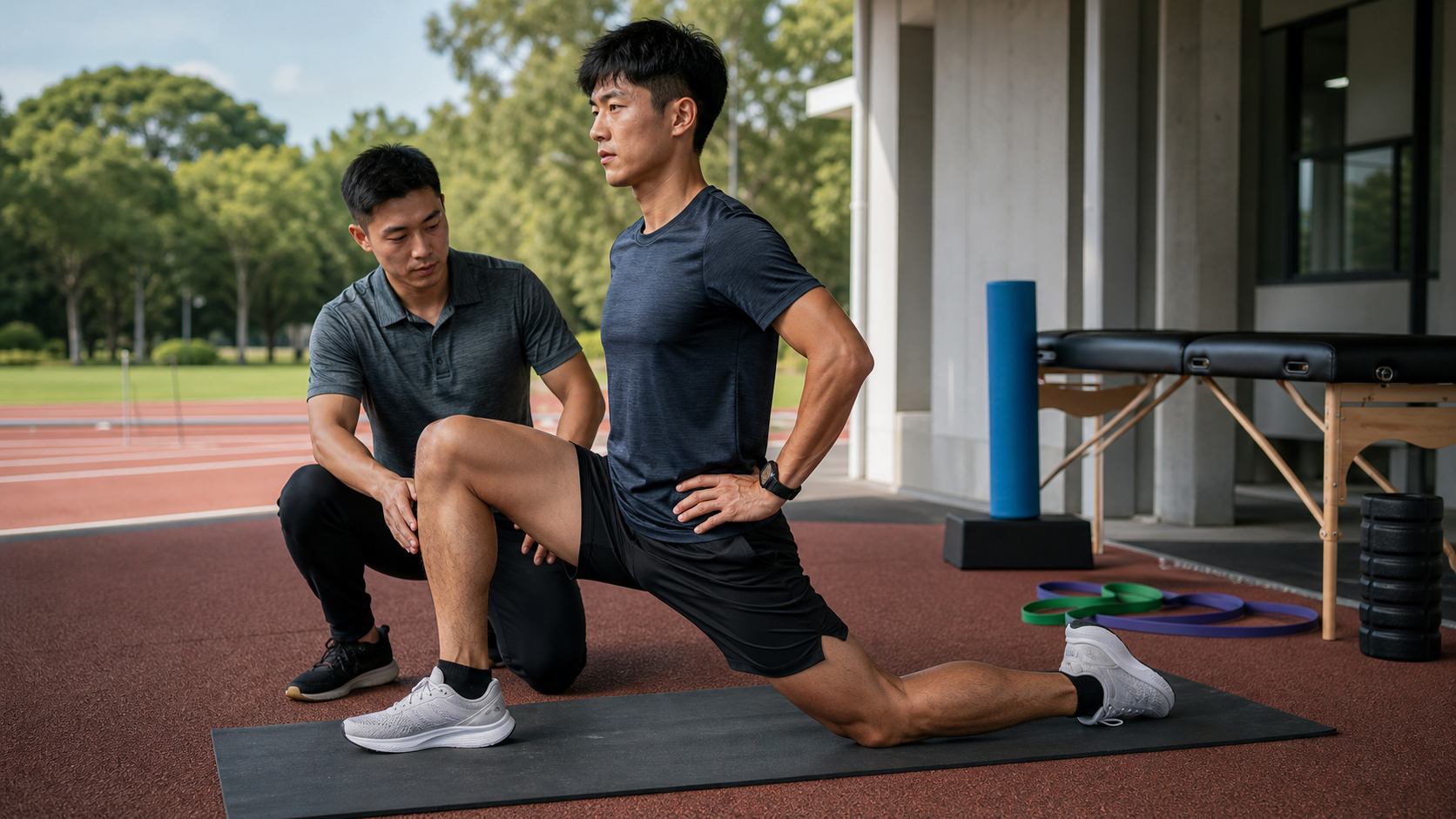
Static Iliopsoas Stretch (Low Lunge Stretch):
- Place the back knee on the ground, front foot flat, keep your torso upright, and shift slightly forward
- Feel a stretch in the front of the back thigh and the groin area
- Hold for 30–45 seconds per set, 3 sets daily
Dynamic Iliopsoas Mobilization (Modified):
- Assume a lunge position with the back knee on the ground, rotate your torso toward the same side as the back leg, and raise your arm overhead
- Move slowly and rhythmically, 10 reps per side, 2 sets daily
Side-Lying Hip Stretch (Modified Pigeon Pose): Suitable for those with limited flexibility, reducing lumbar compensation
Strengthening Program (Weeks 3–8)
Straight Leg Raise (SLR): Supine, one knee bent with foot on the floor, the other leg straight and raised to 45 degrees, lowered slowly (4 seconds), 3 sets × 15 reps
Standing Banded Hip Flexion: Anchor a resistance band around the ankle, stand, and lift the knee forward to hip height, controlling the lowering phase, 3 sets × 12 reps
Dead Bug: Strengthens the deep core’s stable support for the iliopsoas, 30 seconds per set × 3 sets
Mountain Climber: Slow version, holding each step for 2 seconds, to enhance functional hip flexor strength
Special Considerations for Runners: Iliopsoas Fatigue-Related Shortening
Many office-worker runners in Taiwan face the situation of “running after prolonged sitting.” After long periods of sitting, the iliopsoas is in a shortened state; if you enter a long run without proper warm-up, anterior groin pain or lower back soreness can easily occur. Recommendations:
- Perform 5 minutes of dynamic iliopsoas warm-up before running (walking lunges, high-knee walking)
- Stretch immediately after running; don’t wait until the next day
- For those with sedentary jobs, stand and stretch once every hour
Return-to-Running Progression Guidelines
- Pain-free walking for 30 minutes → Test with a 10-minute easy jog → If asymptomatic, increase to 20 minutes the next day → Weekly increase should not exceed 10%
- If a sharp pain deep in the groin or radiating pain down the front of the thigh occurs during running, immediately slow down to a walk
Conclusion
The iliopsoas is the runner’s hidden engine—often overlooked until injured, when its importance becomes clear. A systematic approach of stretching and strengthening, combined with dynamic warm-ups before runs, is the best strategy for preventing hip flexor injuries. Three minutes of daily lunge stretches is the most basic tribute to this hard-working deep muscle group.
Related Reading
- Runner’s Hip Flexor Strain: A Complete Guide to Causes, Rehab Exercises, and Return to Running
- Hip Flexor Strain in Running: Causes, First Aid, and a Timeline for Returning to Running
- Hip Flexor Training for Runners: Key Muscles for Preventing Running Injuries
- Runners with Tight Hip Flexors: Causes, Assessment, and Stretching Prescriptions
一日北高/長距離團騎 常見問題補充篇 / 組團或跟團的眉角 / 壯車友容易被瘦車友慢性拉爆 / 原來屁股痛可能是這個原因...? / 風場配速法 / 公路車 / CT Yeh
2 年前
CT 喇低賽) 武嶺牽車 才是王道 西進牽車四小時內秘訣 攝手位置 如何判斷 防抽筋小秘訣
7 年前
西進武嶺 免費訓練分析服務 Intervals | 練不夠還是練過頭?你哪一種類型選手?AI模型告訴你! | 備戰神器 | 公路車 訓練 | CT Yeh
4 年前
約騎爆笑地獄梗 大腸怎麼了🤣 #公路車 #cycling
3 年前
iPhone內建一秒變長腿🤣 車友必備#cycling
2 年前
爬陡坡被爆胎的車友跑步超車 #cycling #里佳部落
9 個月前
Never Stop 西進武嶺 前後雙機 完整全程錄影 訓練台 實境
8 年前
摔車後補裝備: 好市多新款單車安全帽& Specialized Romin 北高整路屁股都不痛的坐墊 | 一千元居然有MIPS | CT Yeh | 公路車
4 年前