Ankle Sprain Running Rehabilitation: Four Stages of Proprioceptive Training and a Safe Return-to-Run Protocol
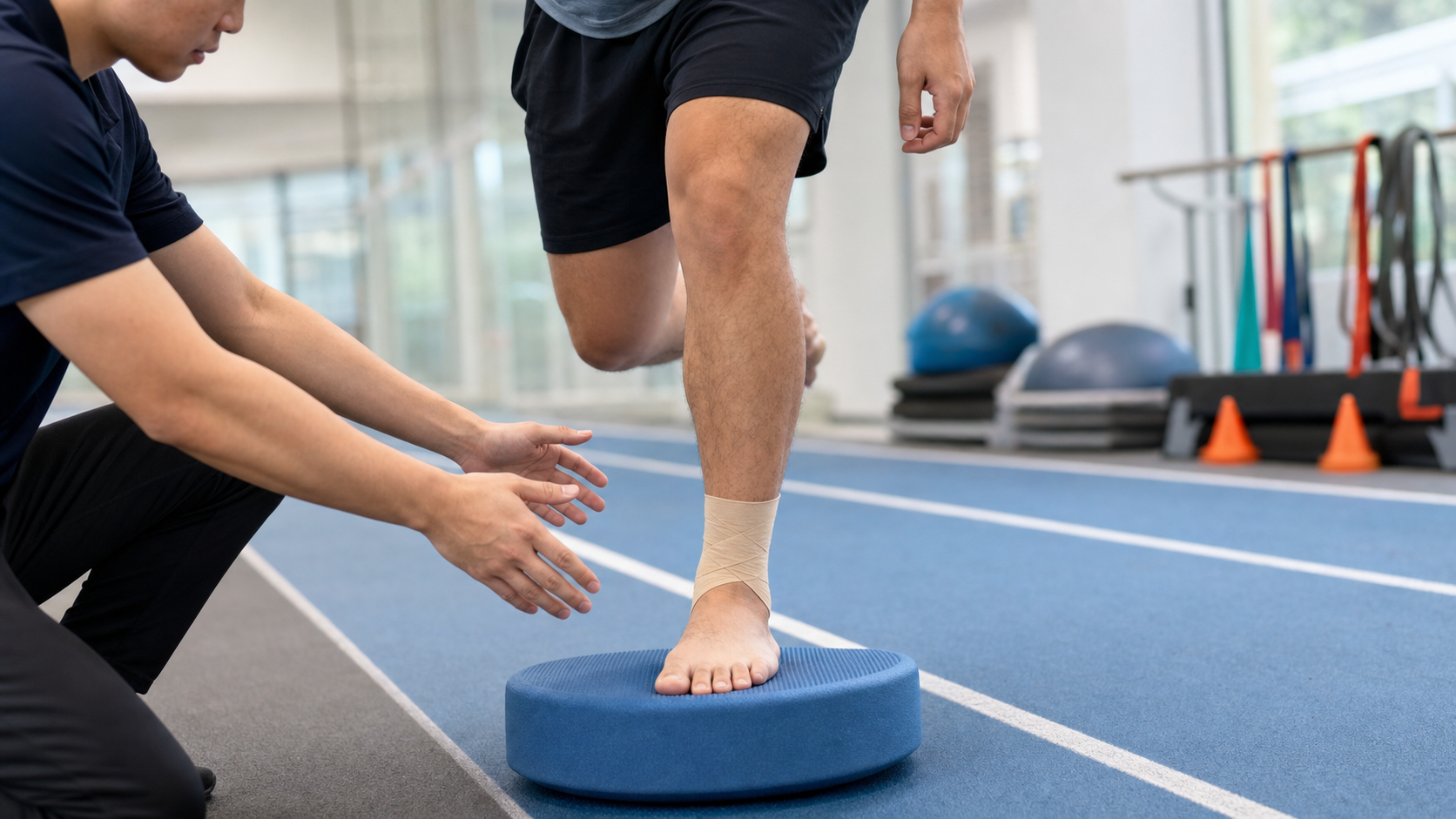
Ankle Sprains: The Most Underestimated Sports Injury
“It’s nothing, just a little twist. A few days of rest and it’ll be fine.” This mindset is the biggest driver of recurrent ankle sprains. Research shows that without complete rehabilitation after an initial ankle sprain, the recurrence rate within one year is as high as 70%, and each recurrence further damages the ligaments and proprioceptive nerves, eventually leading to “Chronic Ankle Instability (CAI).”
For runners, ankle stability directly affects the force transmission at every foot strike and safety on uneven terrain (trails, gravel, grass).
Anatomy of an Ankle Sprain
The most common “inversion sprain” (accounting for 85% of ankle sprains) injures the lateral ligament complex, from front to back depending on severity:
- Anterior Talofibular Ligament (ATFL): Injured first, most common
- Calcaneofibular Ligament (CFL): Injured in moderate to severe sprains
- Posterior Talofibular Ligament (PTFL): Injured only in severe dislocations
| Grade | Injury Severity | Symptoms | Function |
|---|---|---|---|
| Grade I | Microscopic ligament tear | Mild swelling and tenderness | Normal weight-bearing |
| Grade II | Partial tear | Moderate swelling and bruising | Painful weight-bearing |
| Grade III | Complete rupture | Severe swelling and instability | Difficulty weight-bearing |
Ottawa Ankle Rules: X-rays are needed to rule out fractures if any of the following are present: tenderness over the posterior edge/tip of the malleolus within a 6 cm range, tenderness at the base of the 5th metatarsal, or inability to take 4 steps after the injury.
Acute Phase Management (Days 1–3): The POLICE Principle
- Protection: Ankle brace or elastic bandage, but avoid prolonged immobilization (begin movement after 24 hours)
- Optimal Loading: 24–48 hours post-injury, begin active non-weight-bearing ankle movements within tolerable range (alphabet exercise: write A–Z in the air with your toes)
- Ice: Apply ice for 15 minutes every 2–3 hours for the first 48 hours
- Compression: Figure-8 elastic bandage wrapping
- Elevation: Elevate above heart level when resting
Four Stages of Proprioceptive Training
Proprioception is the neurological foundation of ankle stability—ligament injuries also damage the mechanoreceptors within them, which must be rebuilt through systematic training.
Stage 1: Static Balance (Days 5–10 Post-Injury)
Goal: Rebuild basic neural feedback
- Double-leg stance with eyes closed: 30 seconds per rep, 5 reps
- Single-leg stance on the affected leg (eyes open): progress from 10 seconds up to 30 seconds
- Perform on a hard floor, 2 sessions per day
Passing Criteria: Single-leg stance with eyes closed for 30 seconds without significant sway
Stage 2: Dynamic Balance (Weeks 2–3 Post-Injury)
Goal: Maintain ankle control during dynamic movement
- Balance board training: 5 minutes each in forward-backward and side-to-side directions
- Single-leg stance on a pillow: 30 seconds × 5 reps (increased proprioceptive challenge)
- Single-leg stance while catching a ball: 50 catches per side (visual distraction)
Passing Criteria: Single-leg stance on a balance board with eyes closed for 20 seconds
Stage 3: Functional Training (Weeks 3–6 Post-Injury)
Goal: Rebuild ankle control for running and jumping movements
- Jump rope: start with both feet, gradually progress to single-leg on the affected side
- Lateral stepping (side lunges): 3 sets × 12 reps
- Low step-height training: step up and down first, then progress to lateral stepping
- Slow run-walk intervals: 20 minutes per session
Passing Criteria: 10 single-leg jump landings without pain and without a “giving way” sensation in the ankle
Stage 4: Sport-Specific Training (Weeks 6–12 Post-Injury)
Goal: Restore full-speed running and directional changes
- Figure-8 running: gradually reduce the circle radius
- Backward running: 10–20 meters, training posterior ankle proprioception
- Jump-and-catch series: simulating unstable landings in trail running
- Full-speed sprints (50 meters): gradually resume full training if pain-free
Passing Criteria: 5 minutes each of full-speed straight-line running, turning, and uphill/downhill running without pain or instability
When to Use Ankle Taping and Bracing
Acute Phase (first 2 weeks): Figure-8 athletic taping, providing lateral support while allowing some movement
Mid-Rehabilitation: Semi-rigid ankle brace (e.g., Aircast), can be used during training
Early Return to Running: Prophylactic taping can reduce recurrence risk by approximately 50%; it is recommended until completing Stage 4
Conclusion
Complete rehabilitation of an ankle sprain is not just about “being pain-free”—it’s about retraining the nervous system to perceive ankle position during dynamic movement. The four stages of proprioceptive training are a foundational investment that allows runners to land safely on trails, gravel, and during night runs. The next time you sprain your ankle, remember to give it the full opportunity to rehabilitate.
Related Reading
- Ankle Sprains in Road Running: Acute Management and Rehabilitation Training Plan
- Runner’s Ankle Sprain Recovery Guide: From Acute Management to Safe Return to Running
- Sprains Caused by Poor Running Form: A Complete Guide to Ankle Stability Training
- Ankle Proprioceptive Training: The Key to Zero Sprains in Trail Running
Never Stop 西進武嶺 前後雙機 完整全程錄影 訓練台 實境
8 年前
西進武嶺 免費訓練分析服務 Intervals | 練不夠還是練過頭?你哪一種類型選手?AI模型告訴你! | 備戰神器 | 公路車 訓練 | CT Yeh
4 年前
CT 喇低賽) 武嶺牽車 才是王道 西進牽車四小時內秘訣 攝手位置 如何判斷 防抽筋小秘訣
7 年前
[教學] Premiere 影片 手震 修正 教學 防抖 單眼 影像 GoPro 穩定 Video Stabilization
8 年前
摔車後補裝備: 好市多新款單車安全帽& Specialized Romin 北高整路屁股都不痛的坐墊 | 一千元居然有MIPS | CT Yeh | 公路車
4 年前
爬陡坡被爆胎的車友跑步超車 #cycling #里佳部落
9 個月前
2019 夏季KOM 5小 完賽心得 準備攻略 東進武嶺 夏季登山王之路 Taiwan KOM Challenge
7 年前
大禹嶺 到 武嶺牌樓 全程前後實況錄影 | 北進武嶺 | 東進武嶺 | KOM | 訓練台 | 坡度分析 | Taiwan KOM Last 10 km HARD | 公路車
6 年前